Ekonomika ISSN 1392-1258 eISSN 2424-6166
2026, vol. 105(1), pp. 42–59 DOI: https://doi.org/10.15388/Ekon.2026.105.1.3
Othman Boulitama
Hassan II University of Casablanca
Faculty of Law, Economic and Social Sciences –
AIN SEBAA
Email: othmanboulitama@gmail.com
ORCID: https://orcid.org/0000-0003-3541-1582
Brahim Sabiri
Hassan II University of Casablanca
Faculty of Law, Economic and Social Sciences –
AIN SEBAA
Email: brahim.sabiri.93@gmail.com
ORCID: https://orcid.org/0009-0006-6314-3393
Driss Rahli
Hassan II University of Casablanca
Faculty of Law, Economic and Social Sciences –
AIN SEBAA
Email: d.rahli@gmail.com
ORCID: https://orcid.org/0000-0002-3306-4460
Karim Sabri
Hassan II University of Casablanca
Faculty of Law, Economic and Social Sciences –
AIN SEBAA
Email: sabrikarimprof@gmail.com
ORCID: https://orcid.org/0009-0004-8244-949X
Abstract. This paper examines the factors shaping the adoption of Industry 4.0 (I4.0) technologies in Moroccan supply chains (SCs), with a focus on how digitalization, management practices, strategic planning, and financial resources contribute to SC optimization. The study aims to explore how these elements enhance resilience and competitiveness in an increasingly complex economic environment. Drawing on data from a structured survey of 151 Moroccan firms operating across various industries, the research employs a regression analysis based on multilayer neural network models to evaluate the relative importance of these drivers. The findings reveal that digitalization exerts the most substantial influence on supply chain optimization, accounting for nearly a half (47.78%) of the total effect. This is followed by management practices (31.74%), strategic alignment (14.26%), and financing (6.22%). These results highlight the critical role of digital transformation (DT) and effective management in fostering SC efficiency and competitiveness. By emphasizing the integration of advanced technologies and strategic approaches, this study provides practical insights for businesses seeking to enhance operational performance and adaptability. In focusing on the Moroccan context, this research offers a novel contribution by shedding light on the unique challenges and opportunities in developing economies. The use of neural network regression adds methodological depth, enabling a precise assessment of key factors. The findings provide actionable recommendations for companies aiming to align their investments and strategies with I4.0 priorities, ultimately contributing to economic growth and SC excellence.
Keywords: Industry 4.0, Supply Chain Performance, Digitalization, Industry 4.0 technologies, Neural Networks.
_________
Received: 17/12/2024. Accepted: 30/01/2026
Copyright © 2026 Othman Boulitama, Brahim Sabiri, Driss Rahli, Karim Sabri. Published by Vilnius University Press
This is an Open Access article distributed under the terms of the Creative Commons Attribution License, which permits unrestricted use, distribution, and reproduction in any medium, provided the original author and source are credited.
Innovation is a cornerstone of competitive advantage, particularly for companies undergoing transformative changes in their business models (Doan, 2020). However, sustaining high levels of creativity and operational efficiency becomes increasingly challenging in environments defined by disruption and uncertainty. Supply Chain Management (SCM) is pivotal in this context, ensuring that the right products are delivered in the right quantity, time, and place, at optimal cost and quality standards (Bourmistrov & Åmo, 2022).
As global Supply Chains (SCs) face mounting pressures from limited visibility, fragmented control, and sustainability imperatives (Bernardes Junior et al., 2024), there is a growing demand for integrated solutions that align social, economic, and environmental objectives (Seker & Sengür, 2021). Digital Transformation (DT), driven by Industry 4.0 (I4.0) technologies, has emerged as a key enabler of SC innovation (Fedirko & Zatonatska, 2020). By fostering seamless interconnectivity and automation, DT transitions traditional SCs into integrated digital systems capable of autonomous decision-making, enhanced adaptability, and superior operational performance (Cinar, 2023). In fact, Performance measurement is key to maximizing digital SCs, assessing both resource efficiency and customer satisfaction. While it enhances visibility, decision-making, and competitiveness, existing studies often overlook the combined impact of performance factors on the overall SC success (Akerele, 2023).
In fact, the study of SCs is a major issue in the global economic context, particularly in the face of the transformations induced by I4.0 and the increasing digitalization of industrial processes. Numerous studies have investigated the determinants of SC optimization across various international contexts (Chauhan et al., 2023), thereby emphasizing the role of digital technologies, managerial strategies, and financial resources in enhancing organizational performance. However, the literature remains relatively limited with regard to the specificities of SCs in emerging economies, and in particular in the Moroccan context. This lack of empirical work poses a challenge for decision-makers and companies seeking to align their practices with international standards of efficiency and resilience.
Indeed, the urgency of this study is explained by Morocco’s strategic position in the global SC, particularly as a logistics hub for Europe and Africa. With growing industries such as aeronautics, automotive and agri-food, the companies must urgently modernize their SCs to strengthen their competitiveness and secure their place in the global market. However, the vulnerability of Moroccan SCs to exogenous shocks (geopolitical tensions, health crises, fluctuations in raw material costs) reveals a pressing need for optimization and DT.
The present study analyzes the key levers of DT within Moroccan companies, focusing on the dimensions of digitalization, management, strategy, and financing. It aims to measure their contribution to improving performance, resilience, and organizational competitiveness. By mobilizing an empirical approach, this research offers concrete guidelines to support companies in implementing appropriate digital strategies. The article is structured around five sections: literature review, methodology, results, discussion, and conclusion.
With the evolution of economic dynamics, companies have gradually refocused their strategy on the integration and coordination of their SC activities, no longer as isolated entities, but as stakeholders in an interconnected network where performance depends on the quality of relationships between actors. Indeed, the SC, connecting all actors via physical, financial and informational flows, requires smooth coordination of processes to effectively meet the demand (Ivanov & Dolgui, 2020). Faced with a globalized environment and sustainability challenges, companies must rely on adaptive and collaborative strategies to optimize flows and strengthen their competitive position (Ulfsnes et al., 2023).
Digitalization, managerial practices, strategic foresight, and financial capacity collectively shape the efficiency and resilience of SCs. While digital technologies such as AI-driven forecasting and blockchain enhance responsiveness and reduce uncertainty through real time data integration and process automation (Ivanov & Dolgui, 2020), their effectiveness depends on strong managerial alignment. Leadership that promotes collaboration and adaptability ensures that these tools serve broader organizational goals (Dubey et al., 2021). Strategic planning provides direction, enabling firms to anticipate disruptions, allocate resources effectively, and align SC initiatives with long-term objectives (Christopher & Holweg, 2017). Financial resources, in turn, condition the depth and scalability of transformation; well-capitalized firms are better-positioned to adopt advanced solutions, strengthen supplier networks, and build operational buffers (Singh et al., 2019). It is the interplay among these dimensions that ultimately determines a firm’s capacity to optimize and sustain competitive supply chain performance.
The evolution of Industry 4.0 has deeply reshaped supply chain management by integrating advanced technologies that boost efficiency, flexibility, and competitiveness (Korohodova et al., 2024). Digitalization has opened new possibilities in inventory control, cost management, and customer focused production. Tools such as the Internet of Things, data analytics, and intelligent systems have made supply chains more responsive and adaptive to market dynamics in real time (Uddin et al., 2023). The COVID-19 crisis further exposed the fragility of traditional supply chain structures, accelerating the need for innovation and collaboration. In response, firms increasingly rely on automation and predictive analytics to absorb disruptions, optimize operations, and support faster decision making (Chauhan et al., 2023). Furthermore, the DT of SCs is reshaping traditional operational models, fostering transparency, and improving efficiency. Blockchain technology, for instance, has emerged as a pivotal tool for securing data integrity and enabling seamless information sharing between SC stakeholders (Mubarik et al., 2021). Such advancements not only strengthen trust but also reduce inefficiencies and vulnerabilities in the SC network (Rovira et al., 2022). In fact, I4.0 technologies enhance customer centricity by enabling flexible, customized production and leveraging intelligent systems to predict consumer preferences, while boosting SC adaptability and competitiveness.
In addition to operational benefits, I4.0 technologies are driving significant advancements in customer centricity and customization. By enabling flexible manufacturing and tailored production, firms are better equipped to meet diverse consumer demands. These capabilities are further supported by intelligent systems that analyze and predict customer preferences, while enhancing the adaptability and competitiveness of SCs (Uddin et al., 2023).
Ultimately, the adoption of I4.0 technologies is critical for SC survival in a dynamic and competitive global market. By embedding digital tools into their value chains, businesses can achieve greater resilience, transparency, and cost efficiency (Chauhan et al., 2023). To sustain competitiveness, companies must also address escalating data flows and interdependencies, ensuring seamless integration of emerging technologies within SC operations.
However, with the advent of the digital revolution, with the rise of I4.0 technologies, and in an environment characterized by complexity, dynamism, and competitiveness, digitalization has emerged as a new phenomenon that has affected several aspects of business management and improved operational performance (Lachvajderová & Kádárová, 2021). Digital technologies have significantly transformed the way individuals communicate and engage with their surroundings. Technological breakthroughs and personal devices, including mobile phones, personal computers, autonomous vehicles, drones, sophisticated TVs, wearables, smartphones, and smartwatches, are transforming how organizations access and communicate information. These new emerging technologies are affecting all industries, sectors, functions, etc., and SC is no exception.
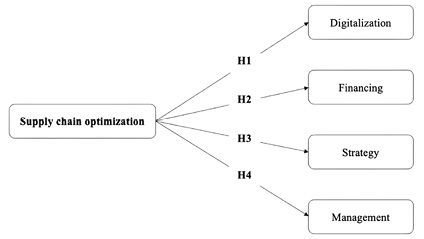
However, in the Moroccan SC, these transformations are paving new ways and opportunities for innovation. Considering this, the current research explores ways in which digitalization, financing, strategy, and management are influencing and enhancing the performance of the Moroccan SC. Furthermore, this paper provides insight into how the adoption of I4.0 technologies will enhance the performance of the Moroccan SC. Therefore, we proposed four hypotheses to guide our research, as illustrated in Figure 1.
(H1). Digitalization adoption is statistically associated with improvements in SC optimization.
Digital technologies have demonstrated their significant influence on inventory management in companies’ SCs. According to Pekarcikova et al. (2020), the digitalization of ‘Lean Thinking’ and the implementation of I4.0 have strengthened visibility and collaboration throughout the SC. Similarly, digitalization has made it possible to track deliveries and supplies in real time, optimize material and information flows, and streamline delivery times. Our second hypothesis is to verify the association between the digitalization on SC in Morocco. To achieve this, we will present the hypothesis in the following format:
(H2). Financing adoption is statistically associated with improvements in SC optimization.
According to Hong (2022), the growth of SC financing has significantly improved and optimized its operations. Based on the dynamics of the system, the author studied the collaborative development of SC finance, which revealed that increasing bank contributions can lead to significant long-term economic benefits. To illustrate this, we will formulate the hypothesis as follows:
(H3). Corporate strategy adoption is statistically associated with improvements in SC optimization.
Research on the influence of a company’s strategy on SC improvement highlights several important findings and advances. It is essential that a company’s SC is consistent with the corporate strategy in order to achieve high performance (Kazmane et al., 2017). The choice of a SC strategy is a statistically significant relationship between the company’s objectives and the external environment. Companies can choose to adopt strategies focused either on operational excellence or on customer proximity, depending on the specifications and expectations of the latter (Kazmane et al., 2017). The fourth hypothesis is associated with the statistical role between the company’s strategy and SC optimization. That said, we present the hypothesis in the following form:
(H4). Management adoption is statistically associated with improvements in SC optimization.
The role of management is predominant in SC management (Waller & Johnson, 1999). Ketchen and Giunipero (2004) studied the role of strategic management in SC management, the use of several strategic management theories (i.e., agency theory, institutional theory, resource-based management theory, etc.), and its importance in explaining how corporate profits should be beneficial for good SC management. Handfield et al. (2005) examined how firms develop environmentally friendly SC strategies. The authors mobilized the technique of interviews with representatives of American, British, Japanese, and Korean companies, as well as another previous research. Many firms already perceive choices regarding SC management and SC strategy as essential. As more and more managers adopt environmentally friendly practices, SC strategies will only increase in priority. In our case, we aim to identify the role of management as a factor that influences the optimization of the SC.
This research aims to explore and quantify the key factors driving the adoption and optimization of I4.0 technologies in Moroccan SCs, with a particular focus on their contributions to enhancing performance, resilience, and competitiveness in an increasingly dynamic economic environment. The study uses advanced neural network regression models to compare the effects of digitization, management practices, strategic alignment, and financial resources. This gives a full and data-driven picture of their roles. Based on data collected from 151 Moroccan firms spanning various industries, the research bridges the gap between theoretical insights and the practical challenges faced by businesses in developing economies. It provides actionable recommendations to enable Moroccan firms to strategically invest in DT initiatives, optimize their SC processes, and align managerial and strategic practices with global I4.0 standards. By highlighting the dominant influence of digitalization and the interplay of management and strategic factors, the study offers a roadmap for businesses and policymakers aiming to enhance operational excellence, drive innovation, and strengthen Morocco’s position in the global SC landscape. This research contributes both practical solutions and methodological advancements to the academic discourse, positioning itself as a critical reference for future studies on DT and SC optimization in emerging markets.
We aim to analyze the statistical relationship between these factors and the optimization of the Moroccan SC. To this end, we adopted an empirical approach based on a self-assessment questionnaire. Its design is based on an in-depth review of recent academic literature (for a period of 2008–2022) and international literature, including articles written by researchers of various nationalities. Moroccan companies of various sizes and structures operating on the national territory are the target audience for the questionnaire consisting of 51 questions. The structure of the questionnaire comprises two main parts:
As shown in Table 1, the questionnaire includes selected questions categorized based on key factors influencing SC optimization.
For data collection, we used two survey techniques widely used in the field of management sciences: the Computer Assisted Web Interviews (CAWI) method, and the Computer Assisted Personal Interviewing (CAPI) method. These techniques allowed us to target 151 companies located in Morocco between July 2022 and September 2022.
|
Factors |
Number of selected questions |
|
Digitalization |
11 questions |
|
Management |
5 questions |
|
Organization |
3 questions |
|
Finance |
2 questions |
In this article, we will rely on an analytical approach based on regression using machine learning methods, namely, neural networks. This technology has revolutionized many aspects of artificial intelligence. A neural network consists of a system of connected artificial neurons that reproduce the way the human brain works. In our study, we have implemented a multilayer neural network (MLP) of the perceptron type, as shown in Figure 2. Frank Rosenblatt first introduced the perceptron as a type of a neural network in 1957 (Singh & Banerjee, 2019). The model imitates the ability to process information and make decisions, as is the case with biological neurons. The basic principle of the functionality of a perceptron is to take inputs from different sources, apply weights to them, summarize them with a bias term, pass the resulting value through an activation function, and produce an output signal.
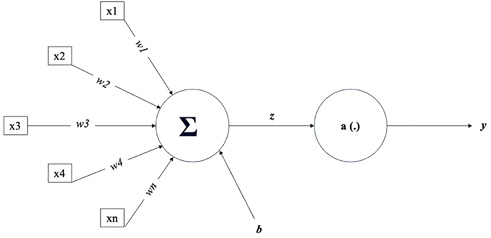
Source: Produced by authors, based on (Hornung et al., 2022)
A perceptron is composed of several parts that work together to efficiently process information. External sources provide values or features to the input layer. Before being summarized by a bias term (b), each input (xi) is multiplied by its corresponding weight (wi). An activation function feeds this weighted sum and the bias term, which signals based on specific criteria or thresholds.
 (1)
(1)
The step or threshold function, which produces binary values (‘0’ or ‘1’) depending on whether the sum exceeds a predefined threshold, is the most frequently used activation function for perceptrons.
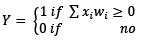 (2)
(2)
At the beginning of the perceptron training process, it is necessary to initialize its weights randomly. Then, it uses iterative learning algorithms like gradient descent to learn from labeled data. The perceptron uses current weights to make predictions at each iteration and adjusts these weights based on the prediction errors calculated by comparing the predicted output with the actual labeled output. The training process aims to reduce errors or increase accuracy. The process of iterative weight changing persists until it meets a convergence criterion, which could be a predetermined number of iterations or an acceptable error level.
MLP regression has an advantage over other forms of regression, such as linear regression, because of its ability to model complex nonlinear relationships. Compared to older models, it can handle multidimensional, heterogeneous data and combine continuous categorical variables with great scalability, while capturing complex interactions across its hidden layers. Its robustness to unstructured data and its ability to learn continuously and iteratively allows it to generalize better. However, to ensure scientific and methodological transparency, it is important to detail the choice of validation metrics in this section.
In fact, the present paper employs a MLP regression model to examine the statistical significance of digitalization, management practices, strategic alignment, and financial resources on SC optimization in Moroccan companies. The selection of MLP is justified by its capacity to capture non-linear and complex interactions between variables, offering a more sophisticated predictive capability compared to traditional regression models. To enhance methodological rigor, the model underwent a systematic hyperparameter tuning process, ensuring optimal performance and robustness. Specifically, we experimented with different model architectures, varying the number of hidden layers between one and three, and adjusting the number of neurons per layer between three and fourteen while using a grid search approach. The activation functions tested included Rectified Linear Unit (ReLU) and Sigmoid, with ReLU getting ultimately selected due to its improved gradient propagation and mitigation of the vanishing gradient problem. Additionally, the learning rate was adjusted within the range of 0.001 to 0.01 by using an adaptive learning rate scheduler, and the Adam optimizer was employed given its ability to balance computational efficiency and convergence stability. To further address potential overfitting, dropout regularization (set at 0.2) and L2 weight decay (λ = 0.001) were incorporated.
To ensure the validity and reliability of the model, k-fold cross-validation (k=5) was conducted, allowing for more robust generalization across different data subsets. The predictive performance of the model was assessed by using multiple evaluation metrics, including Mean Squared Error (MSE) to quantify the overall prediction error, Mean Absolute Percentage Error (MAPE) to gauge relative error sensitivity, and the R² score to determine the proportion of variance in SC optimization explained by the independent variables. Additionally, confusion matrix analysis was performed to assess classification accuracy in distinguishing between optimized and non-optimized SCs. The final model configuration, identified as the most effective based on validation results, consisted of a single hidden layer with six neurons, ReLU activation, an Adam optimizer, and a 60% training / 40% testing data partition. This configuration achieved an R² score of 76.2%, demonstrating a strong predictive capability. By providing a detailed account of hyperparameter selection and validation techniques, this study enhances methodological transparency and replicability, ensuring the robustness of findings within the broader discourse on I4.0 and SC optimization in emerging economies.
To better understand the dynamics that shape SMEs in the face of the challenges of DT and I4.0, we took care to create a varied sample, reflecting the diversity of companies according to their sector, region, size, and level of turnover. This diversity provides a global vision of the different economic and organizational realities of the companies surveyed. Table 2 presents a summary of the main characteristics of the sample, thus providing a detailed overview of the distribution of the companies studied and their structural specificities.
|
Characteristics |
N |
% |
|---|---|---|
|
Sector |
||
|
Primary |
17 |
11% |
|
Secondary |
84 |
56% |
|
Tertiary |
50 |
33% |
|
Region |
||
|
Casablanca-Settat |
83 |
55% |
|
Tangier-Tétouan-Al Hoceima |
20 |
13% |
|
Rabat-Salé-Kénitra |
17 |
11% |
|
Other regions |
31 |
21% |
|
Turnover |
||
|
< 10M MAD (Moroccan Dirham) |
97 |
64,24% |
|
10M-200M MAD |
33 |
21,85% |
|
> 200M MAD |
21 |
13,91% |
|
Number of employees |
||
|
1–10 employees |
11 |
7% |
|
11–50 employees |
50 |
33% |
|
50–250 employees |
54 |
36% |
|
> 250 employees |
36 |
24% |
|
Respondent Occupation |
||
|
Manager |
54 |
36% |
|
Staff |
45 |
30% |
|
Head of Department |
39 |
26% |
|
Director |
13 |
8% |
|
Total |
151 |
100% |
The sample studied consists of 151 Moroccan companies, distributed according to several characteristics. Regarding the sector of activity, 11% of the companies belong to the primary sector (n = 17), 56% are in the secondary sector (n = 84), and 33% are active in the tertiary sector
(n = 50). For the geographical distribution, most of the companies (n = 83, or 55%) are located in the Casablanca-Settat region. The Tangier-Tétouan-Al Hoceima region represents 13% of the companies (n = 20), followed by the Rabat-Salé-Kénitra region with 11% (n = 17). The other regions are represented by a total of 21% of the companies (n = 31). Regarding the turnover, 64.24% of the companies (n = 97) have a turnover of less than 10 million dirhams. 21.85% of companies (n = 33) have a turnover of between 10 and 200 million dirhams, while 13.91% (n = 21) exceed 200 million dirhams. In terms of employee size, 7% of the companies (n = 11) employ between 1 and 10 people. 33% of companies (n = 50) employ between 11 and 50 people, while 36% (n = 54) employ between 50 and 250 people. Finally, 24% of the companies (n = 36) have a workforce of more than 250 people. Finally, the distribution according to the position of the respondents shows that 36% of the respondents (n = 54) occupy a managerial position, 30% (n = 45) are part of the staff, 26% (n = 39) are department heads, and 8% (n = 13) occupy director positions.
We begin our analysis by training our model, which is an essential step since it allows us to validate its ability to identify, understand, and interpret the relationships between the variables studied. This preliminary phase plays a central role in improving the model’s performance by adjusting its parameters so that to minimize errors and optimize its predictive accuracy.
As shown in Table 3, we have implemented 4 forms of partitioning, each time changing the size of the learning or training partition and the test size. We performed the first training run on 50% of the data in Table 3. By generating 8 nodes in the hidden layer, the model achieved 75% relevance in the remaining 50% dedicated to testing. We performed the second training run on 60% of the data size. By reducing the test data size to 40% this time, we were able to improve the model relevance to 6.3% by generating 14 hidden layer nodes. We performed the third training run on a size of 70% of the data, compared to 30% of the data dedicated to the test. By generating a node in the hidden layer, we experienced a 16.6% decrease in the model’s relevance. Following the same logic, we performed the fourth training run on 80% of the data, compared to 20% of the data dedicated to the test. This resulted in a 0.4% decrease in the model’s relevance, while maintaining the same number of nodes within the hidden layer. That said, we chose the most relevant model, since relevance simply means a satisfactory ability to predict the data.
|
Dependent variable |
Number of inputs |
Number of outputs |
Training |
Test |
Number of nodes in the hidden layer |
Model relevance (%) |
|
SC Optimization |
21 |
1 |
50% |
50% |
6 |
67.6% |
|
21 |
1 |
60% |
40% |
6 |
76.2% |
|
|
21 |
1 |
70% |
30% |
3 |
70.2% |
|
|
21 |
1 |
80% |
20% |
3 |
70.7% |
We note that, in 94.6% of the cases, the model was able to predict the companies which do not have a full optimization of their SCs (i.e., true negative), while in 60% of the cases, the companies have an optimization of their SCs (i.e., true positive). On the other hand, the model performed poorly in predicting 40% of cases where companies with an optimized SC were classified as not having an optimized SC, and 5.4% of the cases where companies without an optimized SC were classified as not having an optimized SC. As illustrated in Table 4, the combination of data partitioning with a training/test ratio of 60%/40% is the most relevant combination, as the model accurately predicted 82.6% of the cases.
|
Confusion matrix |
Optimized (Planned) |
Not Optimized (Planned) |
|
Optimized (Observed) |
47 |
9 |
|
Not Optimized (Observed) |
17 |
18 |
After verifying the robustness of the applied model in terms of relevance, we shall now evaluate the capacity of the independent variables by using their predictive weights. As a reminder, the weighting equation of the MLP neural network is presented in the following form:
 (3)
(3)
The graph below displays a ranking of the variables by degree of importance calculated from a weighting function (wi).
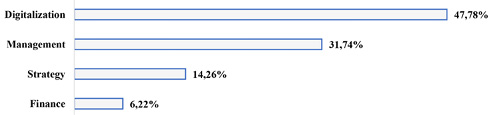
We note that the model assigns a weight to each independent or predictive variable, which reflects the level of its sensitivity to influence. This signifies the extent to which a change in the variable influences the model. As illustrated in Figure 3, this distribution highlights key factors affecting SC optimization. Based on our conceptual framework, we will calculate the accumulation of variables according to their category. The sensitivity of the model is influenced by the digitalization of company processes at 47.78%, followed by the managerial aspect at 31.74%, the strategy aspect at 14.26%, and the financial aspect at 6.22%. In other words, the optimization of the SC is heavily influenced by the technology used within the company, the applicable managerial methods, the company’s strategy, and its financial capacity to invest in technological development and enhancement of the SC’s function. From these results, as shown in Figure 3, we find that the optimization of the SC is based on a combination of these 4 factors in the following proportion:
Supply chain optimization = 0.47 * digitization + 0.31 * Management +
0.14 * Strategy + 0.06 * Finance + b (4)
These results lead us to accept the four hypotheses.
The findings clearly indicate that optimization extends beyond financing sources. Due to technology advancements, accessibility for enterprises, even those with scarce financial means, is attainable. The primary problem exists at the organizational level. The enterprises capable of effectively realizing this enhancement are those that have opted to completely or partly digitize their SCs. Similarly, implementing a proactive management strategy aligned with the objectives of DT is crucial to this achievement. Conversely, a strategy centered on long-term objectives adds to a diminished degree.
The application of MLP neural networks for SC optimization in Morocco provides valuable insights when compared to international practices. In Morocco, (Rezki & Mansouri, 2023) explored the use of Artificial Neural Networks (ANNs) to enhance SC risk management by minimizing subjectivity in human assessments. Their research employed an ANN model as a predictive tool for accurate risk level predictions by using real-world data from a global automotive company specializing in wiring harnesses, thereby demonstrating the model’s effectiveness. Internationally, (Guo et al., 2021) utilized MLP neural networks to optimize regional logistics demand prediction. Their model, which included three hidden layers and was optimized by using Particle Swarm Optimization (PSO), showcased high accuracy in forecasting logistics demand. These studies underline the effectiveness of MLP models in enhancing SC performance, particularly in contexts with access to advanced technologies and diverse datasets. Similarly, studies in developed regions, such as Europe and North America, consistently report predictive accuracies exceeding 80%, facilitated by larger sample sizes, comprehensive data preprocessing, and the use of advanced techniques such as adaptive learning rates and hybrid models. By the same token, on the grounds of findings in Morocco, it has been determined that digitalization frequently emerges as a dominant factor in SC optimization, underscoring its pivotal role in leveraging I4.0 technologies to improve operational efficiency and competitiveness (Luthra & Mangla, 2018).
Based on the results of our study, the four factors exhibit varying degrees of influence SC optimization, with each factor demonstrating a distinct level of statistical significance. SC optimization is a complex and multidimensional process, and companies are constantly looking for ways to improve efficiency, reduce costs, and improve the overall performance. Companies can gain a competitive advantage in the market by optimizing SC to streamline operations and maximize resources.
In the Moroccan SC, financial factors only had a small effect (6.22%). This is different from other places in the world, where financial resources are essential for keeping SC investments going and lowering risks, especially in economies with well-developed SC financing systems. Moreover, international models also demonstrate higher methodological sophistication, often employing deep learning architectures or integrating real time analytics to improve decision making and adaptability. These advanced approaches, combined with robust stakeholder engagement, have proven instrumental in optimizing SC strategies globally. By benchmarking against such international practices, Moroccan companies can enhance their SC models by incorporating real time data streams, adopting hybrid techniques, and addressing financial constraints more effectively. These efforts would position Moroccan SCs as competitive players in the rapidly evolving global economic landscape.
In fact, four key factors are associated with digital optimization. Financing is a key element in SC optimization. Indeed, it is essential for companies involved in international trade to maintain their competitiveness and reduce costs, as companies always seek to consider the financial aspect as a key factor in the continuity of their business activity. Moreover, optimizing financial flows can offer untapped cost reduction potential. Any SC’s cash flow cycle determines its length. There is no doubt that a successful business depends on the accurate and timely delivery of goods or services to its customers. SCM aims to minimize mass and time. An efficiently managed SC requires measuring the costs associated with the physical movement of goods and the associated information flows. Firms can achieve significant economies of scale in their SC network by identifying cost-saving opportunities such as consolidating, reducing inventory levels, or negotiating better supplier contracts (Uddin et al., 2023). Among the elements that help optimize a SC is budget allocation. The latter entails the rational or methodical allocation of financial resources to various logistics links, including transportation, storage, and purchasing (Hong, 2022). Financial risk management is also essential to reduce potential disruptions that could affect the SC and lead to financial losses. Management is also an important factor in optimizing SC. Effective leadership is essential to set clear goals and expectations for SC performance through effective leadership and decision-making processes while also fostering a culture of collaboration and continuous improvement. Indeed, the logistics strategy is an important factor in creating a competitive advantage in an organization, as its implementation must achieve fundamental long-term objectives in the chosen field of activity. In the same context, the decision-making process influences the selection of strategic choices for supplier selection, production in advance, order predictions, distribution network management, and inventory management. By defining roles, functions, tasks, responsibilities, and internal relationships, the organizational structure contributes to the optimization of the SC. Strategy intervenes in SC optimization because it guides long term planning efforts aimed at improving strategic effectiveness and efficiency. Collaboration with stakeholders throughout the SC, including suppliers, distributors, and customers, is essential to align interests, foster innovation, and create value. Aligning goals across functions within an organization helps ensure that everyone is working toward common goals. Coordination improves communication, breaks down silos, and facilitates cross-functional problem solving. Digitalization strives to optimize and streamline SC processes. The introduction of digitalization results in the automation of internal processes, such as warehouse management systems, which can streamline repetitive tasks, increase accuracy, and boost productivity. The company can leverage data analytics tools in order to gain insights, intelligent forecasts, and informed decisions. Companies can collaborate more effectively with their partners, gain real-time visibility into their operations, and respond quickly to changing market conditions by adopting digital platforms for cloud-based software research and visibility chain solutions. Technological advances simplify daily operations and enable organizations to quickly adapt to customer preferences, demand patterns, new regulations, or emerging SC risks.
The relatively limited influence of financial resources on SC optimization in Moroccan companies, as revealed by our analysis, may be explained by several contextual factors. Unlike in developed economies where financial investment directly correlates with technological advancement, Moroccan companies often rely on incremental and cost-effective digitalization strategies due to financial constraints. Cloud-based solutions which do not cost much and government-backed incentives for digitalization make it possible for businesses to use digital tools without having to spend a sizable amount of money. Furthermore, because most businesses in Morocco are companies, strategic flexibility and management skills are more important than direct financial investment when it comes to getting past digitalization barriers. To further mitigate these barriers, Moroccan companies can leverage collaborative financing mechanisms, such as public-private partnerships, industry consortiums, and venture capital investments focused on DT. Encouraging the development of innovation hubs and digital skills training programs can also provide cost-effective pathways to technology adoption. Firms can make SC more resilient and competitive, even in environments with limited resources, by putting management-driven digital strategies ahead of purely financial concerns.
In Europe, DT of a SC is primarily driven by financial factors. Milosavljevic et al.’s (2024) study of the automotive sector shows that only large companies are massively adopting smart technologies. Moreover, the majority of SMEs remain hampered by a lack of financial and human resources. The author highlights that this limitation is visible in the German-speaking region (DACH), which represents 31% of the companies studied, making this cluster the European heart of industrial digitalization. McKinsey (2016) highlights that digital SC in Europe is becoming financially accessible, which promotes an acceleration of chain flexibility while reducing logistics costs by up to 30% and inventories by 75%. This does not prevent mentioning that the continent is still facing the costly infrastructure, cybersecurity, and technical integration issues, with all of these obstacles hindering the diffusion of I4.0 practices beyond the pioneers (Bentaher & Rajaa, 2022). In the European context, the DT on of SCs constitutes a strategic pillar of current industrial policies, supported by initiatives such as Horizon Europe, Digital Europe, or the European Commission’s Industry 5.0 vision, aimed at strengthening the resilience, sustainability, and autonomy of value chains (European Commission, 2021). However, this digitalization still largely relies on the financial capacity of companies. The study by Milosavljevic et al. (2024), conducted in the automotive sector, shows that only large companies in Central European countries, particularly in the DACH region (Germany, Austria, Switzerland), are massively adopting smart technologies, while SMEs remain restrained by a lack of financial and human resources. This disparity is hampering the homogeneous diffusion of I4.0 practices across the continent. McKinsey (2016), however, notes that digitalization is gradually becoming more accessible, allowing significant gains in logistics costs (up to 30%) and inventory levels (up to 75%). Nevertheless, some obstacles remain: the cost of infrastructure, insufficient cybersecurity, and the complexity of technical integration (Bentaher & Rajaa, 2022). These difficulties are particularly pronounced in Mediterranean countries such as Italy, Spain, and Greece, whose SME-dominated economic structures are strongly reminiscent of those of Morocco (Luthra & Mangla, 2018). With this in mind, our study, although anchored in a Maghreb context, offers lessons that can be transferred to other economies facing similar challenges. By identifying the organizational levers – digitalization, strategy, management – that enable the optimization of SCs, it also sheds light on the conditions for the success of European policies supporting the digital transition in semi-peripheral or emerging industrial contexts.
The optimization of the Moroccan SC relies on the integration of four key factors: digitization, management, strategy, and financing. The research findings indicate that digitalization plays a dominant role, accounting for 47.78% of the total effect. It is followed by the management factor, contributing 31.74%, the strategic factor at 14.26%, and finally the financial factor at 6.22%. These results clearly confirm that the adoption of I4.0 technologies offers significant opportunities to enhance the performance of the Moroccan SC.
In addition, the results generated by the neural network model adopted in this study confirm that digitalization, identified as the most influential factor, contributed significantly to the optimized management of information and material flows. Effective coordination and alignment of organizational objectives were primarily ensured by the management and strategic factors. Although the financial factor exhibited the lowest relative weight, it nonetheless proved essential for supporting technological investments, sustaining innovation over time, and ensuring the continuity of financial flows. This research has underscored the significance of implementing and overseeing the implementation of an integrated strategy aimed at transforming SCs into a dynamic and resilient digital ecosystem. Indeed, Moroccan companies with operational SCs in different industries must focus their attention on strategies to integrate the four factors whose objective is to optimize their competitiveness in an environment characterized by constantly evolving competition. To conclude, future research may build upon this study by examining the influence of emerging technologies such as artificial intelligence and Big Data on the DT of Moroccan SCs, as well as by assessing the depth and scope of digital integration across various sectors.
In fact, enhancing SCs in the era of I4.0 transcends the simple use of innovative technologies. This is a global strategy based on digitalization, agile strategic management, adaptable organization, and intelligent financial resource allocation. In fact, investing in technologies such as AI, the IoT, and blockchain is increasingly essential. These instruments boost SC visibility and transparency, hence improving their operational agility and resilience to unforeseen events via increased knowledge. Effective SCM thus relies on competencies tailored for developing digital challenges. Essential competencies now include proficiency in data analysis, assurance of real-time monitoring, and automated decision-making. Strategic planning must also be adaptable and predictive. Integrating hybrid models with a variety of providers mitigates risks and enhances the management of disruptions. In summary, guaranteeing a good digital transition calls for careful control of technology expenditures and the development of the appropriate financing systems. Maximizing ongoing changes relies on an appropriate use of financial resources. Integrating these components logically would assist organizations in augmenting their competitiveness and improving the efficacy of their SCs in a perpetually evolving economic landscape.
Akerele, O.O. (2023). The link between motivation and organizational performance: An exploration of factors influencing employee motivation and its impact on organizational success. International Journal of Business Ethics and Governance, 6(1), 27–37. https://doi.org/10.51325/ijbeg.v6i1.118
Bentaher, O., & Rajaa, S. (2022). Barrières à l’adoption de l’Industrie 4.0 dans les PME européennes : une revue systématique. Revue Européenne des Sciences de Gestion, 38(4), 45–61. https://doi.org/10.3917/resg.384.0045
Bernardes Junior, R., Telles, R., Lobo, T. H. V., Ribeiro Neto, J. de P., & Ferreira, G. G. (2024). Supply chain resilience: Four perspectives on the concept. Contribuciones a las Ciencias Sociales, 17(3), e5305. https://doi.org/10.55905/revconv.17n.3-186
Bourmistrov, A., & Åmo, B. W. (2022). Creativity, proactivity, and foresight. Technological Forecasting and Social Change, 174, 121215. https://doi.org/10.1016/j.techfore.2021.121215
Chauhan, S., Singh, R., Gehlot, A., Akram, S. V., Twala, B., & Priyadarshi, N. (2023). Digitalization of supply chain management with Industry 4.0 enabling technologies: A sustainable perspective. Processes, 11(1). https://doi.org/10.3390/pr11010096
Christopher, M., & Holweg, M. (2017). Supply chain 4.0: Managing supply chains in the digital era. International Journal of Physical Distribution & Logistics Management, 47(10), 843-875. https://doi.org/10.1108/IJPDLM-06-2016-0173
Cinar, B. (2023). Supply chain cybersecurity: Risks, challenges, and strategies for a globalized world. Journal of Engineering Research and Reports, 25(9), 196–210. https://doi.org/10.9734/jerr/2023/v25i9993
Doan, T. T. T. (2020). Supply chain management drivers and competitive advantage in manufacturing industry. Uncertain Supply Chain Management, 8(3), 473–800. https://doi.org/10.5267/j.uscm.2020.5.001
Dubey, R., Bryde, D. J., Blome, C., Roubaud, D., & Giannakis, M. (2021). Facilitating artificial intelligence adoption in supply chain management: An inter-organizational perspective. International Journal of Production Economics, 236, 108141. https://doi.org/10.1016/j.ijpe.2021.108141
European Commission. (2021). Industry 5.0 – Towards a sustainable, human-centric and resilient European industry. Publications Office of the European Union. https://doi.org/10.2777/308407
Fedirko, O., & Zatonatska, T. (2020). Development strategies for national economies after COVID-19 pandemic. Ekonomika, 99(2), 92–103. https://doi.org/10.15388/EKON.2020.2.6
Guo, H., Guo, C., Xu, B., Xia, Y., & Sun, F. (2021). MLP neural network-based regional logistics demand prediction. Neural Computing and Applications, 33(9), 3939–3952. https://doi.org/10.1007/s00521-020-05488-0
Handfield, R., Sroufe, R., & Walton, S. (2005). Integrating environmental management and supply chain strategies. Business Strategy and the Environment, 14(1), 1–19. https://doi.org/10.1002/bse.422
Hong, Y. (2022). Operation optimization of supply chain financial system based on system dynamics. Computational Intelligence and Neuroscience, 1. https://doi.org/10.1155/2022/3005816
Hornung, A. L., Hornung, C. M., Mallow, G. M., Barajas, J. N., Rush, A., Sayari, A. J., Galbusera, F., Wilke, H. J., Colman, M., Phillips, F. M., An, H. S., & Samartzis, D. (2022). Artificial intelligence in spine care: Current applications and future utility. European Spine Journal, 31(8), 2057–2081. https://doi.org/10.1007/s00586-022-07176-0
Ivanov, D., & Dolgui, A. (2020). A digital supply chain twin for managing the disruption risks and resilience in the era of Industry 4.0. Production Planning & Control, 32(9), 775-788. https://doi.org/10.1080/09537287.2020.1768450
Kazmane, J., Ennadi, A., Chafi, A., & Tajri, I. (2017). Design of a strategy supply chain aligned with the strategy of the company. International Journal of Engineering and Technology, 9(2), 368–377. https://doi.org/10.21817/ijet/2017/v9i1/170902315
Ketchen, D. J., & Giunipero, L. C. (2004). The intersection of strategic management and supply chain management. Industrial Marketing Management, 33(1), 51–56. https://doi.org/10.1016/j.indmarman.2003.08.010
Korohodova, O., Hlushchenko, Y., Moiseienko, T., & Chernenko, N. (2024). Ukraine’s green economy growth in the context of Industry 4.0: Challenges and solutions. Ekonomika, 103(2), 24–44. https://doi.org/10.15388/Ekon.2024.104.2.2
Lachvajderová, L., & Kádárová, J. (2021). Digitization, digitalization, and digital transformation in industry: A systematic literature review. In Proceedings of the International Scientific Conference DOKBAT 2021 - 17th International Bata Conference for Ph.D. Students and Young Researchers (pp. 298–309). https://doi.org/10.7441/dokbat.2021.25
Luthra, S., & Mangla, S. K. (2018). Evaluating challenges to Industry 4.0 initiatives for supply chain sustainability in emerging economies. Process Safety and Environmental Protection, 117, 168–179. https://doi.org/10.1016/j.psep.2018.04.018
McKinsey & Company. (2016). Supply Chain 4.0 – The next-generation digital supply chain. https://www.mckinsey.com/business-functions/operations/our-insights/supply-chain-40
Milosavljevic, M., Schmidt, A., & Köhler, D. (2024). Smart technology adoption in the automotive sector: A comparative study across the DACH region. Journal of Industrial Digitalization, 12(1), 77–95. https://doi.org/10.1016/j.jindig.2024.01.006
Mubarik, M., Raja Mohd Rasi, R. Z., Mubarak, M. F., & Ashraf, R. (2021). Impact of blockchain technology on green supply chain practices: Evidence from an emerging economy. Management of Environmental Quality: An International Journal, 32(5), 1023–1039. https://doi.org/10.1108/MEQ-11-2020-0277
Pekarcikova, M., Trebuna, P., Kliment, M., & Rosocha, L. (2020). Material flow optimization through e-kanban system simulation. International Journal of Simulation Modelling, 19(2), 243–254. https://doi.org/10.2507/IJSIMM19-2-513
Rezki, N., & Mansouri, M. (2023). Improving supply chain risk assessment with artificial neural network predictions. Acta Logistica, 10(4), 645–658. https://doi.org/10.22306/al.v10i4.444
Rovira, S. (2022). Digital technologies for a new future. Economic Commission for Latin America and the Caribbean (ECLAC). Retrieved from www.cepal.org/apps
Saucedo-Martínez, J. A., Pérez-Lara, M., Marmolejo-Saucedo, J. A., Salais-Fierro, T. E., & Vasant, P. (2018). Industry 4.0 framework for management and operations: A review. Journal of Ambient Intelligence and Humanized Computing, 9(3), 789–801. https://doi.org/10.1007/s12652-017-0533-1
Seker, Y., & Sengür, E. D. (2021). The impact of environmental, social, and governance (ESG) performance on financial reporting quality: International evidence. Ekonomika, 100(2), 190–212. https://doi.org/10.15388/Ekon.2021.100.2.9
Seyedghorban, Z., Tahernejad, H., Meriton, R., & Graham, G. (2020). Supply chain digitalization: Past, present, and future. Production Planning and Control, 31(2–3), 96–114. https://doi.org/10.1080/09537287.2019.1631461
Singh, J., & Banerjee, R. (2019). A study on single and multi-layer perceptron neural network. In Proceedings of the 3rd International Conference on Computing Methodologies and Communication, Erode, India, 27-29 March 2019, (pp. 35-40). https://dx.doi.org/10.1109/ICCMC.2019.8819775
Singh, S., Darwish, T. K., & Potočnik, K. (2019). Measuring organizational performance: A case for subjective measures. British Journal of Management, 30(3), 634-654. https://doi.org/10.1111/1467-8551.12325
Uddin, M. S., Habib, Md. M., & Mohamed, O. E. B. (2023). The role of supply chain finance on supply chain management and firm’s performance: A conceptual framework. International Supply Chain Technology Journal, 9(6). https://doi.org/10.20545/isctj.v09.i06.01
Ulfsnes, R., Mikalsen, M., Tkalich, A., Moe, N. B., & Conboy, K. (2023). Digital transformation: A flow perspective. Proceedings of the 56th Hawaii International Conference on System Sciences. https://doi.org/10.24251/HICSS.2023.520
Waller, M., & Johnson, M. E. (1999). Vendor-managed inventory in the retail supply chain. Journal of Business Logistics, 20, 183-203.