Ekonomika ISSN 1392-1258 eISSN 2424-6166
2026, vol. 105(3), pp. 96–117 DOI: https://doi.org/10.15388/Ekon.2026.105.3.6
Hisham Jadallah Mansour Shakhatreh*
Faculty of Law, Middle East University, Amman,Jordan
Email: h.shakhatreh@meu.edu.jo
ORCID:https://orcid.org/0000-0001-8693-5744
Doaa Salman Abdou
Faculty of management science, October University for modern sciences and arts,Cairo Egypt
Email: Dsalman@msa.edu.eg
ORCID:https://orcid.org/0000-0001-5050-6104
Ahmed Abbas Hammadi
University of Fallujah ,College of administration & economic,Iraq
Email: ahmedabbas@uofallujah.edu.iq
ORCID:https://orcid.org/0000-0003-3767-3420
Ahmad Hussein Battal
Department of Economics, College of Administration and Economics, University of Anbar, Ramadi, Iraq
Email: ahmed.battall@uoanbar.edu.iq
ORCID: https://orcid.org/0000-0002-8142-8484
Abstract. This study provides a novel investigation into the impact of corporate governance mechanisms specifically, board size, board independence, and CEO duality on the financial performance of industrial companies listed on the Amman Stock Exchange (ASE) measured by return on assets (ROA), return on equity (ROE), and a composite Financial Performance Index (FP) derived from these metrics. The research offers originality by focusing exclusively on Jordan’s industrial sector a critical yet underexplored context in emerging market governance literature using a longitudinal panel dataset (2017-2024) that captures post-regulatory reform performance trends. Unlike previous studies that rely on single metrics or aggregated multi-sector data, this study employs a dual analytical approach, examining both a composite governance index and its individual dimensions (board size, independence, and CEO duality) to disentangle their distinct effects on Return on Assets (ROA) and Return on Equity (ROE). The findings reveal a significant and original insight: while composite governance shows no significant impact, specific mechanisms matter substantially. Board size demonstrates a strong positive effect, and contrary to conventional agency theory but aligned with stewardship perspectives CEO duality positively influences ROA. This study’s original contribution lies in demonstrating that governance effectiveness in Jordan’s industrial sector is mechanism-specific and context-dependent, challenging the universal application of international governance norms and providing empirically grounded guidance for regulatory and corporate policy tailored to emerging market realities.
Keywords: corporate governance, financial performance, board size, board independence, CEO duality, Amman Stock Exchange.
_______
* Correspondent author.
Received: 30/09/2025. Accepted: 01/06/2026
Copyright © 2026 Hisham Jadallah Mansour Shakhatreh, Doaa Salman Abdou, Ahmed Abbas Hammadi, Ahmad Hussein Battal.
Published by Vilnius University Press. This is an Open Access article distributed under the terms of the Creative Commons Attribution License, which permits unrestricted use, distribution, and reproduction in any medium, provided the original author and source are credited.
Corporate governance emerged as a critical system to align management interests with those of shareholders, enhance transparency, and improve accountability, particularly following major corporate failures and scandals (Alam et al., 2020). A primary objective for any business entity is the maximization of shareholder wealth, which is intrinsically linked to its financial performance. As a critical indicator of corporate health, financial performance provides essential signals to shareholders and investors, directly influencing their capital allocation and investment decisions (Turki & Al-Hamdani, 2020).
The context for this study is the Jordanian industrial sector, which viability is significantly influenced by a range of economic and political variables (Pagkalou et al., 2024). In response, Jordan has witnessed a concerted effort to strengthen its corporate governance framework through the development of legislation aligned with local regulations, aiming to foster a culture of transparency and accountability to bolster confidence in the national economy (Jian et al., 2023). However, despite these reforms, empirical evidence regarding the actual financial impact of specific governance mechanisms in Jordan remains inconclusive. Existing studies frequently aggregate data across multiple sectors, potentially obscuring the unique operational and capital-intensive dynamics of industrial firms a vital component of the national economy. Furthermore, findings on core mechanisms, such as board independence and CEO duality, are often contradictory, suggesting a persistent gap between the formal adoption of governance standards and their practical effectiveness.
While international comparisons reveal contextual dependencies in governance effectiveness, the specific mechanisms driving performance in Jordan’s industrial sector particularly given its unique ownership structures and economic challenges remain underexplored. The disconnect between the theoretical predictions of governance mechanisms (especially board independence and CEO duality) and their practical impact on financial performance suggests that the quality and implementation of governance, rather than its mere presence, may be the true differentiating factor.
This gap is addressed by conducting a focused, longitudinal investigation of the industrial sector. Its novelty and originality derive from a dual analytical approach: it examines both a composite governance index and its individual dimensions (board size, independence, and CEO duality) to disentangle their distinct effects on financial performance, measured by Return on Assets (ROA) and Return on Equity (ROE). By testing the tension between agency theory and stewardship theory within a concentrated ownership context, this research moves beyond a compliance checklist to assess how the contextual fit and implementation quality of governance structures determine financial outcomes. Consequently, the primary objective of this study is to empirically analyze and quantify the impact of these three governance dimensions on the financial performance of non-financial industrial companies listed on the ASE. This objective is operationalized through three specific aims:
To achieve these aims, the study employs a quantitative, longitudinal panel data methodology, analyzing a sample of 14 industrial companies over the period 2017–2024. This design is specifically chosen to control for unobserved firm heterogeneity and to isolate the distinct effects of the governance variables under examination
Corporate governance has become a cornerstone of modern economies, largely in response to systemic market failures and major corporate scandals that revealed critical deficiencies in risk management and internal controls (Alam et al., 2020; Atala, 2024). These events underscored the principal-agent problem, highlighting the need to align management interests with those of shareholders (Jensen & Meckling, 1976). In essence, corporate governance comprises the frameworks and processes that direct and control a company, balancing the interests of its stakeholders including management, the board, shareholders, and the broader community. The OECD defines it as the structure of relationships that sets corporate objectives and determines how they are attained and monitored (OECD, 2015, as cited in Ibrahim, 2019). Ultimately, it is a mechanism for fostering sustainable growth through enhanced transparency, accountability, and fairness (Ashhadat & Al-hajaya, 2023).
This study examines three corporate governance dimensions central to agency theory and widely studied for their influence on firm performance: board size, board independence, and CEO duality.
Board size is a critical but contested governance feature. Proponents argue larger boards offer greater expertise, networks, and robust debate, reducing groupthink. Conversely, agency and group dynamics theories warn that larger boards may face coordination issues, communication delays, and slower decision-making, weakening oversight. Empirical findings vary: while some suggest very small boards are optimal (Arum et al., 2023), others find mid-sized boards balance diversity and efficiency best (Boachie & Mensah, 2022). This discrepancy often reflects context – larger boards may hinder coordination in developed markets but provide crucial resources in developing economies (Shakhatreh, 2024).
Board independence is a cornerstone of sound governance. Independent directors – non-executive members free of material ties to the company provide objective oversight and help mitigate agency conflicts (Shakhatreh & Alazzam, 2025), often through roles on key committees. A crucial aspect of this independence is separating the Chairman and CEO roles, as consolidating them concentrates excessive power and weakens the board’s ability to hold management accountable. This separation is supported by research (Faysal et al., 2020) and codified in major exchange rules (e.g., LSE, NYSE). However, in many emerging markets, particularly in the MENA region, concentrated family ownership often leads to combined leadership, resulting in mixed performance outcomes (Alazzam et al., 2026).
CEO duality – the combination of CEO and Chairman roles in one person creates a fundamental conflict of interest by vesting leadership and oversight in the same individual. This concentration of power can allow the CEO to dominate board agendas and evaluations (Albalawee et al., 2023), weakening oversight of strategy and financial reporting, and increasing risks to transparency and integrity (Mousavi et al., 2022). For this reason, governance codes in Jordan and internationally recommend separating the two roles (Alakash et al., 2024).
Financial performance measures a firm’s efficiency in generating profits from its resources, signaling its viability and competitive strength to stakeholders (Turki & Al-Hamdani, 2020; Bahaa Al-Din, 2020). This study employs two key profitability ratios: Return on Assets (ROA), calculated as Net Profit After Tax divided by Average Total Assets, assesses asset utilization efficiency (Hala, 2020); and Return on Equity (ROE), the ratio of Net Profit After Tax to Average Shareholders’ Equity, gauges returns on owner investment (Al-Saeedi et al., 2021).
The empirical evidence on the corporate governance-financial performance nexus is vast yet inconclusive, with findings heavily contingent on national institutional contexts, industry sectors, and ownership structures. This review is structured to highlight these contextual dependencies, moving from global evidence to the specific setting of Jordan.
Studies from Anglo-Saxon economies (e.g., U.S., UK) often align with agency theory, emphasizing the benefits of board independence and the separation of CEO/Chair roles to mitigate agency costs (Alazzam et al., 2022). However, meta-analyses note the marginal benefits of such mechanisms can be context-dependent (Bebchuk & Weisbach, 2010). Research in European contexts further reveals variations influenced by two-tier board systems and concentrated ownership (Pagkalou et al., 2024).
In emerging markets, the governance-performance relationship is often moderated by factors like concentrated family ownership, weaker legal enforcement, and the primacy of relational networks. Studies in Vietnam highlight the overriding importance of firm size and growth opportunities (Pham et al., 2024), while research in China shows board independence can be less effective in state-dominated or family-controlled firms. (Alazzam et al., 2024) This suggests that in such environments, formal governance structures may interact differently with performance drivers (Shakhatreh, 2023).
Research in the Middle East and North Africa (MENA) region, which shares institutional similarities with Jordan, reveals how family and state ownership shape corporate governance outcomes. For example, governance mechanisms interact significantly with ownership structures in Saudi Arabia (Al-Almai, 2018), while in Palestine, board independence and audit quality enhance corporate resilience (Nour et al., 2024). These studies highlight a regional context where formal governance codes operate alongside influential informal networks (Gourari et al., 2025). Separately, research on digital governance indicates that e-government development negatively correlates with corruption, though not all digital participation measures show uniform effects (Selam & Salman, 2024).
A growing body of research has directly examined the governance-performance link within Jordan, offering mixed but informative results. The existing literature establishes several key points from the Acknowledged papers studying Jordanian firms, including industrials, generally affirm a positive association between robust corporate governance and financial performance (Zidan et al., 2024; Abutaber et al., 2021; Alodat et al., 2021). Specific mechanisms show varying degrees of influence as follows:
The Persistent Gap and This Study’s Contribution: Despite this valuable groundwork, critical limitations in the Jordanian literature remain, which this study explicitly addresses:
1. Sectoral Aggregation: Many Jordanian studies aggregate data across financial, service, and industrial sectors (e.g., Saidat et al., 2019; Zureigat et al., 2024), potentially obscuring the unique governance dynamics and capital-intensive nature of industrial firms.
2. Inconsistent Findings on Core Mechanisms: The continued ambiguity surrounding the effects of board independence and CEO duality in Jordanian studies suggests that structural presence alone is an insufficient metric. The quality of implementation and the context of leadership remain underexplored.
3. Methodological Focus: Prior research often relies on cross-sectional data or shorter panels, limiting the ability to control for firm-specific, time-invariant factors and to observe trends.
This study addresses these limitations and introduces novelty by employing a longitudinal, sector-specific research design. Unlike prior multi-sector aggregations, this focused approach allows for a clearer attribution of effects. Furthermore, by analyzing both a composite index and individual mechanisms, this research can disentangle the nuanced and often contradictory influences of board size, independence, and CEO duality offering a more granular understanding of what truly drives performance in Jordan’s capital-intensive industrial firms. This study therefore aims to resolve these contradictions and fill the identified gap by conducting a focused, longitudinal analysis exclusively on the Jordanian industrial sector from 2017–2024. By employing a panel data methodology with fixed effects to control for unobserved heterogeneity, and by testing both a composite governance index and its individual dimensions (board size, independence, CEO duality), this research provides clearer, context-specific evidence on which mechanisms truly drive financial performance in this critical segment of the Amman Stock Exchange.
Grounded in the theoretical premises of agency and stewardship theories, and informed by the conflicting empirical evidence within Jordan, this study tests the following null hypotheses:
H₀1: There is no statistically significant effect (at α ≤ 0.05) of corporate governance dimensions (board size, board independence, CEO duality) on the combined measure of financial performance (return on assets and return on equity).
H₀1-1: There is no statistically significant effect (at α ≤ 0.05) of corporate governance dimensions (board size, board independence, CEO duality) on return on assets.
H₀1-2: There is no statistically significant effect (at α ≤ 0.05) of corporate governance dimensions (board size, board independence, CEO duality) on return on equity.
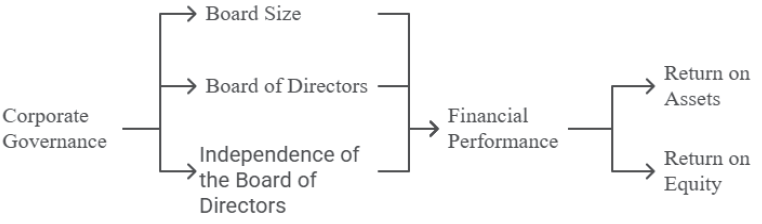
The final sample of 14 companies was determined based on data availability criteria, including complete financial and governance data for the entire 2017-2024 period. The sample characteristics are detailed in Table A1. Data Collection: Secondary data was extracted from the companies’ annual reports and the Amman Stock Exchange database. Independent Variables (Corporate Governance Dimensions): Board Size (BS), Board Independence (BI), and CEO Duality (CEO). An aggregate Corporate Governance (CG) index was also used. Dependent Variables (Financial Performance Measures): Return on Assets (ROA), Return on Equity (ROE), and a composite Financial Performance (FP) index. The following figure represent the conceptual frame work:
Source: prepared by the researchers
The analysis was conducted in EViews using panel data regression. To determine the optimal model, we performed diagnostic tests: an F-test selected Fixed Effects over Pooled OLS, and a Hausman test confirmed Fixed Effects over Random Effects. The Fixed Effects model was therefore employed for all regressions, as it effectively controls for unobserved, time-invariant firm heterogeneity (e.g., corporate culture or management style), yielding more reliable estimates of the governance-performance relationship.
The main null hypothesis (H₀1) stated that there is no significant effect of corporate governance on financial performance. Verification: For the aggregate governance index (CG), the null hypothesis is accepted (not rejected), as its effect was statistically insignificant across all models. However, for the individual mechanisms, the results are mixed:
H₀1-1 (Effect on ROA): Partially rejected. The effect of BS and CEO is significant, while CG and BI are not.
H₀1-2 (Effect on ROE): Partially rejected. The effect of BS is significant, and CEO is marginally significant, while CG and BI are not.
Therefore, the study concludes that while specific governance mechanisms matter, the overall formal governance structure, as measured by a composite index, does not have a significant statistical impact on the financial performance of the sampled companies.
The operational definitions for the variables used in the statistical analysis, acting as a key for interpreting the study’s models. It categorizes variables into two groups: independent and dependent. The independent variables, which represent the dimensions of corporate governance being tested, are a composite measure of governance (CG), Board Size (BS), Board Independence (BI), and CEO Duality (CEO). The dependent variables, which represent the outcomes being measured, are a composite Financial Performance index (FP) and its two primary components, Return on Assets (ROA) and Return on Equity (ROE), see Table 1.
|
Variable name |
Symbol |
Variables |
|
Corporate governance |
CG |
Independent variables |
|
Board size |
BS |
|
|
Independence of the Board of Directors |
BI |
|
|
Board duplication |
CEO |
|
|
Financial performance |
FP |
Dependent variables |
|
Return on assets |
ROA |
|
|
Return on equity |
ROE |
Source: Prepared by researchers
The final sample of 14 industrial companies was determined by applying stringent data-availability filters for the complete 2017–2024 period. This sample represents the entire population of non-financial industrial firms listed on the Amman Stock Exchange with uninterrupted, audited financial and governance disclosures for the eight-year study window. The study uses a longitudinal panel of 14 firms across 8 years (112 firm-year observations), a sample size typical for in-depth analysis in this context. To ensure robustness against outliers in our limited sample, we applied a top/bottom coding procedure to all continuous variables, replacing values below the 1st percentile and above the 99th percentile with the values at those percentiles. This process caps extreme values, providing more robust and reliable statistical estimates. The panel data methodology, particularly the Fixed Effects model, is well-suited for such designs, as it efficiently utilizes within-firm variation over time to derive estimates, controlling for unobserved heterogeneity. The sample’s sufficiency is supported by the consistency of model diagnostics and the statistical significance of the results obtained.
The preliminary overview of the dataset’s characteristics by presenting descriptive statistics for all 112 observations. The data reveals significant insights and potential issues. Notably, the average Return on Equity (ROE) is negative (-0.047%), suggesting the sample companies struggled with profitability for shareholders during the study period, see Table 2.
To provide a holistic assessment, this study employs two composite indices: a Corporate Governance (CG) Index and a Financial Performance (FP) Index. The construction of each is detailed below to ensure transparency and replicability.
Corporate Governance (CG) Index: The CG Index aggregates the three governance dimensions under study into a single, normalized score. It is calculated as follows:
Component Variables: The index incorporates Board Size (BS), Board Independence (BI), and CEO Duality (CEO). Normalization: Each component for each company-year observation was normalized to a 0–1 scale using the min-max method to render them unit-free and comparable:
Componentnorm = (Component raw−Min (Component) / Max(Component)−Min(Component)
The CEO Duality (CEO) variable is a binary indicator coded as 1 if the roles of Chairman and CEO are held by the same individual, and 0 otherwise; no normalization was required as it was already on a comparable scale
Aggregation: The normalized values of BS, BI, and CEO were then averaged using equal weights:
CG Index=(BSnorm+ BInorm+CEO ) / 3
A higher CG Index value indicates a stronger overall governance structure as defined by these three mechanisms.
The composite Financial Performance Index (FP Index) was calculated using the normalized values of both ROA and ROE to ensure scale consistency:
FP Index=(ROA norm +ROE norm )/2
This normalization (Min-Max scaling) transforms both metrics into a range between 0 and 1, eliminating any bias from different variance level
A higher FP Index value indicates superior combined financial performance. This methodological approach ensures that the composite indices provide summary measures while allowing the individual components to be analyzed independently, as presented in the regression results. The methodologically novel finding that a composite governance index is insignificant while specific mechanisms are impactful offers a critical insight: governance effectiveness is not about blanket compliance but about the strategic optimization of specific structures suited to the local institutional environment.
|
FP |
ROA |
ROE |
CG |
BS |
BI |
CEO |
|
|
Mean |
0.313 |
0.359 |
-0.047 |
0.312 |
8.256 |
0.702 |
0.666 |
|
Median |
0.375 |
0.066 |
-0.031 |
0.220 |
7.666 |
0.747 |
0.682 |
|
Maximum |
0.675 |
4.000 |
0.214 |
0.950 |
13.400 |
1.000 |
1.000 |
|
Minimum |
0.002 |
0.020 |
-0.474 |
0.000 |
7.030 |
0.000 |
0.000 |
|
Std. Dev. |
0.194 |
1.011 |
0.138 |
0.279 |
1.413 |
0.135 |
0.131 |
|
Observations |
112 |
112 |
112 |
112 |
112 |
112 |
112 |
Source: Authors’ computation using EViews.
Note: Values for FP (Financial Performance Index), ROA, ROE, and CG (Corporate Governance Index) are presented as decimal shares.
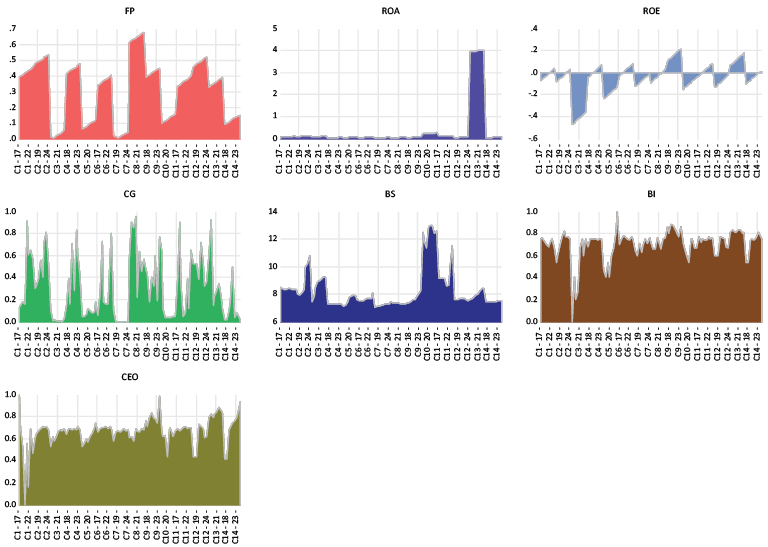
Source: From the researchers’ work based on the statistical program Eviews.
Furthermore, the extreme values and high standard deviations, especially for Board Size (BS) and ROA, indicate substantial volatility and the presence of outliers within the sample. The stark difference between the mean and median for Board Size highlights a skewed distribution, where a small number of companies with very large boards disproportionately influence the average. This summary is crucial for understanding the data’s nature before proceeding to complex causal analysis. Moreover, the variables for each parameter is represented in the following Figure 2. To estimate the impact of corporate governance variables on financial performance, this study employed a panel data methodology. The dataset comprised 14 industrial companies listed on the Amman Financial Market over the period from 2017 to 2024, resulting in a balanced panel of 112 observations. The analysis considered three static panel data model specifications: the Pooled Regression Model, the Fixed Effects Model, and the Random Effects Model. The most appropriate model for each analysis was determined through a two-step testing procedure: an F-test was used to select between the Pooled and Fixed Effects models, and the Hausman test was then applied to choose between the Fixed and Random Effects models.
The correlation coefficient matrix Person between independent variables is presented in table 3.
|
|
CG |
BS |
BI |
|
BS |
-0.008 |
|
|
|
BI |
0.294 |
0.219 |
|
|
CEO |
0.058 |
0.339 |
0.496 |
Source: Researchers’ accounts
The simple linear correlation coefficient matrix shows that the square of the correlation coefficients between the independent variables is less than the coefficients of determination in the estimated models. According to Klein’s test, these equations do not contain the multicollinearity problem (Hossain, 2024).
Heteroskedasticity test: Table 4 shows there are no heteroskedasticity in all estimate equations.
|
Equation |
Stat. |
Prob. |
Decision |
|
FP |
2.0649 |
0.1536 |
(H₀): There is no heteroskedasticity |
|
ROA |
0.3586 |
0.9746 |
(H₀): There is no heteroskedasticity |
|
ROE |
0.8800 |
0.5361 |
(H₀): There is no heteroskedasticity |
Source: From the researchers’ work based on the statistical program E-Views
Autocorrelation test: There are a serial correlation in all estimate equations, therefore, clustered standard errors will be good candidate when the panel data set has firm effect or both time and firm effects (Thompson, 2011), so all equations were estimated with standard errors that are robust to simultaneous correlated across time and firms, see Table 5.
|
Equation |
Stat. |
Prob. |
Decision |
|
FP |
31.9595 |
0.0000 |
(Hi): There is a serial correlation. |
|
ROA |
96.5768 |
0.0000 |
(Hi): There is a serial correlation. |
|
ROE |
51.6433 |
0.0000 |
(Hi): There is a serial correlation. |
Source: From the researchers’ work based on the statistical program EViews
|
Decision |
Testing the normal distribution of residuals error |
|
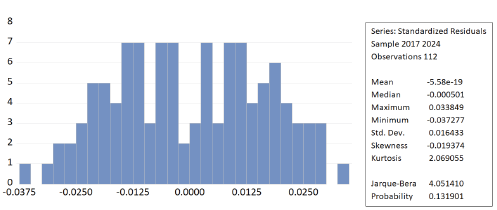
The Jarque-Bera statistic appears to be non-significant at the 5% level, which means that the residuals error are normally distributed for the FP equation |
|
|
FP Equation Residuals |
|
|
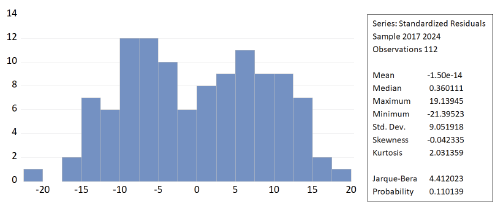
The Jarque-Bera statistic appears to be non-significant at the 5% level, which means that the residuals error are normally distributed for the ROA equation |
|
|
ROA Equation Residuals |
|
|
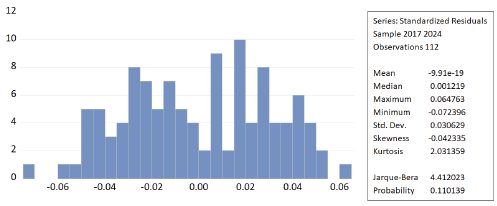
The Jarque-Bera statistic appears to be non-significant at the 5% level, which means that the residuals are normally distributed for the ROE equation |
|
|
ROE Equation Residuals |
Source: Researchers’ accounts
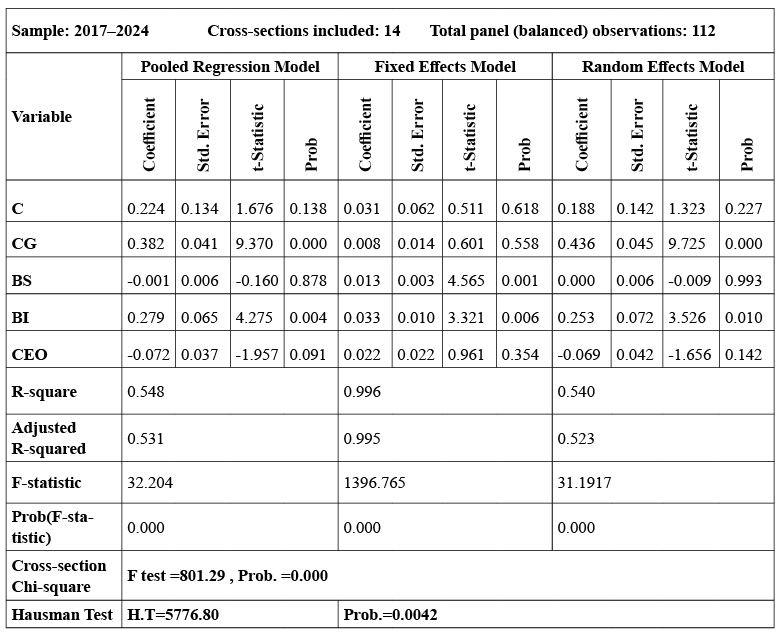
Panel data analysis was conducted to estimate the impact of corporate governance on financial performance. Model specification tests confirmed the Fixed Effects model as most appropriate, with both the F-test (F = 801.29, p < 0.05) and Hausman test (HT = 5776.80, p < 0.05) being significant.The results, presented in Table 7, show a mixed impact. The composite corporate governance index (CG) had a positive but statistically insignificant effect. In contrast, specific mechanisms showed significant positive relationships: both board size (BS) and board independence (BI) significantly improved financial performance (p < 0.05). CEO duality (CEO) showed a positive but insignificant impact. The model demonstrated high explanatory power, with an R² of 0.996, indicating the independent variables explain 99.6% of the variation in financial performance. The significant F-statistic (F = 1396.76, p < 0.05) leads to the rejection of the null hypothesis, confirming that corporate governance variables collectively have a significant impact on the financial performance of Jordanian industrial companies from 2017 to 2024.
Source: From the researchers’ work based on the statistical program EViews.
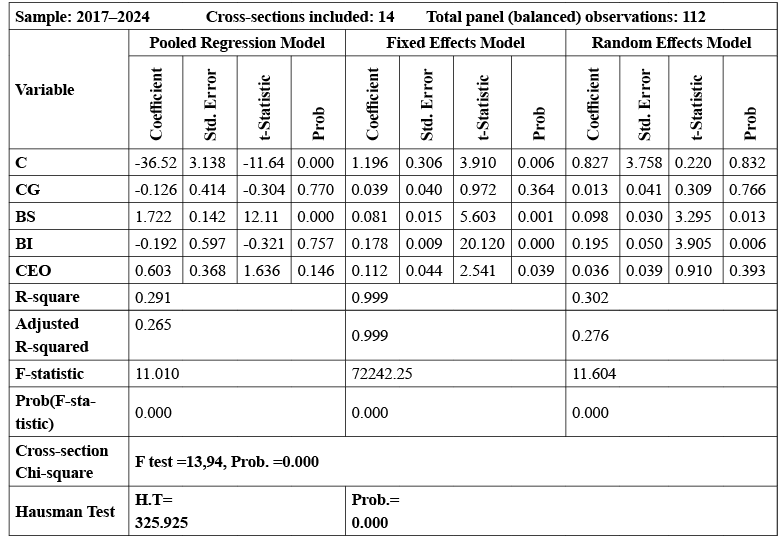
The results of the regression analysis on Return on Assets (ROA) are summarized as follows, see Table 8. Model specification tests confirmed the Fixed Effects model as the most appropriate for this analysis. The significant F-test (F = 13.94, p < 0.05) led to the rejection of the Pooled OLS model, and the significant Hausman test (HT = 325.925, p < 0.05) supported the Fixed Effects model over the Random Effects model. The analysis of individual governance variables yielded mixed results, see Table 8, it shows that the composite corporate governance index (CG) exhibited a positive but statistically insignificant relationship with ROA (β = 0.040, p > 0.05). And that the Board size (BS) demonstrated a small but statistically significant positive effect on ROA (β = 0.08, p < 0.05). Conversely, board independence (BI) showed a positive coefficient that was insignificant (β = 0.17, p > 0.05).So, CEO duality (CEO) had a significant positive impact on ROA (β = 0.11, p < 0.05). The overall model exhibited exceptional explanatory power, with a coefficient of determination (R²) of 0.999, indicating that the model explains 99.9% of the variance in ROA. The highly significant F-statistic (F = 72242.24, p < 0.05) provides strong evidence to reject the null hypothesis, confirming a significant overall impact of the corporate governance variables on the ROA of Jordanian industrial companies listed on the Amman Financial Market for the period 2017 to 2024.
Source: From the researchers’ work based on the statistical program EViews.
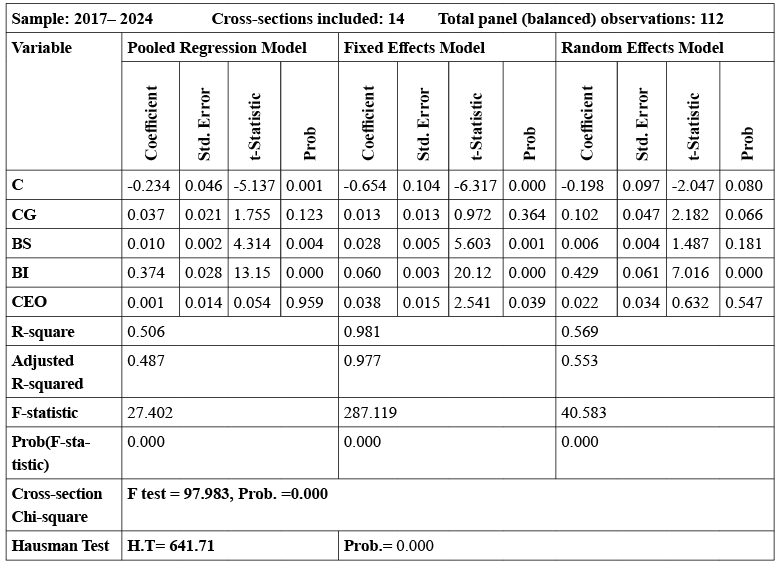
The impact of governance on Return on Equity (ROE) was analyzed using a Fixed Effects model, confirmed by significant F-test (F = 97.98, p < 0.05) and Hausman test (HT = 641.71, p < 0.05) results. As shown in Table 9, the composite governance index (CG) had an insignificant effect (β = 0.013, p > 0.05). Board size (BS) showed a small but significant positive relationship (β = 0.028, p < 0.05), while board independence (BI) was positive but insignificant (β = 0.060, p > 0.05). CEO duality (CEO) had a marginally significant positive impact (β = 0.038, p < 0.10).
The model exhibited strong explanatory power (R² = 0.986) and a significant F-statistic (F = 387.119, p < 0.05), confirming that corporate governance variables collectively have a significant impact on the ROE of Jordanian industrial companies from 2017 to 2024.
Source: From the researchers’ work based on the statistical program EViews.
This section presents the empirical findings from testing the study’s hypotheses using panel data regression analysis and provides an interpretive discussion of these results. The study employed panel data analysis (Fixed Effects, Random Effects, and Pooled OLS models) on a dataset of 112 observations (14 companies over 8 years). The Hausman test consistently indicated the Fixed Effects model as the most appropriate for all analyses. The results of the panel data regression analyses are presented below. It is important to contextualize the model fit statistics. The exceptionally high R² values (ranging from 0.986 to 0.999) and correspondingly large F-statistics are characteristic of the Fixed Effects (FE) model specification employed.
The FE model accounts for all time-invariant, unobserved heterogeneity across firms (e.g., specific management culture, historical brand value, or unique operational advantages) by including individual firm intercepts. Consequently, the reported R² primarily reflects the model’s high explanatory power for within-firm variation over time. These values do not indicate overfitting or scaling issues but are a known outcome when firm-specific effects are substantial and stable, as is often the case in corporate financial panel data. The statistical significance of the models is further validated by robust standard errors, clustered at the firm level, which correct for potential serial correlation. Estimating the impact of corporate governance variables on the financial performance the key findings regarding each hypothesis are summarized below, see Table 10:
|
Hypothesis |
Variable Relationship |
Result |
Statistical Significance |
|
H₀1 |
CG → FP (Index) |
Not Rejected |
Insignificant |
|
H₀1-1 |
CG → ROA |
Not Rejected |
Insignificant |
|
BS → ROA |
Rejected |
Significant (p<0.05) |
|
|
BI→ ROA |
Not Rejected |
Insignificant |
|
|
CEO→ ROA |
Rejected |
Significant (p<0.05) |
|
|
H₀1-2 |
CG → ROE |
Not Rejected |
Insignificant |
|
BS → ROE |
Rejected |
Significant (p<0.05) |
|
|
BI→ ROE |
Not Rejected |
Insignificant |
|
|
CEO→ ROE |
Rejected |
Significant (p<0.10) |
Hypothesis H₀1 (Overall Impact on Financial Performance): The results fail to reject the null hypothesis. The composite corporate governance (CG) index demonstrated a positive but statistically insignificant effect on the overall financial performance (FP) index (Coefficient = 0.0058, p-value > 0.05). However, when examining the individual governance dimensions, the model was highly significant (F-statistic = 1236.98, p < 0.00) with an explanatory power of 99.6% (R² = 0.996).
Hypothesis H₀1-1 (Impact on Return on Assets - ROA): The results fail to reject the null hypothesis. The composite CG index showed a positive but statistically insignificant relationship with ROA (Coefficient = 2.296, p-value > 0.05). Among the individual dimensions, Board Size (BS) and CEO Duality (CEO) had a statistically significant positive effect on ROA, while Board Independence (BI) was insignificant. The model was highly significant (F-statistic = 572387, p < 0.00) with an R² of 0.999.
Hypothesis H₀1-2 (Impact on Return on Equity - ROE): The results fail to reject the null hypothesis. The composite CG index showed a positive but statistically insignificant relationship with ROE (Coefficient = 0.0078, p-value > 0.05). For the individual dimensions, Board Size (BS) and CEO Duality (CEO) had a statistically significant positive effect on ROE (CEO significant at the 10% level), while Board Independence (BI) was insignificant. The model was highly significant (F-statistic = 383.139, p < 0.00) with an R² of 0.986.
The most significant and novel finding of this study is the positive relationship between CEO duality and performance. This provides original empirical support for stewardship theory in the Jordanian context, challenging the predominance of agency theory prescriptions and highlighting the importance of contextual leadership models.
This study set out to address the primary question: To what extent does corporate governance affect the financial performance of industrial companies listed on the Amman Stock Exchange? The results provide a nuanced answer. The analysis of the composite governance index (addressing the broad intent of H₀1) reveals no statistically significant impact, suggesting that a holistic, “check-box” approach to governance does not directly translate to financial gains. However, disaggregating the mechanisms offers critical clarity.
The mixed results underscore the context-dependent nature of corporate governance efficacy. The positive role of CEO duality aligns more closely with stewardship theory, which can be more applicable in environments like Jordan’s industrial sector, characterized by economic volatility and concentrated ownership, where strong, unified leadership is often valued. The limited standalone impact of board independence calls for a critical evaluation of its implementation beyond tokenism. These findings collectively challenge the direct transplantation of agency theory prescriptions to all institutional settings.
For regulators (e.g., the Amman Stock Exchange, Jordan Securities Commission), the findings advocate for a shift from a compliance-centric to a principles-based approach, emphasizing the quality and substantive effectiveness of governance structures over their mere existence. For companies and boards, careful consideration should be given to constructing boards of an optimal size that balances diversity with cohesion, and to making strategic, context-aware decisions regarding leadership structure.
This study’s limitations, including its exclusive focus on quantitative metrics and a single national sector, point to fruitful directions for future inquiry. Research employing mixed methods (e.g., interviews with board members) could illuminate the qualitative dynamics behind the quantitative patterns. Furthermore, longitudinal studies tracking the evolution of governance effectiveness as Jordan’s market matures, and comparative studies with similar emerging economies, would deepen the understanding of contextual contingencies
We re-ran the main regressions using a trimmed sample (excluding the top and bottom 1% of values for continuous variables). The direction and significance of the key results concerning board size and CEO duality remained substantively unchanged, supporting the robustness of our findings.
This study makes a distinct contribution to the corporate governance literature by demonstrating that the mechanism-specific and context-contingent nature of governance effectiveness is a critical factor in emerging markets. The originality of this work lies not in proposing new governance features, but in rigorously demonstrating why standard features produce divergent results, thereby providing a framework for more effective, context-sensitive governance implementation beyond Jordan.
This investigation into Jordan’s industrial sector demonstrates that the financial performance impact of corporate governance is not monolithic. The central insight is that specific mechanisms matter more than a broad-brush approach. While a composite governance index proved insignificant, the analysis revealed that board size is a consistent positive driver of profitability, and CEO duality can be performance-enhancing in this particular context, challenging one-size-fits-all governance doctrines. The ambiguous results for board independence highlight a critical area for qualitative improvement.
These insights lead to two concrete strands of recommendation. First, for practice and policy, stakeholders should prioritize the strategic optimization of specific governance structures – particularly board composition and leadership design – tailored to the firm’s environment, moving beyond generic compliance. Second, for the academic community, future research should delve into the qualitative “black box” of board operations and expand comparative analyses to build a more contingent theory of governance for emerging markets. Ultimately, this study affirms that governance effectiveness is profoundly shaped by its institutional context, urging both practitioners and scholars to embrace this complexity.
Hisham Jadallah Mansour Shakhatreh: Methodology, Formal analysis, Data curation, Investigation, Writing – review & editing.
Doaa Salman Abdou: Conceptualization, Methodology, Investigation, Writing – original draft, Writing – review & editing, Supervision, Project administration.
Ahmed Abbas Hammadi: Investigation, Validation, Resources, Writing – review & editing.
Ahmad Hussein Battal: Formal analysis, Visualization, Software, Writing – review & editing.
Abutaber, T., Bzur, A., Odeh, M., Alathamneh, M., Al-Okaily, M., & Afaneh, M. (2021). The effect of corporate governance indicators on enhancing the financial performance of industrial listed companies on the Amman Stock Exchange. Accounting, 7(2), 415-422. https://doi,org/10.5267/j.ac.2020.11.009
Alam, N., Ramachandran, J., & Nahomy, A. H. (2020). The impact of corporate governance and agency effect on earnings management: A test of the dual banking system. Research in International Business and Finance, 54(101242), 1–16. https://doi.org/10.1016/j.ribaf.2020.101242
Al-Almai, Ali. (2018). The Impact of Corporate Governance on Financial Performance in Saudi Joint Stock Companies –An Applied Study on the Insurance Sector in the Kingdom of Saudi Arabia, Journal of Economic, Administrative and Legal Sciences, 14 (2)
Alkhazaleh, Q., Ghazali, A., & Shahbudin, A. (2022). The Relationship between Corporate Governance Mechanisms and Firm Performance: Evidence from Jordanian’s Listed Firms. International Journal of Academic Research in Accounting, Finance and Management Sciences. https://doi.org/10.6007/ijarafms/v12-i4/15809
Alodat, A., Salleh, Z., Hashim, H., & Sulong, F. (2021). Corporate governance and firm performance: empirical evidence from Jordan. Journal of Financial Reporting and Accounting. https://doi.org/10.1108/jfra-12-2020-0361
Al-Saeedi, Ahmed and Saadawi, Murad and Abdel Moneim, Najla. (2021). The role of corporate governance principles in improving financial performance –A field study of a sample of economic institutions in the states of Laghouat and Bouira, Journal of Economic Sciences, Management and Commercial Sciences, 14 (1).
Arum, E. D. P., Wijaya, R., Wahyudi, I., & Brilliant, A. B. (2023). Corporate governance and financial statement fraud during the COVID-19: Study of companies under special monitoring in Indonesia. Journal of Risk & Financial Management, 16(7), 1–15. https://doi.org/10.3390/jrfm16070318
Alshhadat, M.Q. & Al-Hajaya, K. (2023). Corporate governance in the COVID-19 pandemic: current practices and potential improvement, Corporate Governance, Vol. ahead-of-print No.ahead-of-print. https://doi.org/10.1108/CG-05-2022-0203
Alazzam, F. A. F., Shakhatreh, H. J. M., Aldrou, K. K. A. R., Assaf, M. A. M., Albalawee, N. M., & Almahasneh, A. A. A. (2026). Information systems audit implications of trading law compliance in e-commerce: A bibliometric analysis. EDPACS. https://doi.org/10.1080/07366981.2026.2635151
Atallah, A. (2024). The corporate governance role in protecting minority shareholders rights in public joint-stock companies (Comparative Study). https://hdl.handle.net/10016/45172
Albalawee, N., Franchuk, V., Balas, H. A., Shakhatreh, H. J. M., & Yosyfovych, D. (2023). Public administration of the economic security system through the prism of human rights protection in a changing political and legal environment. Social & Legal Studios, 6(4), 9–17. https://doi.org/10.32518/sals4.2023.09
Alakash, M. A. N., Altaany, H. M., Abuirmilah, B., Shakhatreh, H. J. M., Magableh, N. Z. S., & Al Daraiseh, A. K. M. S. (2024). Enhancing the implementation of international humanitarian law in conflict zones: A comprehensive review. Pakistan Journal of Criminology, 16(3), 1365–1378. https://doi.org/10.62271/pjc.16.3.1365.1378
Alazzam, F. A. F., Shakatreh, H. J. M., Gharaibeh, Z. I. Y., Aldrou, K. K. A. R., & Alkhatib, A. J. (2022). COVID-19 vaccinations: Medical, ethical and legal aspects. Medical Archives, 76(6), 413–418. https://doi.org/10.5455/medarh.2022.76.413-418
Alazzam, F. A. F., Al-zoubi, T. M. H., Aldghaim, R. A. I., Al-Maagbeh, M. M., Bani-Meqdad, M. A. M., & Shakhatreh, H. J. M. (2024). Legal responsibility for negative effects of the vaccine: Nature and financial compensation. Edelweiss Applied Science and Technology, 8(5), 1997–2006. https://doi.org/10.55214/25768484.v8i3.1940
Bahaa El-Din, Nawar. (2020). The impact of company characteristics on the financial performance of insurance companies: an applied study of a sample of companies listed on the Amman Financial Securities Market for the period from 2016-2005, Anbar University Journal of Economic and Administrative Sciences, Volume 12, Issue 29.
Basalat, H., Koni, S., & Nour, A. (2023). The Impact of Governance on the Financial Performance of Companies Listed in Amman and Palestine Stock Exchanges for the Period 2013-2019. Jordan Journal of Business Administration. https://doi.org/10.35516/jjba.v19i3.1124
Bebchuk, L. A., & Weisbach, M. S. (2010). The state of corporate governance research. The Review of Financial Studies, 23(3), 939-961. https://doi.org/10.1093/rfs/hhp121
Boachie, C., & Mensah, E. (2022). The effect of earnings management on firm performance: The moderating role of corporate governance quality. International Review of Financial Analysis, 83, 102270. https://doi.org/10.1016/j.irfa.2022.102270
Bouqalieh, B. (2023). The Impact of Corporate Governance Principles on Financial Performance in Jordanian Family Companies. Jordan Journal of Business Administration. https://doi.org/10.35516/jjba.v19i1.740
Faysal, S., Salehi, M., & Moradi, M. (2020). Impact of corporate governance mechanisms on the cost of equity capital in emerging markets. Journal of Public Affairs, 21, 1–11. https://doi.org/10.1002/pa.2166
Hala, Laila. (2020). The contribution of implementing corporate governance to increasing the financial performance of family businesses, unpublished master’s thesis, Faculty of Economics, Commercial Sciences and Management, Larbi Ben Mehdi University, Oum El Bouaghi, Algeria
Ibrahim, Al-Saeed Mabrouk. (2019). Governance and Asymmetry of Accounting Information, Cairo, Egypt, Al-Baheth Foundation for Research Consultations and International Publishing.
Jensen, M. C., & Meckling, W. H. (1976). Theory of the firm: Managerial behavior, agency costs and ownership structure. Journal of Financial Economics, 3(4), 305–360. https://doi.org/10.1016/0304-405X(76)90026-X
Jian, J., He, K., Liu, Y., & Sun, Y. (2023). Corporate social responsibility: Opportunistic behavior under earnings management? Asia-Pacific Journal of Accounting & Economics, 1–22. https://doi.org/10.1080/16081625.2023.2170891
Gourari, F. M., Alazzam, F. A. F., Shakhatreh, H. J. M., Alhajeri, S. A. H., & Al Mansoori, S. A. A. (2025). Legal liability for AI-assisted radiographic diagnosis errors: A comparative review of French, Jordanian, and UAE law. Acta Informatica Medica, 33(3), 184–189. https://doi.org/10.5455/aim.2025.33.184-189
Shakhatreh, H. J. M. (2024). Impact of external environmental factors on sustainable commercial development in the Jordan: The case of legal aspect of the eco-business. International Journal of Environmental Impacts, 7(1), 93–100. https://doi.org/10.18280/ijei.070111
Shakhatreh, H. J. M., & Alazzam, F. A. F. (2025). Legal frameworks for AI-driven diagnostics and robotic surgery. Acta Informatica Medica, 33(3), 248–252. https://doi.org/10.5455/aim.2025.33.248-252
Shakhatreh, H. J. M. (2023). Development of e-commerce within the framework of compliance with financial law. Financial and Credit Activity: Problems of Theory and Practice, 4(51), 429–439. https://doi.org/10.55643/fcaptp.4.51.2023.4123
Mousavi, M., Zimon, G., Salehi, M., & Stępnicka, N. (2022). The effect of corporate governance structure on fraud and money laundering. Risks, 10(9), 1–25. https://doi.org/10.3390/risks10090176
Nour, A. I., Najjar, M., Al Koni, S., Abudiak, A., Noor, M. I., & Shahwan, R. (2024). The impact of corporate governance mechanisms on corporate failure: empirical evidence from Palestine Exchange. Journal of Accounting in Emerging Economies, 14(4), 771-790. https://doi.org/10.1108/JAEE-10-2022-0283
OECD. (2015). G20/OECD principles of corporate governance. OECD Publishing. https://doi.org/10.1787/9789264236882-en
Pagkalou, F. I., Galanos, C. L., & Thalassinos, E. I. (2024). Exploring the relationship between corporate governance, corporate social responsibility and financial and non-financial reporting: A study of large companies in Greece. Journal of Risk and Financial Management, 17(3), 97. https://doi.org/10.3390/jrfm17030097
Pham, T. (2020). on the relationship between total quality management practices and firm performance in Vietnam: The mediating role of non- financial performance. Management Science Letters, 10 (8), 1743 -1754. https://doi.org/10.5267/j.msl.2020.1.005
Saidat. Z., Silva, M., & Seaman, C. (2019). The relationship between corporate governance and financial performance: Evidence from Jordanian family and nonfamily firms. Journal of Family Business Management, 9(1), 54-78. https://doi.org/10.1108/JFBM-11-2017-0036
Pham, M. T., Van Nguyen, L., & Nguyen, T. T. M. (2024). The Effect of Corporate Governance on Tax Avoidance: Evidence from Listed Firms in Vietnam. Economic Insights-Trends & Challenges, 13(2).
Seiam, D. A., & Salman, D. (2024). Examining the global influence of e-governance on corruption: a panel data analysis. Future Business Journal, 10(1), 29.
Sharif Hossain. ( 2024). Econometric Analysis: An Applied Approach to Business and Economics, Cambridge Scholars Publishing, UK.
Thompson, S. B. (2011). Simple formulas for standard errors that cluster by both firm and time. Journal of Financial Economics, 99, 1–10.
Turki, Moatasem, Al-Hamdani, Rafi’a. (2020). Economic indicators & their impact on the financial performance of a sample of industrial companies listed on the Iraqi Stock Exchange for the period 2010-2017, Tikrit Journal of Administrative & Economic Sciences, Volume 16, Issue 1.
Zidan, H., Hamad, H., & Abed, M. (2024). The impact of rational governance on the financial performance of industrial company’s sample (Pharmaceutical companies) listed in Amman stock exchange. International Journal of Financial Management and Economics. https://doi.org/10.33545/26179210.2024.v7.i1.260
Zureigat, B., Hazimeh, A., Batayneh, R., & Alrawashedh, N. (2024). Does board of directors affect financial performance? A study of the Jordanian companies. Uncertain Supply Chain Management. https://doi.org/10.5267/j.uscm.2024.4.007
|
No. |
Company Name (English) |
Primary Industry Sub-Sector |
Market Cap (JOD Million) |
Major Shareholder(s) / Type |
Ownership Type Classification |
|---|---|---|---|---|---|
|
1 |
Dar Al Dawa Development and Investment |
Pharmaceuticals |
150.5 |
Al-Masri Family |
Family-Controlled |
|
2 |
Al Hayat for International Vaccines |
Pharmaceuticals |
89.2 |
Government Pension Fund, Local Banks |
Institutionally-Held |
|
3 |
Philadelphia for Pharmaceutical Manufacturing |
Pharmaceuticals |
210.0 |
Founders‘ Group (60%) |
Family-Controlled |
|
4 |
Industrial Commercial Agricultural (Production) |
Diversified Investments / Food & Beverage |
55.7 |
No single >10% shareholder |
Dispersed Ownership |
|
5 |
Al Mutasademah for Works and Projects |
Construction & Engineering |
120.3 |
Holding Company XYZ |
Corporate Subsidiary |
|
6 |
Jordan Industrial Resources |
Manufacturing / Chemicals |
45.8 |
Data to be collected |
To be determined |
|
7 |
Arab for Pesticides & Veterinary Drugs Manufacturing |
Chemicals / Animal Health |
78.9 |
Data to be collected |
To be determined |
|
8 |
Jordanian for Slaughtering, Processing & Marketing of Poultry |
Food & Beverage |
95.0 |
Data to be collected |
To be determined |
|
9 |
Jordanian Ahlian |
Insurance |
310.0 |
Data to be collected |
To be determined |
|
10 |
General Investments |
Diversified Investments / Financial Services |
180.5 |
Data to be collected |
To be determined |
|
11 |
United Filters for Spring & Cigarette Production |
Tobacco Manufacturing |
420.8 |
Data to be collected |
To be determined |
|
12 |
Arab for Aluminum Industry (RAL) |
Manufacturing / Metals |
65.2 |
Data to be collected |
To be determined |
|
13 |
National Steel Industry |
Manufacturing / Metals |
110.7 |
Data to be collected |
To be determined |
|
14 |
Jordan Phosphate Mines Company |
Mining & Resources |