Ekonomika ISSN 1392-1258 eISSN 2424-6166
2026, vol. 105(3), pp. 22–39 DOI: https://doi.org/10.15388/Ekon.2026.105.3.2
Petra Motyčková* (Ph.D. candidate)
Tomas Bata University in Zlín
https://ror.org/04nayfw11
Faculty of Management and Economics,
Mostní 5139, 760 01 Zlín, Czech Republic
Department: Centre for Applied Economic Research
Email: motyckova@utb.cz
Phone: +420 777 339 527
ORCID: https://orcid.org/0009-0006-1001-7211
Tomáš Urbánek, Ph.D.
Tomas Bata University in Zlín
https://ror.org/04nayfw11
Faculty of Management and Economics,
Department of Statistics and Quantitative Methods
Mostní 5139, 760 01 Zlín, Czech Republic
Email: turbanek@utb.cz
ORCID: https://orcid.org/0000-0002-6307-2824
Abstract. This study examines the extent to which enterprises differ across economic sectors in their adoption of artificial intelligence (AI) for strategic management, with a particular focus on AI integration, perceived strategic benefits, and adoption barriers. The aim is to assess whether the sectoral context represents a decisive factor in shaping AI-driven strategic practices or whether common patterns prevail across industries. The research is based on a quantitative design using primary survey data collected from enterprises operating in multiple sectors of the Czech economy, which were analyzed by using descriptive and inferential statistical methods. The findings indicate that enterprises across sectors exhibit largely comparable levels of AI integration and similar expectations regarding the strategic benefits of AI, including an improved decision-making quality, efficiency, and competitive positioning. However, statistically significant sectoral differences emerge in the perceived barriers to AI adoption, with IT- and service-sector firms reporting greater challenges related to data quality, system integration, and implementation complexity. These results contribute to the literature on AI adoption and strategic management by suggesting that AI integration is increasingly a cross-sectoral strategic phenomenon, while adoption barriers remain context-dependent. From a managerial and policy perspective, the findings imply that AI support initiatives should combine broad cross-sectoral measures with targeted interventions addressing sector-specific obstacles.
Keywords: artificial intelligence; AI adoption; strategic management; sectoral differences; digital transformation.
_________
* Correspondent author.
Received: 14/01/2026. Accepted: 01/06/2026
Copyright © 2026 Petra Motyčková, Tomáš Urbánek. Published by Vilnius University Press
This is an Open Access article distributed under the terms of the Creative Commons Attribution License, which permits unrestricted use, distribution, and reproduction in any medium, provided the original author and source are credited.
The rapid development of Artificial Intelligence (AI) is reshaping how organizations create value, make strategic decisions, and measure performance. Recent research emphasizes that AI does not generate impact through isolated tools alone. Instead, its value emerges through the development of AI capabilities that combine technological, human, and organizational resources. These capabilities enable firms to sense opportunities, learn, and continuously reconfigure their processes (Mikalef & Gupta, 2021). As such, AI capabilities function as dynamic capabilities that enhance strategic responsiveness and support the integration of data-driven insights into performance-management systems.
Rather than producing immediate financial outcomes, AI strengthens internal processes, analytical sophistication, and knowledge-based competencies, particularly through improvements in human resource management practices and decision-making routines (Mikalef et al., 2020; Li et al., 2023). This logic closely aligns with the Balanced Scorecard (BSC), which conceptualizes performance as a multidimensional outcome shaped by learning and growth, internal process excellence, customer value creation, and financial results, reflecting broader calls for non-financial and integrative performance measurement approaches (Nandi et al., 2023). Integration of AI into the BSC framework therefore has the potential to transform how organizations monitor strategic progress and respond to environmental change.
At the same time, research on AI adoption shows that successful implementation depends on more than technological readiness. Organizational structures, managerial support, data maturity, and environmental conditions play a critical role. Drawing on the Technology–Organization–Environment (TOE) framework, Badghish and Soomro (2024) demonstrate that technological sophistication, organizational characteristics, and industry-specific pressures significantly shape AI adoption decisions. These contextual factors are particularly relevant for understanding potential sectoral differences in AI adoption, which are central to the research design of this study. Similar constraints are highlighted by the OECD (2021), which identifies skill shortages, weak data governance, and limited strategic readiness as key barriers to AI adoption among SMEs.
The strategic importance of AI adoption is further supported by evidence linking AI-enabled capabilities to multidimensional and sustainable performance outcomes. These outcomes include operational efficiency, innovation capacity, and long-term organizational resilience (Soomro et al., 2025). Such effects closely mirror the four perspectives of the Balanced Scorecard, reinforcing the view that AI should be examined not merely as a technological initiative but as a driver of strategic transformation. Research on the evolution of the BSC similarly emphasizes that digital transformation is accelerating the shift toward more data-driven and predictive performance-management systems (Tawse & Tabesh, 2023; Kumar et al., 2024; Pierce, 2022; Usman et al., 2023).
Despite growing international evidence, empirical knowledge remains limited on how AI capabilities and BSC principles interact within Central European economies, particularly in the Czech Republic. Existing studies suggest that Czech enterprises often use AI tools in isolated functional areas but rarely integrate them into formal strategic frameworks (Motyčková, 2025). This gap is especially relevant given the structural characteristics of the Czech economy, which include a high share of SMEs, a strong manufacturing base, and persistent challenges in digital readiness. According to the Digital Economy and Society Index (DESI) 2023, the Czech Republic ranks 22nd among the EU member states and faces a shortage of ICT professionals as well as below-average digital intensity among SMEs (European Commission, 2023). The Digital Decade Report 2024 similarly shows that while 69.1% of the population possesses basic digital skills, only 49.3% of SMEs reach basic digital intensity (European Commission, 2024). The IMD World Digital Competitiveness Ranking places the Czech Republic in the global middle tier, indicating solid infrastructure but limited future readiness (IMD World Competitiveness Center, 2024).
This article builds on a previous publication based on the same survey dataset (Motyčková, 2025). The earlier study provided a descriptive overview of AI use and the application of BSC principles among Czech enterprises. The present article substantially extends this work by adopting a hypothesis-testing approach and by examining whether sectoral contexts lead to systematic differences in AI adoption and the use of strategic performance-management frameworks. The theoretical framing, analytical objectives, and statistical methods therefore differ fundamentally, positioning this study as a more explanatory phase of the research. Unlike the earlier study, which focused primarily on descriptive patterns of AI use and BSC awareness, the present research develops a theoretically grounded analytical model and applies hypothesis-driven statistical analysis to examine sectoral differences in AI adoption and strategic performance management.
Although existing literature points to complementarities between AI capabilities and BSC principles, no studies have so far examined how these dynamics vary across sectors in the Czech Republic. This represents a clear gap in current research and underscores the relevance of analyzing sectoral differences in AI adoption and strategic integration.
Accordingly, this study investigates how enterprises in the Czech Republic adopt artificial intelligence across sectors and to what extent they apply the Balanced Scorecard principles. The guiding research question is: How do enterprises in the Czech Republic differ across sectors in their adoption of Artificial Intelligence and in the application of Balanced Scorecard principles?
Artificial Intelligence Capability (AIC) is defined as a multidimensional dynamic capability comprising technological infrastructure, human expertise, and organizational routines that enable firms to integrate and leverage AI effectively. This capability-based perspective is consistent with broader resource-based and institutional approaches, which emphasize that organizational performance depends on how technological resources are embedded in capabilities and routines rather than on the technologies themselves, a view that is also reflected in recent conceptual work on performance measurement (Nandi et al., 2023). This framework shows that differences in AI use arise not from the technology itself, but from the resources and competencies that support it, particularly the ability to integrate AI into human resource processes and organizational routines (Li et al., 2023). Studies demonstrate that AI improves performance primarily indirectly – by strengthening internal processes, analytical sophistication, and decision quality (Mikalef & Gupta, 2021). These mechanisms map directly onto the Balanced Scorecard (BSC): learning and growth capabilities influence internal process excellence, which in turn shapes customer and financial outcomes. Because these capability components differ systematically between sectors, AIC provides the theoretical foundation for expecting sectoral variation in AI integration (leading to H1). This multidimensional view of performance is consistent with recent empirical evidence showing that AI adoption enhances organizational outcomes through improvements in HR processes, employee engagement, and operational efficiency rather than through isolated financial effects (Li et al., 2023).
Differences in AI adoption are further shaped by technological readiness, organizational capacity, and environmental pressures, as articulated by the Technology–Organization–Environment (TOE) framework (Badghish & Soomro, 2024). Technological barriers such as insufficient data quality or system compatibility, and organizational barriers such as skill shortages and limited managerial support, vary across industries. Evidence shows that IT and service firms face more acute human-capital constraints, while manufacturing firms are more affected by data limitations and implementation complexity (Bag et al., 2022; Várallyai et al., 2024). These patterns provide a theoretically grounded explanation for sector-specific differences in perceived barriers (leading to H3).
Comparative studies show that AI-based models outperform traditional statistical methods in forecasting operational and environmental performance (Makridakis et al., 2023; Azadi et al., 2023). At the strategic level, Soomro et al. (2025) demonstrate that AI adoption enhances economic, environmental, and social performance, confirming its multidimensional nature and alignment with the BSC framework. Because different sectors adopt different types of AI tools (e.g., decision-support in services vs. automation in manufacturing), literature provides a strong basis for expecting sectoral variation in AI use cases (leading to H2).
AI capability acts as a driver of digital transformation, enabling organizations to automate processes, redesign workflows, and achieve sustainable operational outcomes (Bag et al., 2022). Digital transformation studies confirm that firms benefit unevenly from AI depending on the structure of their processes and sector-specific constraints. This asymmetry supports the expectation that sectors differ not only in how they adopt AI, but also in the benefits they expect from AI-enabled performance systems (leading to H4).
Despite progress in AI adoption research, no study integrates AI capability, TOE determinants, and the Balanced Scorecard into a unified framework, nor is it anywhere compared how these mechanisms differ across sectors. Evidence on sectoral differences remains fragmented and rarely includes Central European contexts, where structural digital constraints are well-documented (Motyčková, 2025). This gap directly motivates examination of sectoral differences in AI adoption and BSC-related practices in enterprises in the Czech Republic.
Building on the reviewed literature, the present study examines whether enterprises in the Czech Republic across sectors differ in their adoption of Artificial Intelligence (AI) and in the application of Balanced Scorecard (BSC) principles. Prior research consistently demonstrates that technological, human, and organizational conditions for AI adoption vary substantially across industries (Mikalef & Gupta, 2021; Badghish & Soomro, 2024), which provides a strong theoretical basis for expecting sector-level differences. At the same time, empirical evidence suggests that these differences may manifest in distinct aspects of AI usage – such as integration depth, use-case focus, perceived barriers, and expected strategic benefits (Bag et al., 2022; Soomro et al., 2025).
General Null Hypothesis (H0):
There are no differences between sectors in any aspect of AI adoption or the application of Balanced Scorecard principles.
H1: Companies in the IT and technology sector report a higher level of AI integration into strategic management compared to manufacturing firms.
H2: Service-sector companies use AI primarily for administration and decision-support activities, while manufacturing firms focus more on process efficiency and quality control.
H3: The perceived barriers to AI adoption differ by sector: IT and service firms highlight a lack of qualified employees, whereas manufacturing firms emphasize implementation complexity and insufficient data.
H4: The expected benefits of linking AI with the Balanced Scorecard are strongest in manufacturing and service firms, particularly regarding faster decision-making and more accurate performance monitoring.
This section presents the methodological framework used to examine sectoral differences in the adoption of Artificial Intelligence (AI) and the application of Balanced Scorecard (BSC) principles among enterprises in the Czech Republic. It outlines the overall research design, characteristics of the sample, data collection procedures, measurement of key variables, and analytical techniques. The methodological approach follows established empirical standards in studies on AI adoption and strategic performance management (e.g., Mikalef & Gupta, 2021; Badghish & Soomro, 2024; Soomro et al., 2025). Each subsection provides a transparent description of the research process to ensure the validity, reliability, and replicability of findings.
This research was designed as a quantitative cross-sectional study aimed at examining differences among sectors of enterprises in the Czech Republic in the adoption of Artificial Intelligence (AI) and the application of Balanced Scorecard (BSC) principles within strategic performance management. The choice of a quantitative approach stems from the objective to systematically compare the level, forms, and barriers of AI and BSC implementation across industries using measurable indicators and statistical hypothesis testing.
The methodological design follows previous empirical studies employing survey-based quantitative approaches to examine the relationship between artificial intelligence adoption and organizational performance (Mikalef & Gupta, 2021; Badghish & Soomro, 2024; Soomro et al., 2025). Similarly to these studies, the present research applies a cross-sectional questionnaire survey among enterprises with the objective to capture sectoral differences in AI integration and strategic performance management practices. All three studies confirm that survey-based quantitative methods – often analyzed through PLS-SEM or hybrid SEM–ANN models – represent a well-established methodological standard for investigating organizational and technological factors of AI adoption.
The study builds on previous research by Motyckova (2025), which examined the overall awareness of the BSC concept and the degree of AI utilization in firms in the Czech Republic. The current phase extends the original model by introducing a comparative sectoral perspective and testing four specific hypotheses focused on differences between manufacturing, service, and technology-oriented enterprises.
Data were collected by using the CAWI (Computer-Assisted Web Interviewing) method, which enabled the inclusion of a wide range of respondents from various industries and company-size categories. This approach proved effective for gathering a large dataset while ensuring a high degree of response standardization.
The questionnaire combined validated concepts of strategic performance management with current trends in AI adoption. It consisted of twelve main questions divided into three thematic blocks:
The measured variables included both scale items (1–10) for assessing the level of AI integration and its perceived benefits, as well as dichotomous and multiple-choice items capturing specific forms of AI use and barriers to implementation.
Given the ordinal and categorical nature of the data, non-parametric methods were selected for hypothesis testing so that to ensure valid comparison between sectors.
The research sample consisted of 300 enterprises in the Czech Republic representing a wide range of industries and company sizes. The data were collected between October 2024 and January 2025 through a Computer-Assisted Web Interviewing (CAWI) survey distributed to business representatives across the Czech Republic. The sample included firms from the manufacturing, services, and IT/technology sectors as the primary focus of comparison, along with additional representation from industries such as healthcare, energy, logistics, construction, and finance. The sectoral structure of the research sample is presented in Table 1.
|
Sector |
Number of responses |
Percentage |
|
Manufacturing |
73 |
18% |
|
Services |
83 |
21% |
|
IT / Technology |
75 |
19% |
|
Healthcare |
15 |
4% |
|
Energy |
12 |
3% |
|
Financial services |
36 |
9% |
|
Logistics |
24 |
6% |
|
Construction |
29 |
7% |
|
Agriculture |
3 |
1% |
|
Retail / Wholesale |
52 |
13% |
|
Total |
402 |
100% |
Source: Authors’ own research
Note: The respondents were allowed to indicate more than one sector of activity; therefore, the total number of sectoral responses (402) exceeds the number of surveyed firms (N = 300).
When designing the survey, the optimal sample size was assessed in relation to the population of actively operating companies in the Czech Republic. Theoretical calculations for a 95% confidence level and maximum variability suggested a minimum of 384 respondents. However, considering the challenge of reaching enterprises and the comprehensive nature of the questionnaire, 300 valid responses were obtained. Although this number is slightly below the statistical optimum, it is considered sufficient for exploratory purposes, given the heterogeneity of the sample and the study’s focus on sectoral differentiation rather than representativeness.
The sampling strategy was based on voluntary participation and availability, reflecting a non-probability convenience approach. Despite this limitation, the sample structure captured substantial diversity across the company size categories – from micro-enterprises (1–10 employees) to large firms (over 250 employees) – as well as across sectors with varying technological maturity. This diversity provides a solid foundation for comparing patterns of AI adoption and the application of performance management tools across industries.
All responses were collected anonymously and processed in accordance with data protection regulations. Participation in the survey was voluntary, and the respondents were informed about the purpose of the study and the confidentiality of their answers.
The data were collected by using the Computer-Assisted Web Interviewing (CAWI) method between October 2024 and January 2025. The online questionnaire was distributed to business representatives across the Czech Republic through professional and institutional networks, business associations, and direct e-mail invitations. This approach was selected for its efficiency in reaching a broad spectrum of enterprises across various regions and sectors while ensuring standardized data collection.
The respondents were informed in advance about the purpose of the study, the voluntary nature of participation, and data confidentiality. Participation required that the respondents would hold a management or decision-making position within their organizations to ensure that their answers would reflect informed strategic perspectives. Each company could submit only one response to avoid duplication.
The survey was created and administered in an online environment, and all responses were automatically recorded in a structured database for subsequent analysis. Prior to its distribution, the questionnaire was reviewed for clarity, logical structure, and alignment with the research objectives. The instrument was examined by two academic experts in the field of strategic management and digital transformation and pilot-tested with several managers from Czech enterprises with the objective to ensure the comprehensibility and relevance of the questions. Based on their feedback, minor wording adjustments were made to improve clarity and reduce potential ambiguity.
After the completion of data collection, all responses were screened for completeness and consistency. Incomplete or invalid entries were excluded from the dataset, resulting in 300 fully usable responses. These data provided a solid empirical foundation for the statistical testing of the study’s hypotheses.
The questionnaire was designed to capture the degree and forms of Artificial Intelligence (AI) adoption in enterprises in the Czech Republic, the application of Balanced Scorecard (BSC) principles, and the barriers and perceived benefits of integrating these two approaches within strategic performance management. The instrument consisted of twelve main questions structured into three thematic sections:
(1) knowledge and application of the BSC,
(2) implementation of AI in performance management, and
(3) challenges and expected benefits of AI–BSC integration.
All items were based on the literature on AI adoption and digital performance management (e.g., Mikalef & Gupta, 2021; Bag et al., 2022; Badghish & Soomro, 2024) and adapted to the Czech business context. The questions combined ordinal scales, multiple-choice items, and dichotomous indicators to reflect both the extent and qualitative aspects of AI use.
The independent variable in the analysis was the sector of the enterprise, categorized as manufacturing, services, and IT/technology. This classification enabled the testing of sectoral differences in AI adoption patterns. Additional control variables included the company size (measured by the number of employees) and the industry type.
The dependent variables corresponded to the four formulated hypotheses:
The scale items used a ten-point Likert-type format (‘1’ = very low, ‘10’ = very high) to measure perceptions of integration, difficulty, and benefits. Categorical variables were coded numerically for statistical processing. Before conducting analysis, all data were checked for completeness and logical consistency.
Content validity was ensured by aligning the questionnaire items with established constructs in AI adoption and performance management research. The structure and wording of the questions were reviewed to minimize ambiguity and to maintain conceptual correspondence between theoretical constructs and their empirical measurement.
While the overall sample includes firms from several additional sectors (e.g., healthcare, energy, logistics, construction, and finance), the hypothesis testing focuses on manufacturing, services, and IT/technology sectors as the primary analytical groups. Firms from other sectors were included in the dataset to capture the broader diversity of the Czech business environment and were considered in descriptive statistics but were not used as primary comparison groups in the hypothesis testing due to their smaller representation.
The collected data were analyzed by using quantitative statistical methods to test the four hypotheses concerning sectoral differences in AI adoption and the application of the Balanced Scorecard (BSC) principles among enterprises in the Czech Republic. The analytical procedure combined descriptive statistics with non-parametric inferential tests, reflecting both the exploratory character of the study and the nature of the dataset.
Descriptive statistics were first used to summarize the structure of the sample and to identify general trends in the AI use, BSC application, and perceived barriers or benefits across sectors. Due to the fact that most variables were ordinal or categorical, and tests of normality (Shapiro–Wilk) indicated deviations from a normal distribution, non-parametric statistical techniques were applied for hypothesis testing.
Specifically, the Wilcoxon rank-sum test was employed to compare differences in the level of AI integration and the perceived benefits of AI-enhanced performance management between sectors. Fisher’s exact test was used to evaluate variations in the primary types of AI applications across industries, while the Chi-squared test with Yates’ correction examined associations between the sector type and the most frequently reported barriers to AI adoption. These non-parametric methods were selected for their robustness and suitability for data that do not meet parametric assumptions or involve groups of unequal sizes.
All statistical analyses were conducted by using standard statistical software. The significance level was set at α = 0.05, and effect sizes such as Cramer’s V and odds ratios were reported wherever relevant to complement statistical significance. Summary tables and descriptive statistics were used to present key findings and highlight sectoral patterns in AI adoption and performance management practices.
Overall, this methodological approach ensures that the subsequent analysis can reliably capture and compare how enterprises in the Czech Republic across different sectors integrate Artificial Intelligence into their strategic performance management systems.
This section presents the outcomes of the statistical analyses conducted to evaluate the four hypotheses formulated in the study. As described in the Methodology section, non-parametric tests were applied due to the distributional characteristics of the data and the measurement scales used. The results are organised according to the four hypotheses, each addressing a specific aspect of sectoral differences in AI adoption and the application of the Balanced Scorecard principles. In the following subsections, the findings are presented together with the corresponding visualizations to illustrate the distribution of values and the observed sectoral patterns.
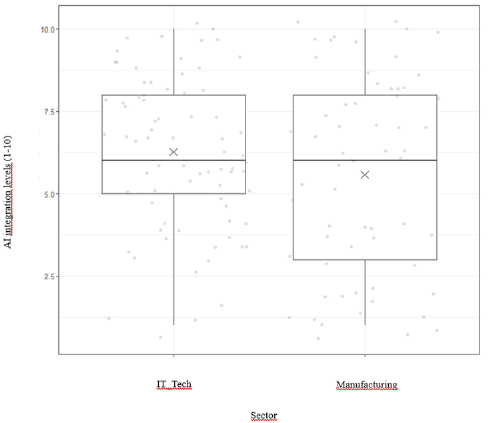
The analysis of H1 showed that the level of AI integration into strategic management does not significantly differ between IT/technology firms and manufacturing enterprises (Wilcoxon W = 2564.5, p = 0.1117). The boxplot in Figure 1 illustrates that both sectors exhibit median integration levels around six points, with very similar interquartile ranges and overall distribution shapes. These visual patterns, together with the non-significant test result, indicate that neither sector reports higher or lower levels of AI integration. This suggests that, at the current stage of development, companies in the Czech Republic across these sectors adopt AI tools for strategic purposes to a comparable extent. The finding also implies that the sector affiliation alone does not substantially shape how deeply AI becomes embedded in strategic management systems. Overall, the result highlights a consistent pattern across industries, supported by both descriptive and inferential evidence.
Source: Authors’ own research
|
Variable |
Manufacturing Median (IQR) |
IT/Technology Median (IQR) |
|
AI integration into strategic management |
6 (3–8) |
6 (5–8) |
Source: Authors’ own research
The analysis of H2 examined whether the primary application of AI differs between the services and manufacturing sectors, focusing on decision support versus process efficiency (Fisher’s exact test, p = 0.1719). Table 3 shows that, in both sectors, the majority of firms report using AI mainly for decision support, with 46 cases in the services sector and 21 cases in manufacturing. In contrast, process-efficiency applications appear far less frequently; they were reported by only 2 service firms and 4 manufacturing firms. These frequencies indicate a similar pattern of AI use across the two sectors, with decision support being the dominant purpose in both. The non-significant test result suggests that the sector affiliation does not substantially influence the primary type of AI application at this stage. Overall, the data reveal a consistent distribution of AI usage patterns, supported by both descriptive counts and inferential analysis.
|
AI Application |
Services Sector n (%) |
Manufacturing Sector n (%) |
Total |
|
Decision Support |
46 (95.8%) |
21 (84.0%) |
67 |
|
Process Efficiency |
2 (4.2%) |
4 (16.0%) |
6 |
|
Total |
48 |
25 |
73 |
Source: Authors’ own research
The analysis of H3 assessed whether the distribution of perceived barriers to AI adoption differs between sectors, comparing data- and implementation-related issues with skills-related obstacles (χ² = 4.8194, p = 0.0281, Cramer’s V = 0.136). Table 4 shows that IT/technology and service-sector firms most frequently reported data and implementation barriers (71 cases), whereas manufacturing firms more often highlighted a lack of qualified employees (37 cases). In contrast, data- and implementation-related challenges were reported less frequently in manufacturing (18 cases), and skills-related barriers were slightly less common in IT/technology and services (67 cases). These patterns reveal a sector-specific distribution of obstacles, while indicating that different industries struggle with different aspects of AI adoption. The significant test result confirms that this variation is not random, and that it actually reflects a meaningful difference between sectors. Overall, the findings show that sector affiliation shapes which type of barrier firms perceive as most critical when adopting AI.
|
Barrier |
IT/Tech & Services n (%) |
Manufacturing n (%) |
Total |
|
Data / Implementation Complexity |
71 (51.4%) |
18 (32.7%) |
89 |
|
Lack of Skilled Employees (Skills Index) |
67 (48.6%) |
37 (67.3%) |
104 |
|
Total |
138 |
55 |
193 |
Source: Authors’ own research
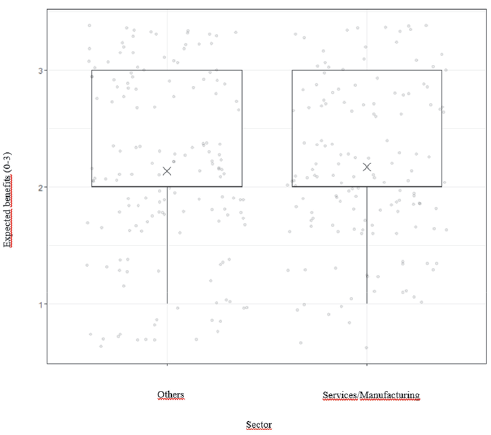
The analysis of H4 examined whether the expected benefits of integrating AI with the Balanced Scorecard differ between sectors, by using a Wilcoxon rank-sum test (W = 10998, p = 0.6382). Figure 2 shows that both sectors exhibit very similar median scores on the 0–3 scale, with nearly identical interquartile ranges and the overall distribution shapes. These visual patterns indicate that firms across sectors share comparable expectations regarding the potential advantages of combining AI with performance management frameworks. The non-significant test result reinforces this observation, suggesting that sector affiliation does not play a substantial role in shaping perceived benefits. This implies that expectations about AI–BSC integration may be influenced more by firm-level factors than by sector characteristics. Overall, the data reveal consistent expectations across industries, supported by both descriptive evidence and inferential analysis.
Source: Authors’ own research
This study contributes to this discussion by offering new insights into how enterprises in the Czech Republic incorporate AI into strategic management processes, and how these patterns relate to perceived barriers and anticipated benefits. Taken together, the findings invite a reconsideration of the assumption that sectoral dynamics necessarily shape all aspects of AI adoption; instead, they point toward a more nuanced picture in which some dimensions remain shared across sectors, while others diverge.
Across the four hypotheses tested in this study, only one statistically significant association has been identified. While the analyses for H1, H2, and H4 showed no significant sectoral differences in AI integration, primary AI application, or expected benefits of AI–BSC integration, the chi-square test for H3 revealed a significant relationship between sector type and perceived barriers to AI adoption. Notably, the direction of the observed relationship in H3 differed from the original assumption, as IT/technology and service-sector firms reported data- and implementation-related barriers more frequently than manufacturing firms.Table 5 summarizes these results by showing that sector-based variation emerges exclusively in the area of perceived barriers, while the remaining dimensions exhibit largely uniform patterns across sectors.
Taken together, these findings suggest that the sector affiliation influences only specific aspects of AI adoption in enterprises in the Czech Republic, rather than shaping all elements of AI integration and strategic use. In this sense, the results challenge overly deterministic views of sectoral effects and point, instead, to a partially shared trajectory of AI adoption across industries.
|
Hypothesis |
Statistical Test |
p-value |
Decision |
|
H1 |
Wilcoxon rank-sum test |
0.1117 |
Not supported |
|
H2 |
Fisher’s exact test |
0.1719 |
Not supported |
|
H3 |
Chi-square test |
0.0281 |
Supported |
|
H4 |
Wilcoxon rank-sum test |
0.6382 |
Not supported |
Source: Authors’ own research
From a theoretical perspective, this study contributes to the literature on AI adoption and strategic management by refining current assumptions about the role of the sectoral context. Prior research often emphasizes sector-specific technological conditions and competitive pressures as key drivers of differential AI adoption. The present findings indicate that, at least in the context of Czech enterprises, such sectoral distinctions do not uniformly translate into differences in AI integration, application focus, or expected strategic benefits.
Instead, the results suggest that barriers to AI adoption represent the primary dimension in which sectoral differences materialize. This supports a more differentiated view of AI adoption, in which shared strategic aspirations and integration patterns coexist with sector-specific constraints. In particular, the finding that IT and service firms report more data- and implementation-related barriers than manufacturing firms challenges conventional expectations and highlights the importance of organizational complexity, data governance demands, and implementation scope as theoretical lenses for understanding AI adoption dynamics.
By demonstrating that sectoral effects are selective rather than pervasive, this study extends existing AI adoption frameworks and suggests that future research should distinguish more clearly between dimensions of adoption (e.g., integration, use, expectations, and barriers) rather than treating the sectoral context as a uniform explanatory factor.
These findings are broadly consistent with previous studies emphasizing the role of organizational capabilities and contextual factors in shaping AI adoption rather than sectoral affiliation alone (Mikalef & Gupta, 2021; Soomro et al., 2025). In particular, the identified sector-specific barriers correspond with the Technology–Organization–Environment (TOE) framework, which highlights how technological readiness, organizational resources, and environmental pressures influence the adoption of new digital technologies (Badghish & Soomro, 2024). At the same time, the relatively similar levels of AI integration across sectors suggest that AI may increasingly function as a general-purpose strategic capability rather than a sector-specific technological tool.
From the perspective of the Balanced Scorecard framework, the observed benefits of AI adoption can be interpreted across several performance dimensions. Improvements in the decision-making speed and monitoring accuracy primarily relate to the internal process perspective, while enhanced analytical capabilities may also contribute to learning and growth through improved knowledge utilization. Indirectly, these improvements may support financial performance and customer value creation, although these effects were not directly measured in this study.
From a managerial and policy perspective, the findings imply that strategies to support AI adoption should not rely solely on sector-based categorizations. Since enterprises across sectors report similar levels of AI integration and comparable expectations regarding strategic benefits, managers may benefit from cross-sectoral learning and the diffusion of best practices in AI-supported strategic management.
At the same time, the observed sectoral variation in perceived barriers highlights the need for targeted interventions. For IT and service-sector firms, addressing challenges related to data quality, system integration, and implementation complexity appears particularly relevant. Policymakers and support institutions may therefore consider complementing broad AI promotion initiatives with more focused measures aimed at improving data infrastructures, implementation capabilities, and organizational readiness, especially in knowledge-intensive sectors.
Overall, the results suggest that effective AI adoption policies should combine horizontal measures that address common strategic needs across sectors with selective support mechanisms that respond to sector-specific barriers, thereby fostering a more balanced and inclusive progression of AI use in enterprises.
This study has several limitations that should be considered when interpreting the findings. The analysis is based on cross-sectional survey data, which restricts the ability to draw causal inferences regarding the relationships between AI adoption, strategic expectations, and perceived barriers. In addition, the study relies on self-reported measures that may be affected by perceptual bias or differences in the respondents’ understanding of AI-related concepts. The empirical focus on enterprises operating in the Czech Republic may limit the generalizability of the results to other institutional and national contexts. Furthermore, the sectoral classification employed captures broad industry categories and may not fully reflect intra-sectoral heterogeneity among firms. Finally, the study emphasizes perceived levels of AI integration and strategic expectations rather than objective performance outcomes, which is consistent with conceptual research highlighting the relevance of indirect and non-financial performance indicators in emerging digital contexts (Nandi et al., 2023).
Future research could build on the findings of this study in several ways. First, longitudinal research designs would be valuable for examining how AI adoption and its strategic implications evolve over time and for assessing potential causal relationships. Second, future studies could extend the analysis beyond the Czech Republic to include cross-country or comparative settings, thereby accounting for differences in institutional, regulatory, and technological environments. Third, more fine-grained sectoral or firm-level analyses could help uncover intra-sectoral differences related to the organizational size, digital maturity, and business models. In addition, combining survey data with objective indicators of organizational and strategic performance would strengthen the empirical assessment of AI-related outcomes. Finally, qualitative or mixed-method approaches could provide deeper insights into managerial decision-making processes and the organizational mechanisms underlying AI-supported strategic management. Future research could also explore alternative grouping approaches, such as clustering firms according to their level of digital maturity or AI capability rather than relying solely on traditional sectoral classifications.
This study examined whether enterprises in the Czech Republic differ across sectors in their adoption of Artificial Intelligence (AI) and in the application of the Balanced Scorecard (BSC) principles. Based on a cross-sectional survey of 300 enterprises and non-parametric statistical analyses, the findings indicate that sectoral differences in AI adoption are more limited than anticipated. In particular, enterprises across manufacturing, services, and IT/technology sectors display a high degree of convergence in the level of AI integration into strategic management as well as in their strategic expectations regarding AI-enabled performance management.
While enterprises in the Czech Republic show a high degree of convergence in AI integration and strategic expectations across sectors, sector-specific differences persist in the barriers to AI adoption. The analysis reveals that IT and service-sector enterprises more frequently report data-related and implementation-related constraints, whereas manufacturing enterprises primarily emphasize shortages of qualified employees. This pattern suggests that the sector affiliation shapes the nature of obstacles encountered during AI adoption rather than the strategic depth or intended use of AI within performance-management systems.
Overall, the results highlight that AI is emerging as a cross-sector strategic resource rather than an industry-specific tool in the Czech Republic. The relative uniformity in AI integration and expected benefits implies that many enterprises are currently at comparable stages of AI-enabled transformation, regardless of the sector. At the same time, the persistence of sector-specific barriers underscores the importance of organizational capabilities, data readiness, and human capital in shaping AI adoption outcomes. These findings contribute to the literature by demonstrating that sectoral variation in AI adoption manifests primarily through contextual constraints rather than through fundamentally different strategic approaches.
From a policy perspective, the results suggest that support measures for AI adoption should be differentiated according to the dominant barriers faced by enterprises in different sectors. Initiatives aimed at improving data governance, system interoperability, and implementation support may be particularly relevant for IT and service-sector enterprises, whereas manufacturing enterprises would benefit more from targeted investments in AI-related skills development and workforce training. At the same time, the convergence observed in strategic AI integration across sectors indicates that unified national guidelines for embedding AI into strategic performance-management frameworks, such as the Balanced Scorecard, could be effective in supporting AI-driven transformation among enterprises in the Czech Republic.
Azadi, M., Yousefi, S., Farzipoor Saen, R., Shabanpour, H., & Jabeen, F. (2023). Forecasting sustainability of healthcare supply chains using deep learning and network data envelopment analysis. Journal of Business Research, 154, 113357. https://doi.org/10.1016/j.jbusres.2022.113357
Badghish, S., & Soomro, Y. A. (2024). Artificial Intelligence Adoption by SMEs to Achieve Sustainable Business Performance: Application of Technology–Organization–Environment Framework. Sustainability, 16(5), 1864. https://doi.org/10.3390/su16051864
Bag, S., Dhamija, P., Pretorius, J. H. C., Chowdhury, A. H., & Giannakis, M. (2022). Sustainable electronic human resource management systems and firm performance: An empirical study. International Journal of Manpower, 43(1), 32–51. https://doi.org/10.1108/IJM-02-2021-0099
European Commission. (2023). Digital Economy and Society Index (DESI) 2023: Czech Republic. https://digital-strategy.ec.europa.eu/en/policies/desi-czech-republic
European Commission. (2024). Digital Decade Report 2024: Czech Republic. https://digital-strategy.ec.europa.eu/en/policies/digital-decade-compass
IMD World Competitiveness Center. (2024). World Digital Competitiveness Ranking 2024. https://www.imd.org/centers/world-competitiveness-center/rankings/world-digital-competitiveness-ranking/
Kumar, S., Lim, W. M., & Sureka, R. (2024). Balanced scorecard: Trends, developments, and future directions. Review of Managerial Science, 18, 2397–2439. https://doi.org/10.1007/s11846-023-00700-6
Li, P., Bastone, A., Mohamad, T. A., & Schiavone, F. (2023). How does artificial intelligence impact human resources performance. Evidence from a healthcare institution in the United Arab Emirates. Journal of Innovation & Knowledge, 8(2), 100340. https://doi.org/10.1016/j.jik.2023.100340
Makridakis, S., Spiliotis, E., Assimakopoulos, V., Semenoglou, A.-A., Mulder, G., & Nikolopoulos, K. (2023). Statistical, machine learning and deep learning forecasting methods: Comparisons and ways forward. Journal of the Operational Research Society, 74(3), 840–859. https://doi.org/10.1080/01605682.2022.2118629
Mikalef, P., & Gupta, M. (2021). Artificial intelligence capability: Conceptualization, measurement calibration, and empirical study on its impact on organizational creativity and firm performance. Information & Management, 58(3), 103434. https://doi.org/10.1016/j.im.2021.103434
Mikalef, P., Krogstie, J., Pappas, I. O., & Pavlou, P. (2020). Exploring the relationship between big data analytics capability and competitive performance: The mediating roles of dynamic and operational capabilities. Information & Management, 57(2), 103169. https://doi.org/10.1016/j.im.2019.05.004
Motyckova, P. (2025). Integration of artificial intelligence and the BSC system in enterprises: A survey of current trends. In DOKBAT 2025 – 21st International Bata Conference for Ph.D. Students and Young Researchers (Vol. 21, pp. 241–251). Zlín, Czech Republic: Tomas Bata University in Zlín, Faculty of Management and Economics. https://doi.org/10.7441/dokbat.2025
Nandi, S., Hervani, A. A., Helms, M. M., & Sarkis, J. (2023). Conceptualising Circular economy performance with non-traditional valuation methods: Lessons for a post-Pandemic recovery. International Journal of Logistics Research and Applications, 26(6), 662–682. https://doi.org/10.1080/13675567.2021.1974365
OECD. (2021). The digital transformation of SMEs. https://doi.org/10.1787/bdb9256a-en
Pierce, E. (2022). A balanced scorecard for maximizing data performance. Frontiers in Big Data, 5, 821103. https://doi.org/10.3389/fdata.2022.821103
Soomro, R. B., Al-Rahmi, W. M., Dahri, N. A., Almuqren, L., Al-Mogren, A. S., & Aldaijy, A. (2025). A SEM-ANN analysis to examine impact of artificial intelligence technologies on sustainable performance of SMEs. Scientific Reports, 15(1), 5438. https://doi.org/10.1038/s41598-025-86464-3
Tawse, A., & Tabesh, P. (2023). Thirty years with the Balanced Scorecard: What we have learned. Business Horizons, 66(1), 123–132. https://doi.org/10.1016/j.bushor.2022.03.005
Usman, A., Mediaty, Liwan, N. A., & Nindita, O. (2023). A systematic literature review: The role of Balanced Scorecard in performance measurement for corporate sustainability. Journal of Financial and Business Dynamics, 2(4), 463–484. https://doi.org/10.55927/jfbd.v2i4.7253
Várallyai, L., Botos, S., Bálint, L. P., Kovács, T., & Szilágyi, R. (2024). Agricultural and business digitalisation degree in achieving sustainable development goals. International Journal of Sustainable Agricultural Management and Informatics, 10(3), 327–345. https://doi.org/10.1504/IJSAMI.2024.139725