Knygotyra ISSN 0204–2061 eISSN 2345-0053
2026, vol. 86, pp. 221–252 DOI: https://doi.org/10.15388/Knygotyra.2026.86.10
The World as Vulva: Genital Metaphors in the Writing and Images of Female Mystics
Jennifer Konrad
Department of Art History, Institute of Art History and Musicology, Johannes Gutenberg University
Georg-Forster-Gebäude, Jakob-Welder-Weg 12, 55128 Mainz, Germany
E-mail: jekonrad@uni-mainz.de
ORCID: https://orcid.org/0009-0002-1603-024X
Summary. The notion of a “rise of the individual” in the twelfth century offers a fruitful lens for examining early mystical literature. While the modern idea of individuality does not strictly apply, monastic writers increasingly turned their attention to the anima, the seipsum, and the homo interior. This inward turn positioned the self as a space of divine encounter. Through practices such as contemplation, confession, and visionary meditation, the self became an object of scrutiny, a site where human nature, created in God’s image, could be observed and understood. Mystical writings give vivid expression to these experiences, employing first-person narration, reflexive commentary, and inventive attempts to convey the ineffable. Erotic and corporeal imagery, often highlighted by scholars, does not signify transgression but serves as a vehicle for theological insight, transforming inner spiritual processes into forms that can be communicated. In this context, the self operates both as witness to the divine and as an instrument through which the divine is apprehended and interpreted.
Against this background, the thesis can be further elaborated by linking the analysis with the methodological instruments of egodocument research and book history. In the case of Hildegard von Bingen’s Liber Scivias (1151/1152), she emerges not only as a visionary but also as an active participant in a self-reflective writing and translation process that reveals traces of an individual, spiritual self both in the text and in the subsequent book production. Similarly, in the case of fourteenth-century books of hours, the clients’ instructions and requests for specific images provide insight into how they reveal traces of themselves and their devotional identity.
Manuscript culture extends this dynamic: texts are paired with images: diagrams, symbolic bodies, or anthropomorphic cosmologies that visualize inner processes. Female mystics developed intimate forms of Unio Mystica with Christ, often expressed in metaphors of intercourse, which later influenced books of hours depicting Christ’s side wound vulvarly. These works reveal the integration of corporeality, gendered experience, and individualized spirituality into textual and visual media, demonstrating that medieval mystical and devotional culture relied on a sophisticated interplay of self-reflection, materiality, and gender-specific religious practice.
Keywords: Mysticism, Manuscript, Illumination, Devotion, Gendered Spirituality
Pasaulis kaip vulva: lytinių organų metaforos moterų mistikių kūryboje ir vaizduose
Santrauka. XII amžiaus „individualumo iškilimo“ sąvoka suteikia vaisingą perspektyvą ankstyvosios mistinės literatūros tyrimams. Nors šiuolaikinė individualumo samprata čia nėra visiškai taikytina, vienuolynų rašytojai vis daugiau dėmesio skyrė „anima“, „seipsum“ ir „homo interior“. Šis vidinis posūkis savastį pavertė dieviškojo susitikimo erdve. Per tokias praktikas kaip kontempliacija, išpažintis ir vizionieriška meditacija „savastis“ tapo tyrimo objektu – vieta, kurioje buvo galima stebėti ir suprasti žmogaus prigimtį, sukurtą pagal Dievo atvaizdą. Misticizmo literatūroje šios patirtys išreiškiamos vaizdingai, naudojant pirmojo asmens pasakojimą, refleksyvius komentarus ir kūrybingus bandymus perteikti tai, kas neapsakoma. Erotiniai ir kūniški vaizdiniai, kuriuos mokslininkai dažnai išskiria, nereiškia nuodėmės, bet tarnauja kaip teologinės įžvalgos priemonė, paverčianti vidinius dvasinius procesus formomis, kurias galima perteikti. Šiame kontekste „savastis“ veikia tiek kaip dieviškoji liudytoja, tiek kaip priemonė, per kurią dieviškumas suvokiamas ir interpretuojamas.
Atsižvelgiant į tai, šią tezę galima išplėtoti, susiejant analizę su egodokumentų tyrimų ir knygų istorijos metodologinėmis priemonėmis. Hildegard von Bingen su savo „Liber Scivias“ (1151/1152) pasirodo ne tik kaip vizionierė, bet ir kaip aktyvi savirefleksyvaus rašymo bei vertimo proceso dalyvė, kuri tiek tekste, tiek vėlesniame knygos gamybos etape atskleidžia individualaus, dvasinio „aš“ pėdsakus. Panašiai ir XIV a. valandų knygų atveju užsakovų nurodymai bei prašymai dėl konkrečių vaizdų leidžia suprasti, kaip jie atskleidžia savo paties ir savo religinės tapatybės pėdsakus.
Rankraštinės knygos kultūra išplečia šią dinamiką: tekstai derinami su vaizdais – diagramomis, simboliniais kūnais ar antropomorfinėmis kosmologijomis, kurios vizualizuoja vidinius procesus. Moterys mistikės plėtojo intymias „Unio Mystica“ su Kristumi formas, dažnai išreiškiamas lytinio akto metaforomis, kurios vėliau paveikė valandų knygas, kuriose Kristaus šoninė žaizda vaizduojama kaip moteriškosios lyties organas. Šie kūriniai atskleidžia kūniškumo, lyties patirties ir individualizuoto dvasingumo integraciją į tekstines ir vizualines medijas, parodydami, kad Viduramžių mistinė ir pamaldumo kultūra rėmėsi sudėtingu savirefleksijos, materialumo ir lyties specifinių religinių praktikų sąveikavimu.
Reikšminiai žodžiai: misticizmas, rankraštinė knyga, iliustracija, pamaldumas, lyčių aspektu grindžiamas dvasingumas.
Introduction
The question of whether the twelfth century witnessed the ‘rise of the individual’ has become a productive starting point for research on early mystical literature. Although the concept of the ‘individual’ is modern, as John Benton emphasises, monastic authors developed a heightened concern for the anima, the seipsum, and the homo interior. This turn to the interior did not imply autonomous selfhood in a modern sense, but emphasised the inner person as the locus of divine encounter. Through practices of contemplation, confession, and visionary meditation, the self became an object of reflection: a space in which human nature, created in the image of God, could be recognised and examined1.
Mystical texts give this development a vivid form. Their authors articulate visionary experiences through first-person narratives, reflexive commentary, and attempts to render the ineffable in language2. Even the use of erotic or bodily imagery, often highlighted in scholarship, functions not as transgression but as theological insight, translating interior transformation into a communicable form. The self thus becomes both a witness and a medium: it receives divine enlightenment and interprets it simultaneously. This dynamic extends beyond text. Twelfth-century manuscripts often accompany visionary works with images that visualise inwardness: diagrams of light, anthropomorphic cosmologies, and symbolic bodies translate the hidden processes of the soul into a spatial and sensory form. Image and text interact to produce a coherent representation of the mystical self: narrated in words, made visible in colour, and materially anchored in the manuscript. In this way, mystical writing and visual language together render the medieval self conceivable, representable, and shareable.
Medieval mysticism is particularly known for its attention to the dynamics between the earthly body and ecstasy as a religious experience3. These experiences are recorded in ego-documentary visions and autobiographical descriptions within richly illuminated manuscripts. Christian mysticism reached a first peak in the twelfth century. Defined as both the personal experience of the divine and the practices undertaken to achieve it (asceticism, meditation, fasting, and sometimes self-flagellation) mysticism emphasises the union of the human soul with God (Unio Mystica), often accompanied by ecstasy. Such experiences are subsequently recorded in writing as visions, providing intimate insight into the spiritual and personal life of the author. In this sense, mystical texts share essential features with egodocuments, as both articulate highly subjective, personal experience.
In her work Liber Scivias (1151/1152), the famous mystic Hildegard von Bingen was the first to develop a new visual interpretation of the cosmos and described it in supposedly genital terms. The accompanying illustration of the cosmos has the shape of an egg, but one can also interpret it as an abstract vulva4. Several scholars have described the connection between Hildegard von Bingen as a mystic, her gender-specific language in her visions, and the genital illustration of the cosmos5. However, the ego-documentary approach is a new way of describing and analysing the motifs of highly personal visions that are transcribed into a text manuscript and visualized for the purpose of devotion. Together with the author’s portrait of the female clergywoman, which adorns the entire page of folio 1 of the Liber Scivias, Hildegard von Bingen’s textual and pictorial work can be understood as a complex egodocumentary. It was the female mystics of the 14th century who took up and revised the female mysticism of the 12th century and developed a highly intimate idea of the so-called Unio Mystica with Christ, which is described as an act of transcendental merging, often circumscribed with metaphors of intercourse. This new, and even more intimate approach to devotion and meditation was used by the Beguines and other female mystics for intensive exercises6. The powerful images and a new hyperfocus on Christ’s side wound were strongly emphasised in these sexually connoted texts (among others). This powerful literal image is then found as illuminations in books of hours, which were small books, intended for intimate devotion, in which vulvar forms are taken up again, this time in reference to Christ’s side wound: the perfect form for an isolated, full-page depiction of the wound of Jesus Christ. In some cases, scholars know that these books were made specifically for noblewomen7. There therefore seems to be a correlation between spiritual female mysticism, the specifically female concept of Unio Mystica, and the piety and devotion of secular women.
Thesis, State of Research, Method
With regard to the verifiability of literary and artistic traces of a staged and constructed ego, this article examines the use of sexually connoted and erotic imagery in a mystical context and its seemingly contradictory function. The erotic descriptions and images serve as triggers for somatic arousal in order to achieve ecstatic, cosmic transgression. They invite touching and kissing to deepen devotion and open up a sensual dimension of devotional practice. Sexuality and eroticism thus become a means of religious practice and, at the same time, provide insight into the thinking of female scholars (as authors) and patrons (as recipients). Against this background, the formulated thesis can be further elaborated by consistently linking the analysis with the methodological instruments of egodocument research and book history. In the case of the Liber Scivias, it becomes apparent that Hildegard von Bingen is not only a visionary, but also an active participant in a self-reflective writing and translation process which reveals traces of an individual, spiritual self in the text and in the later course of book production. In the case of the books of hours, the clients must be examined to determine the extent to which they reveal traces of themselves and their role in relation to religion through their instructions and requests for specific representations.
From the perspective of book history, it also becomes clear that Hildegard von Bingen’s Rupertsberger Codex is not only a carrier of text, but also an intentionally designed object whose materiality, decoration and pictorial programme are closely linked to Hildegard’s self-representation within a (male) prophetic tradition, which I will explain in the course of this essay on the basis of the full-page portrait of the author8.
A similar methodological approach can be applied to late medieval books of hours, especially those manuscripts which depict an isolated wound on Christ’s side in the form of a vulva and whose production is often attributed to noblewomen. Although these are not egodocuments in the strict sense (because the texts in the form of prayers or Bible sequences are not autobiographical), it can be plausibly argued that the iconographic and devotional design of such manuscripts is an expression of the specific piety practices and devotional self-positioning of their patrons. Commissions for certain types of images, the emphasis on the visually hyper-focused side wound, or the choice of certain prayers allow conclusions to be drawn about the religious needs, ideas, and body concepts of the users. In this expanded sense, books of hours can thus be understood as ‘ego-documentary’ artefacts of a second kind: not because they reflect personal experiences in textual form, but because, as materialised spaces of devotion, they embody individual and gender-specific devotional practices.
An interdisciplinary approach that combines iconographic analysis with a reading of the texts thus makes it possible to consider gender-marked forms of image and language together: In the Liber Scivias, female mysticism is articulated as theologically legitimised self-revelation; in the books of hours of the 14th and early 15th centuries, visual programmes emerge which emphasise the female perspective on the unio mystica with Christ and the physical-somatic dimension of devotion. These correspondences between text, image, and materiality open up new insights into the question of intimacy and self-discovery in the High and Late Middle Ages. At the same time, they show that mystical sexual imagery and erotic pictoriality were not understood as transgressions in a sinful sense, but as creative means of an individual, deeply physical approach to the divine.
Hildegard von Bingen: Biographical Key Data and the Creation of Scivias
Hildegard von Bingen was born around 1098 and died on 17 September 1179. As a member of a noble family from the Rhineland, she was sent to the Disibodenberg Monastery as an oblate at an early age, where she was educated by the abbess Jutta von Sponheim. After Jutta’s death around 1136, Hildegard took over the management of the monastery and later became the founder of the community at Rupertsberg near Bingen and in Eibingen9. From 1141 onwards, Hildegard reported ongoing visionary experiences, which she understood as direct revelations from God. These visions formed the basis for her three great visionary treatises (Liber Scivias, Liber vitae meritorum, and De operatione Dei/Liber divinorum operum). Hildegard herself dates the first occurrence of serious, compelling visions to 1141. Work on the Liber Scivias took several years and is usually dated by researchers to the years up to 1151/1152, although later dates, but before 1179, have also been discussed10.
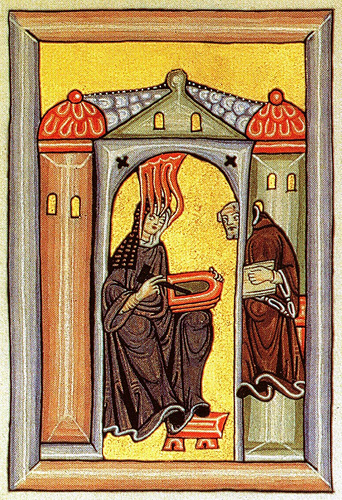
Fig. 1. Vision of the cosmos (‘The World Egg’). Miniature from Hildegard von Bingen’s Liber Scivias (Rupertsberg Codex), created ca. 1165–1175. Formerly Wiesbaden, Hessian State Library, Ms. 1, fol. 14r (lost, here according to the 1927 facsimile).
In view of the novelty of her visions, Hildegard sought spiritual support: she turned to Bernard of Clairvaux, whose encouraging, albeit cautionary, letter she made public. Bernard’s positive assessment contributed to Hildegard’s reputation. At the same time, there is evidence of an apostolic or synodal review and approval of her writings by Pope Eugene III in 1147/48, which allowed her to continue her publishing work. These confirmations played an important role because they legitimised Hildegard’s claim to public authority and teaching in the 12th century11.
It is known that Hildegard worked with secretaries such as Volmar. Researchers assume that she did not write her visions into a final continuous text by hand. Modern researchers (e.g., Margot Fassler) believe that Hildegard worked closely with Volmar in a collaborative writing process: she received visions, dictated them, and Volmar and other transcribers helped with the writing and editing12. The fact that her visionary texts later appeared as manuscripts with illustrations suggests that this dictation and editing process was part of a conscious media-supported design13. The frontispiece (Fig. 1) of the Rupertsberg Codex allows us to draw conclusions about the close collaboration between Hildegard as a visionary medium, the scriptorium as a translator of the text, and the wax tablet in her hands as a threshold between the experienced and the written: the author is depicted seated with a wax tablet in her hand, writing something with a quill. The person looking through the archway on the right could be Volmar or another representative working on the same codex, which is depicted in an almost performative manner on this frontispiece. However, if Volmar wrote the texts for the codex, one might wonder why Hildegard – and not him – is depicted as the main figure on the frontispiece. Research has emphasised the importance of their cooperation both for the creation of the text and for its linguistic form14. The process between experiencing, dictating and writing down was therefore collaborative, but not automatically anonymous: Hildegard explicitly claimed authorship of the content of the visions and intervened in the textual disposition15. Although she did not carry out the entire writing process herself, she is nevertheless the author and director of her own visions, and her circle of colleagues appreciate this unique position. With her visions, which she experiences as her ‘ego’ and which are expressed in the first person, Hildegard creates a prophetic first-person role: she refers to divine tradition, formulates direct speeches of God, and constructs a theological first-person authority from them.
And it is for this reason that Hildegard is depicted in the frontispiece not only as the main character, but also in the prophetic tradition, as emerged from a centuries-old tradition of evangelist images, seen, for example, in the Lorscher Evangeliar by Karl the Great in the early 9th century. The fact that she is also provided with the writing medium of a tablet and a pen only underlines her role as the author. Ultimately, we must understand this collaborative work today less as censorship than as a common drafting and writing process that can be assumed to have been commonplace, regardless of Hildegard von Bingen being a female writer.
Two authors, Madeline Caviness and Nathaniel M. Campbell, go one step further and link the autobiographical visions with the miniatures in the Rupertsberg Codex: Madeline H. Caviness argues that Hildegard was not only linguistically active when dictating her visions, but may also have been drawing at the same time: in the frontispiece of the Scivias manuscripts, she is depicted sketching on a wax tablet while dictating to Volmar. Caviness suggests that spontaneous sketches, in the sense of rough outlines of her visions, were later elaborated by workshops16. The double meaning of the word scriber, which Hildegard uses, could indicate her role not only as an author but also as an illustrator, according to Caviness17. Nathaniel M. Campbell expands on this interpretation in his essay Imago expandit splendorem suum by showing that Hildegard played an active theological role in the design of the miniatures in the Rupertsberg Scivias: The images are not mere decoration, but, rather, an independent theological discourse closely interwoven with the vision text, so that Hildegard could have given specific design instructions to convey the vision theology in a pictorial form18.
Rupertsberg Codex (Scivias Manuscript) and the Relationship between Image and Text
Regarding the creation of the illuminated Scivias Codex (also known as the Rupertsberg Codex), there is broad consensus among researchers that the manuscript was created during Hildegard’s lifetime at the Rupertsberg Monastery and was used there19. Recent research confirms the existence of an active scriptorium at Rupertsberg during Hildegard’s lifetime20. Palaeographic and codicological studies show the involvement of several scribes, uniform styles in the page layout, rubrication and indexing, as well as recurring types of miniatures, thereby suggesting institutionalised book production at the monastery21. The close correspondence between the text and the image in the Scivias manuscript also points to a coordinated workshop mode in which text editing and image design were planned jointly and presumably in close collaboration with Hildegard von Bingen.
Hildegard von Bingen’s copyright claim can also be examined in terms of the stylistic nature of the written text with regard to ego-documentary aspects. Hildegard consistently reports her visions in the first person (“I saw”, she describes what she saw, and what she heard). The formal prerequisite of the ‘I’ as a textual location thus becomes clear here as a narrative scheme. This is particularly noteworthy, as research is aware of editorial intervention by male figures. Hildegard’s decision to leave the visions in the first-person perspective is therefore a literary commitment by the male editors to consciously make Hildegard, as the recipient of the visions, poetologically tangible22. Scivias can thus also be described as an autofictional text, as Hildegard narratively shapes her own person as a visionary subject, and, at the same time, legitimises her theologically. Autofiction here does not mean invention in the modern literary sense, but rather the self-construction of a character, ‘Hildegard’, who speaks through divine inspiration. Barbara Newman shows that Hildegard translates her visions into a first-person narrative structure which stages the author as God’s chosen one while, at the same time, conveying theological teaching. Newman speaks of a ‘crafted persona’ that deliberately serves to authorise her revelations23. Caroline Walker Bynum also points out that Hildegard uses narrative self-designs to stabilise her female authority24.
In medieval research, a certain degree of autofiction in historical documents is considered an essential part of narrative processes, including in religious works. It should therefore not be understood as opposed to egodocuments, but rather as an integral part of them. In Hildegard’s case, egodocuments (e.g., visions, letters, autobiographies) are not neutral records, but rather self-constructions, primarily due to their editorial preparation25. Central to this investigation is therefore the fact that Hildegard not only reports her visions, but also performs them as a literary persona: the Hildegard who speaks in Scivias is a theologically constructed self, not merely a documented one. The text thus fulfils the central characteristics of pre-modern autofiction: self-narration, self-interpretation and self-stylisation in the field of tension between experience and poetic-theological design26. An important aspect that supports this thesis is the transfer of the visions into what was then the most precious artistic medium: the illuminated book. Creating a manuscript as magnificent as the Rupertsberg Codex required extremely valuable resources such as calfskin from up to 100 animals, expensive colour pigments, as well as skilled scribes and painters to illuminate the text and images. This conglomerate of actors shows how Hildegard constructed her visionary self as a medium of divine truth.
With this insight in mind, we will now examine the question of the extent to which, in addition to the steps of: a) visionary experience, b) dictation, c) writing and d) editing, e) translation into images, it is also an integral part of ego-documentary staging and experience. We have established so far that the revision and editing of texts served the medieval tradition of text production. Nevertheless, the ego remains documentable in the text. But can Hildegard’s intimate experience of the visions also be conveyed through a visual medium? To what extent do the miniatures contribute to the staging and construction of Hildegard’s ‘self’? Can we understand the process of translating text into images in a similar way to ego-documentary, as the translation of directly seen visions into written text suggests?
Before the execution of the most famous miniature on the third vision of the cosmos can be analysed, the relationship between image and text must be briefly discussed. First, let us look at the structure of the visions, which follows a strict system. As Lieselotte E. Saurma-Jeltsch notes: “With the exception of the 13th vision in the third book, each vision is largely structured according to the same pattern: in the first section, the vision, what Hildegard saw, is conveyed. In the following audition, the divine voice then interprets each image one by one”27. There are therefore two essential forms: WHAT was seen, and HOW it is understood. Furthermore, Saurma-Jeltsch attributes a very close relationship between the miniatures and the text28. This means that, in contrast to exemplary illustrations, which are loosely attached to the text and merely added for viewing, in the Rupertsberg Codex, the miniatures are very precisely derived from the content of the vision in the first step. In the second step, however, the illuminations unfold an independent visual exegesis, according to Caviness. This means that they expand, interpret or comment on the vision text visually. Similar to the textual structure of each vision, the miniatures are also divided into two aspects: firstly, they show what Hildegard saw, and secondly, they interpret on a genuinely visual level how what was seen is to be understood, but often go beyond the text. In my opinion, the structural relationship between the text and the image structure is an indication of the visual translation of Hildegard’s staging of her prophetic self: the Scivias images repeatedly not only reproduce what was seen, but also visually represent the visionary experience, prophetic voice and theological argumentation. In other words, they create a visual ‘self-presence’ similar to the first-person presence of the text. Only in the interaction of both levels does the entire ego-documentary dimension of the codex unfold.
The visual aspect that characterises a divine vision is particularly important when interpreting miniatures as ego-documentary media. Medieval visionaries described their experiences not as physical seeing, but as spiritual seeing which takes place in waking consciousness. The theoretical basis for this is provided by Augustine, who distinguishes between physical perception (visio corporalis), imaginative perception (visio spiritalis) and purely spiritual insight (visio intellectualis)29. Building on this tradition, 12th-century visionaries emphasise that their revelations belong to the third category. Hildegard von Bingen explains in the prologue to Scivias that she receives her visions “in vigilia, non in somno” – i.e., in a waking state, not in sleep – and that what she sees is given to her “in mente, non in phantasia”30. Visions were understood as multimodal revelations: a simultaneous “seeing, hearing and understanding”, as Madeline Caviness elaborates for Hildegard31. Thus, visions appear as theologically framed processes of knowledge in which the inner eye of the soul receives and interprets images, words and meanings simultaneously.
If visions are not expressed through optical seeing, then they are expressed through spiritual seeing, seeing in the mind. Thus, Saurma-Jeltsch also titles Hildegard’s frontispiece “The Seer”32. The visions experienced by Hildegard are also described in extremely vivid terms in the texts and are accompanied by associations, as we shall see. We can assume that Hildegard receives the vision primarily as an image and secondarily as sound through spiritual vision. This visionary experience must be translated into a text form, where what is seen is described linguistically. This text form can then serve as a basis for further translation, ultimately into an image as a painting. Another possibility is that painters were already present during the dictation of her vision in order to hear what was said directly for further processing. Ultimately, Caviness’s thesis is cited here once again, namely, that Hildegard may have made sketches herself, which were then executed by painters33. Either way, the mental image of a vision does not correspond explicitly to the product of the miniature, but these processes of translation make it clear that all textual and pictorial media are intertwined and at the same time originate from the original vision that Hildegard experienced as ‘I’. The principle of autofiction can ultimately be applied to the miniatures: they process the visionary experience as a subjective experience and use it to form a visual narrative that is also theologically instructive. They are thus ‘visual autofiction’ as staged subjectivity in colour and form.
Analysis of the Cosmos, 3rd. Vision in Liber Scivias
In the following section, the ego-documentary level of miniatures will be discussed by way of example. For this analysis, I would like to focus on the third vision, “God, Cosmos and Humanity”. The miniature presents the universe as a concentrically structured ‘cosmic egg’ (Fig. 2). At its centre is an almond-shaped, organic-looking form surrounded by several clearly delineated zones of colour. An outer ring of golden fire marks the divine sphere and forms the dynamic shell of the image. It consists of flame-like tongues that move regularly outwards and inwards, visualising God’s creative energy. This is followed by a dark, membrane-like ring that appears as a boundary between the divine fire and the cosmic order. Further inside is a blue zone sprinkled with stars, symbolising the heavenly realm or the sphere of the stars. Within this heavenly layer are further colour zones in red, blue, and gold, which, in their layering and symmetry, structure the cosmos and evoke a divinely ordered world architecture. In the centre is a ‘sandy’ sphere. Here, Hildegard saw “between the north and the east something like a very large mountain, which cast much shadow to the north and much light to the east” (lines 100–103, translated by J. K.). This innermost part is understood as the globe.
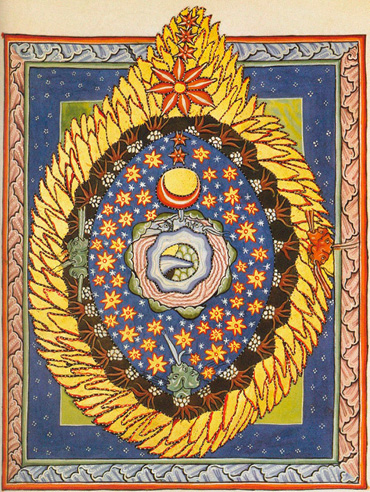
Fig. 2. Hildegard receives divine inspiration and dictates to Provost Volmar. Frontispiece from the Liber Scivias by Hildegard von Bingen (Rupertsberg Codex), created ca. 1165–1175. Formerly Wiesbaden, Hessian State Library, Ms. 1, fol. 1r (lost, shown here according to the 1927 facsimile)
Three artistic decisions are particularly striking. First, to design the cosmos not as round, but as egg-shaped. Secondly, to suggest the cosmos as symmetrical, but to evoke asymmetry in the upper section, as the tip of the flame network is slightly tilted to the right. And thirdly, the oversizing of the cosmos, where the tips of the flames extend beyond the decorative frieze. In the research literature, this is often referred to as a world egg. Saruma-Jeltsch states: “Hildegard’s view of the world egg <...> is part of a long tradition of cosmological ideas that originated in antiquity. As a symbol of the cosmos, the egg shape was then incorporated into medieval literature”34. With this insight, it can first be established that no classical geometric mandorla was used for the shape of the cosmos. The mandorla is one of the central forms of medieval visual art, and it functions as a visual marker of the sacred. In art history, it can be traced back to late antique and early Christian pictorial traditions, in which an almond-shaped aura serves to highlight Christ or other transcendent figures from the earthly sphere. In its function, the mandorla combines iconographic and theological meanings. Formally, it can be understood as an intermediate space that separates the earthly from the heavenly, but at the same time opens a threshold through which the divine can become visible35. On closer inspection, the vision of the cosmos in the Rupertsberg Codex takes on an ambivalent form. To understand this ambivalence, we must refer to the text of the vision and its pictorial description:
“Then I saw a huge structure, round and shadowy. It tapered like an egg
at the top, becoming wider in the centre and narrower again towards the bottom. Its outermost
Layer all around was light fire. Beneath it lay a dark skin. [...] Under the dark
Skin flooded with the purest ether. [...] Below the ether I saw hazy air and
A white skin underneath. The vapour flooded back and forth and supplied the whole structure
with moisture. Sometimes it would suddenly clench. Then he would let out
violently rushing downpours.” (Hildegard von Bingen 1963, 109–110, translated by J. K.)
In summary, the inner spheres are shaped like an egg. The outermost sphere of fire, however, forms points at the top and at the bottom. While Hildegard’s text itself refers to an egg, in line with ancient conceptions of the cosmos as an egg in this type of representation, this does not explain the pointed shape of the sphere of fire and the asymmetry caused by the point tilted to the right. A comparison of the text and image reveals a further association that could explain the artistic peculiarity. The text, which focuses heavily on physical imagery (skin, membrane, moisture, contraction), aims to describe the female genitals, specifically, the vulva. According to this interpretation, the sphere of fire would be the outer labia, the planetary sphere, ergo “the dark skin” would be the inner labia. The lunar sphere, shown here as a yellow sphere with a crescent moon, would be the clitoris, and, most significantly, the white sand sphere, understood as the Earth, lying in the centre would be the birth canal. So there, where the cosmos unfolds the world through its creative power, lies the Earth at the centre. In this miniature, we see her being born from the birth canal, from the cosmic vagina. Moisture, a biological property of the vagina as a whole in the form of secretions, and a downpour, perhaps in the sense of menstruation, describe the nature of the cosmos. The intermittent clenching could be understood as a birth contraction.
Several scholars have already made this connection between Hildegard’s cosmos and the birth organ. The extremely carnal description of the cosmos, the egg-shaped structure, the zones that look “like a shaded skin”, moisture, etc. are laid out in the vision text and have been interpreted by Saurma-Jeltsch as physical descriptions36. Joanna Godlewicz-Adamiec and Paweł Piszczatowski state even more clearly:
“The cosmos is described by the seer in archaic egg-shaped terms. In addition to echoes of the morphological aspects of a chicken egg, the Rupertsberg cosmos miniature shows far more than other depictions the symbolic reference to the human vulva, the female sex. <...> The arrangement of the sun as a ‘reddish sparkling fireball, so large that the entire structure received its light from it’ in the upper third of this cosmos is easily recognisable as the anatomical location of the clitoris. The theology of the incarnation of God <...> is based in Hildegard’s vision on the experience of female sexuality, as Scivias texts show. In them, the visionary uses emotional and physiological aspects of female sexuality as cosmic ciphers <...> – allusions to orgasms and menstruation.”37 (Translated by J. K.)
For the first time, however, this knowledge is described in female-genital language – and by a female mystic who also wrote treatises on medicine, gynaecology and sexuality. Minji Lee analyses Hildegard’s knowledge she writes about in her book Causae et Cure of female reproductive organs in detail, including her descriptions of menstruation, conception and sexual desire38. It is therefore indisputable that Hildegard had relevant anatomical and medical knowledge of female reproductive organs. In view of the genital description of the cosmos in the text and the image, it stands to reason that Hildegard could have used this knowledge to describe cosmic forces. In my opinion, it is therefore not unreasonable to assume that Hildegard’s personal visions which also evoke the confrontation with the female self as an intrinsic experience. At this point, we must ask ourselves about the motives for describing the cosmos as a vulva or a vagina in its reproductive function. Just as the cosmos is the God-created origin of life from which every organism springs, so the vagina as the entire reproductive and, above all, birthing organ is the origin of the life of mammals, ergo humans. The clear correlation between the description of the cosmos and the miniature also points to this female-connoted definition of the cosmos as the ultimate place of fertility. Every life that exists is born out of the cosmos, just like out of the vagina. The cosmos is a womb that conceives, protects and gives birth. However, this cosmological and physical correlation also results from the impossibility of translating highly personal, divine visions that are received spiritually into earthly forms of expression. Textual and visual languages reach their limits here, as they have to translate metaphysical, mystical experiences into a profane, tangible expression. Describing the cosmos in female terms, as a condition of life and becoming, seems only logical here. Finally, let us return to the special form between egg and mandorla. The egg is one of the oldest and most widespread symbols of fertility in human history. Its symbolic meaning derives from its form and function: as the protected origin of new life, the egg has been understood in many cultures since the Neolithic period as a metaphor for cosmic, biological, and spiritual fertility. The egg appears particularly prominently in the ancient world: for the Greeks and Romans, it was associated with the idea of a world egg from which creation emerged39. The mandorla, on the other hand, is an intermediate space between the earthly and the heavenly, a threshold and opening that separates and yet unites the dimensions. Both pictorial traditions can thus be associated with the vulva: organically, it is the site of fertility, the origin of life. Formally, however, the vulva is also a threshold between the body and the world from which this life emerges: physically, through birth40.
Comparing the cosmos miniature with the other texts and images in the Rupertsberg Codex, one often recognises similar feminine, identity-forming topoi, such as maternal and bridal metaphors, which have a clear gender expression and convey this to the recipient. One might assume that pictorial motifs such as fertility and motherhood imagery are female body analogies, as are depictions of the Ecclesia as a female figure. In this way, Hildegard von Bingen’s own gender, the feminine, would be incorporated as a self-representation, amplifying the miniatures as a ‘female voice’ in writing and image. Caviness has followed this assumption, while discussing the extent to which certain pictorial motifs in Scivias visually implement gender metaphors. For Caviness, a key motif is gender-specific symbolism: many pictorial forms and compositions correspond to female metaphors or to the role of the Ecclesia or the Church41.
Nevertheless, we must be careful to attribute a genital, feminine language for visions per se only to female authors. As mentioned above, Bernard of Clairvaux was a supporter of Hildegard of Bingen. He is also attributed to the early mysticism, and this is not per se only practised by women. Of particular interest is the turn to ‘maternal language’ or ‘imagery’ in the 12th century in the Cistercian circle and with the rise of mysticism. Clairvaux described Jesus as a mother in various sermons and letters. For him, it was not the aspect of the mother as giving birth that was important, but the female breast. Leaning on Jesus’ breast and drinking from it was seen as a symbol of giving life, comfort and protection. To Bernard, breasts are a symbol of pouring oneself out towards others, of loving unconditionally and nurturing, as Jesus did42. It will be of interest that, in medieval devotions such as the Sacred Heart, milk and blood are often interchangeable, as are Christ’s breasts and the wound in his side43. Guerric, Abbot of Igny, who was – like Hildegard – also a pupil of Bernard of Clairvaux, develops a different maternal imagery. Guerric is fascinated by images of pregnancy and of the womb44. To Guerric, the maternity of Jesus that is associated with the womb is a symbol of fertility. It can be assumed that Hildegard of Bingen and Guerric of Igny knew each other in the circle of Bernard of Clairvaux, and that this is where the mystical language as genital language began.
The tension between Hildegard’s female-connoted imagery and language and the simultaneously demonstrable use of similar gender-charged metaphors by male clerics of the 12th century shows that gender symbolism in mystical discourse was less tied to biological gender identity than it may appear in modern terms. It is tempting to understand the organic, bodily forms of the cosmos miniature or Hildegard’s metaphorical speech about giving birth, nourishing and conceiving as an expression of a ‘female’ self-relationship and thus to identify a gender-specific voice (female voice) in the text and image. Researchers such as Madeline Caviness have reinforced this perspective by showing how Hildegard translates female bodily imagery – such as motherhood, fertility, wound or body rhetoric – into theological imagery.
At the same time, however, the male mystical tradition invalidates this assumption: authors such as Bernard of Clairvaux and Guerric of Igny made extensive use of maternal, birth- and breast-related metaphors to describe Christ. Bernard speaks of Christ as a mother whose breast provides comfort, nourishment and divine love; whereas, Guerric even develops a symbolism of pregnancy and the divine ‘womb’. This imagery, formulated long before Hildegard and received by her, shows that gender-connoted bodily imagery in the 12th century was not primarily a question of personal gender identity, but rather an expression of a broader theological paradigm: the search for suitable, affective, body-related images to describe the closeness, devotion and interpenetration between God and man.
The interplay between Hildegard’s visionary language and fluid gender imagery can be conclusively integrated into the concept of the egodocument, considering that medieval self-testimonies do not describe autobiographical identity in the modern sense, but rather the inner self-positioning before God, who is the union of female and male at the same time. In Scivias, Hildegard’s ‘I’ does not arise from biographical details, but, instead, from the disclosure of her inner experience: she describes her bodily sensations, her calling, her fear and her being overwhelmed in the face of the divine. The gender-coded images she uses, like the entire mystical tradition, are therefore not a direct reflection of her biological sex, but symbolic tools for translating her personal experience of God as the Union of gender into culturally understandable forms45. It is precisely this symbolic flexibility that enables her to make the invisible visible and to communicate her innermost feelings. In this sense, Scivias functions as a genuine egodocument: a text in which an individual self is brought forth through visionary experience, metaphorical self-interpretation, and gendered to sexual imagery.
14th Century Books of Hours
A more complex case of interpreting miniatures with sexual imagery as ego-documentary are the depictions of Christ’s side wounds in prayer books and books of hours, which became increasingly common from the 14th century onwards. In the 14th century, a new, highly emotional form of imagery became established in book illumination: the isolated, full-page depiction of Christ’s side wound46. While earlier depictions – such as Christ on the cross with a visible wound or the scene of ‘doubting Thomas’ reaching into the wound – embedded the side wound in narrative contexts, it is now increasingly presented as an autonomous devotional image. This development can be explained by the growing affective piety of the late Middle Ages, which intensively emphasised physical closeness, compassion and empathy with the suffering of Christ47. Such isolated depictions of wounds appear particularly frequently in books for private devotion, especially in books of hours. The wound is depicted as almond-shaped, sometimes clearly vulvar: a form that refers to both the physical access to divine love and symbolically charges the connection between wound, heart and birth48.
It can be assumed that these visual images are related to texts of female mysticism from the 14th century. Their visionary texts emphasise a strongly physical, emotionally intense relationship with Christ, in which his wound appears as a place of comfort, fusion and divine love. Mechthild of Magdeburg, for example, repeatedly speaks of the ‘healing wound’ (woundes / wounde) of Christ. She explicitly calls the wound a remedy for the soul49. In her book The Flowing Light of Divinity, Mechthild describes Christ’s wound as the birthplace, but also the retreat of the soul (p. 160, III, 2, 24–11): “There stood open both his wounds and his breasts; the wounds poured, the breasts flowed, so that the soul was alive and completely healed when he poured the bright red wine into her red mouth”50.
The isolated depiction of Christ’s side wound, now rendered as an image in the manuscripts, enables precisely this form of affective immersion: it acts as a meditative portal which focuses the gaze, heightens emotions and creates an intimate, almost synaesthetic closeness to the suffering Christ. Thus, in the 14th century, the wound in his side became a central visual symbol of female devotion: a place of spiritual encounter that embodies vulnerability, love and divine permeability51.
Above all, the protective idea that the soul could hide in it leads modern scholars to assume that the wound can be understood as a vulva in which the soul finds rapture. Both male and female mystics repeatedly play a role in the generation of erotically connoted images of wounds. In particular, the pursuit of the Unio Mystica (union of the soul with God or Jesus) is described in the form of sexual encounters using the stylistic means of sexual intercourse52. Lochrie also demonstrates how the metaphor “vulnus / vulva” was deliberately used in mystical literature and visual art to express an erotic dimension of the Passion: “The ‘copulation’ of the mystical soul with Christ thus occurs at the site of his wound (vulnus), which is transformed into the female vulva when vulnus vulneri copulatur, ‘wound is joined to wound.’ The key to the idea of the joining of wounds is that the lover’s soul becomes wounded with love, and this wounding in turn allows him to join in Christ’s suffering.”53
I would now like to explain the extent to which the depictions of Christ’s wounds and their vulvar symbolism play a role. Experiential mysticism and its realisation in ego-documentary texts and writings, which incidentally also served as a way to pass on to their sisters, reached a sexual climax here. Numerous texts of this kind have survived, but none with illuminations. Presumably, erotic explicitness was tolerated as an abstract text form, but not as the obvious addition of a clearly erotic image. For this reason, I would like to refer to another phenomenon that is, however, connected with erotic mysticism: the Books of Hours and their intimate illuminations. In the 14th century, Books of Hours were increasingly produced for noble women. They are close to the experiences of female mystics, as devotion, the Eucharist and deep meditation take centre stage here. Books of hours are often for private use. They contain rich paintings and often show the stigmata of Christ (without his body) as supposedly true to scale in full-page miniatures. This is striking because the wound, which was previously always depicted with Christ’s whole human form and horizontally, is suddenly isolated and positioned vertically, and the choice of colour and shape is strongly reminiscent of a vulva54. Let us consider a few examples.
Let us take the Book of Hours, commissioned by Bonne de Luxembourg. The miniature of Christ’s side wound in the Prayer Book of Bonne of Luxembourg shows the wound isolated from the rest of the body and centred in the image field, aligned vertically and covering almost the entire height of the page (Fig. 3). The wound itself is dark brown and shaded, creating a plastic three-dimensionality, while the surrounding flesh is modelled in shades of red and lighter shades, emphasising the depth and materiality of the tissue. The background is bright blue and decorated with golden ornaments, highlighting the wound as a sacred focus. The absence of the rest of the body underlines the autonomous significance of the wound as an object of devotion, while the Arma Christi, such as the lance, cross and spear, are discreetly grouped around the wound. These tools refer to the Passion, frame the wound and mark it as a sacred opening between life, death and salvation.
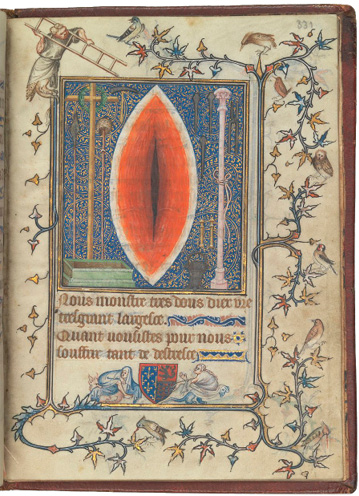
Fig. 3. Jean Le Noir (attributed): The wound in Christ’s side. Miniature from the Psalter and Book of Hours of Bonne de Luxembourg, Paris, before 1349. New York, The Metropolitan Museum of Art, The Cloisters Collection, Inv. 69.86, fol. 331r.
The similarity between the side wound and the vulva can be interpreted on several levels. Firstly, the wound represents an injury to Jesus’ body, which not only evokes his death, but also gives the meditator access to his heart. Through this immersion in the holy body, an experience similar to the unio mystica (union of the soul) takes place. The miniature shows how narrative depictions of the Passion are transformed into an independent, physical and emotional instrument of devotion through visual concentration on the wound. This depiction combines visual exegesis, symbolic condensation and emotional intimacy, allowing Christ to be experienced both as a suffering human being and as a source of life and salvation. The image of the womb as a protective and living space is also evident here. What the cosmos as fertility was for Hildegard von Bingen is here the body of Jesus: in Jesus, there is life, through him, all will experience eternal life. By allowing the wound to enter the body, believers return to the place/cosmos from which they were created.
The wound/vulva can also be seen as a source of life. The shape of the wound is that of a mandorla, which can be interpreted repeatedly as a threshold between the outside and the inside, the mandorla, traditionally a symbol of holiness, is transferred to the wound and opens up a conception of Christ as access to grace and salvation. At the same time, the vulvar shape evokes associations with birth, fertility and mystical fusion. Alongside the symbolism of birth from the divine or from the vagina, the blood becomes a carrier of meaning. In the Eucharist, the blood of Jesus is symbolically consumed as wine. In mystical language, Jesus’ blood is deeply anchored as life-giving. Some miniatures show profusely bleeding wounds, with the blood being imbibed by the faithful in order to be spiritually nourished by Jesus. Vulva and breast and their life-giving properties now become female properties on the male body of Jesus. Like a slipped vulva that appears parallel to Jesus’ biological sex, he embodies father and mother, rule and nurture, at the same time. As the Son of God, Jesus is thus the maximum source of life and is to be understood as a cosmos in his own right55.
A further correlation between a wound and a vulva is created by the momentum of penetration. Jesus’ body is pierced in several ways during the Passion. First, there are the lashes of the whip on the pillar of the Passion. Then, the violent nailing of the body to the cross with nails and a hammer. There is the crown of thorns which pierces his head. Then, of course, the spear gets thrust into his side. Finally, there is the insertion of the sponge soaked in vinegar into his mouth. All these Arma Christi are gathered here around the side wound in the Book of Hours of Bonne de Luxembourg. For her, however, the spear is the most significant: not only does it cause that immense wound: “The Holy Lance marked the culmination and climax”56. As we look into the wound of Christ himself, our gaze turns to the spear. We penetrate visually. The image directs the gaze directly to the opening, thus creating an intimate, physically experiential space for devotion and enabling concentrated meditation on the suffering of Christ.
The symbolism of the sword and the spear as a penis is widespread in the Middle Ages, for example, in secular literature (Romance of the Rose), but also in mystical texts. In a work called Stimulus Amoris (“Sting of Love”), which was widespread in Europe, the side wound is not understood as a birth opening, but as a vulva into which the author wants to sink himself and his “holy lance”. The author was probably a Franciscan named James of Milan in the 13th century. The miniatures in the Books of Hours clearly show that the viewer’s gaze also becomes a phallic moment in which we are invited to look very closely and deeply into the wound/vulva. Seen medially, the colour becomes bodily fluid, and the parchment of the page (animal skin) becomes the body. Painting, writing and viewing become processes of compassio itself. Volker Schier and Corine Schleif also discuss this connection, while noting that, in songs and images, the lance was interpreted as ‘phallic’, with clear sexual symbolism, associated with the wound as a female opening. The historical texts cited there speak of the “triumphant sword entering the living breast” and “fertile blood” flowing through the wound. The iconographic combination of wound and lance serves not only as a reminder of the Passion, but also as a conscious visual and liturgical strategy in which the wound functions as an erotic and spiritual symbol of opening and transformation: the book as a medium itself becomes part of the physical event: the parchment, one could say metaphorically, takes on the skin of Christ57.
This isolated, monumental wound becomes a meditative portal that enables closeness, comfort and personal identification. Images, such as folio 331r of the prayer book, allow viewers to experience an immediate, physically tangible closeness to Christ, which reinforces both the spiritual and the emotional dimensions of devotion. They represent a medial space, in which, spirituality, identification and physicality merge, and the wound appears as a mediating opening between the human and the divine realms.
The isolated depictions of Christ’s side wound that emerged in the 14th century can be understood as a special form of ego-documentary testimony, not in the classical sense of texts that explicitly formulate personal experience, but as visual self-revelations of the patrons. Books of hours, in which these vulval-looking wound images appear disproportionately frequently, were mostly used in private settings, and were commissioned individually. Even though their texts are predominantly standardized, the miniatures create an intimate visual zone in which the personal piety, desires and spiritual needs of the users become visible.
The wound on the side functions as a concentrated opening which directs the gaze to a single, physically charged inner field. In this way, it resembles visionary diagrams in which mystical perception is also focused on a central, physical-spiritual opening. This visual narrowing allows for contemplative immersion that physically affects the viewer and binds them emotionally. In this sense, the images become carriers of inner experience: they do not document the inner world of the illuminators, but rather the spiritual expectations of those who commissioned them.
At the same time, the pictorial forms tie in with theological traditions that interpret the wound in the side as the birth opening of the Church or as access to the heart of Christ. By stylising the wound as vulval, it merges with a female semantics of giving birth, nourishing and receiving – motifs that were central to late medieval mysticism, especially among women. Christ thus appears as both a male and a maternal figure, as a gender-flexible subject of salvation whose body offers believers space for affective identification.
The wound in his side thus becomes a medium of devotional self-reference: an image that captures the desire for touch, closeness and union with God, uniquely reflecting the inner piety of the patrons, their longing for sensually experienceable transcendence, in an ego-documentary manner.
Conclusion
The mystical texts of the 12th to 14th centuries reflect an intense engagement with the self and suggest that forms of subjectivity were already emerging within medieval religious experience. In Christian mysticism, especially in the writings of Hildegard von Bingen and Mechthild of Magdeburg, the divine is expressed through highly personal and gendered imagery. Visions of the cosmos as a female reproductive organ exemplify how spiritual experience was articulated through embodied, female metaphors: motifs that reappear in the visual culture of the 13th and 14th centuries, particularly in books of hours.
Hildegard von Bingen’s Liber Scivias can be read as an egodocument in which individual visionary experience, theological intention and the author’s authority are equally materialised and staged. The text in the first person and the richly illuminated miniatures illustrate Hildegard’s active self-presence: She not only appears as the recipient of divine visions, but also stages them medially by apparently setting content and design guidelines for the pictorial programme. Cosmic visions are charged both textually and visually with female metaphors with genital connotations that reflect fertility, creative power and the genuinely female perspective. Hildegard’s knowledge of female anatomy and sexuality allows for a precise articulation of these metaphors, while at the same time it becomes clear that in the medieval context, female symbolism is highly effective in divine contexts, since God is conceived as a united male-female entity.
The miniatures in late medieval Books of Hours can be understood in a similar way: based on mystical texts and the Unio Mystica, they visualize isolated wounds of Christ and transform them into immersive objects of devotion. The wounds are often read as vulvar, serving as a birth opening for souls and the Church, as a place of retreat and protection for the faithful. These representations allow for a physical-affective identification in which the viewers – mostly women – experience access to divine closeness, comfort and healing through the contemplation of the wound.
The combination of a textual template, iconographic implementation and specific commission of the wound depictions provides insights into the piety and sensual, somatically influenced need for meditation and salvation of the female patrons. Both Liber Scivias and the Books of Hours show that medieval mysticism and visualization are closely interwoven: they articulate the self in the first person, allow for introspective contemplation, and embody the experience of divine intimacy. In this interlocking of text, image, and materiality, the individual relationship with God is not only reflected, but can also be experienced performatively, with erotic or sexual metaphors serving primarily as a means of spiritual communication. Simone Weil’s observation that mystical love for God must be understood analogously to the material means of painting sums this up: the representation of female and genital imagery serves not erotic gratification, but the symbolic communication of piety, belonging and transcendence.
I would like to end with the following quote from Simone Weil:
“To accuse mystics of loving God with the power of sexual love is like accusing a painter of painting pictures with colours made of material substances. We have nothing else with which we can love.” 58 (Translated by J. K.)
Bibliography
1. AUGUSTINUS. De Genesi ad litteram. In: Aurelii Augustini Opera. Pars XI. Ed. Joseph Zycha. Wien: F. Tempsky; Leipzig: G. Freytag, 1894, p. 361–402. (Corpus Scriptorum Ecclesiasticorum Latinorum, vol. 28, pars 1).
2. BAILEY, Michael F. “More Catholic than Rome“: Art and Lay Spirituality at Venice’s Scuola di S. Fantin, 1562–1605. Renaissance Quarterly, 2011, vol. 22, no. 2, p. 55–56. https://doi.org/10.33137/confrat.v22i2.17131.
3. BELTING, Hans. Bild und Kult: eine Geschichte des Bildes vor dem Zeitalter der Kunst. München: C. H. Beck, 1990. 700 p. ISBN 978-3-406-37768-6.
4. BENTON, John F. Culture, Power and Personality in Medieval France. Ed. Thomas N. Bisson. London; Rio Grande: Hambledon Press, 1991. 519 p. ISBN 1-85285-030-2.
5. BEZZEL, Anne. Leibhaftige Frömmigkeit: die Verehrung der Seitenwunde Christi als Schnittfläche und Fluchtpunkt spätmittelalterlicher Frömmigkeitsphänomene. Tübingen: Mohr Siebeck, 2023. XIV, 418 p., [14] p. ISBN 978-3-16-162197-0.
6. BYNUM, Caroline Walker. Holy Feast and Holy Fast: The Religious Significance of Food to Medieval Women. Berkeley; Los Angeles: London: University of California Press, 1987. XVII, 444 p. ISBN 978-0520063297.
7. BYNUM, Caroline Walker. Jesus as Mother: Studies in the Spirituality of the High Middle Ages. Berkeley: University of California Press, 1982. x, 279 p. ISBN 978-0-520-05222-2.
8. BYNUM, Caroline Walker. Wonderful Blood: Theology and Practice in Late Medieval Northern Germany and Beyond. Philadelphia: University of Pennsylvania Press, 2007. xviii, 402 p., [16] ill. ISBN 978-0-8122-3985-0.
9. CAMPBELL, Nathaniel M. Imago expandit splendorem suum: Hildegard of Bingen’s Visio-Theological Designs in the Rupertsberg Scivias Manuscript. Eikón / Imago, 2013, vol. 2, no. 2, p. 1–68. DOI: https://doi.org/10.5209/eiko.73380.
10. CAMPBELL, Nathaniel M. Picturing Hildegard of Bingen‘s Sight: Illuminating Her Visions. In: The Cambridge Companion to Hildegard of Bingen. Ed. Jennifer Bain. Cambridge: Cambridge University Press, 2021, p. 257–279. ISBN 978-1108471350.
11. CAVINESS, Madeline Harrison. Gender Symbolism and Text-Image Relationships: Hildegard of Bingen’s Scivias. In: Translation Theory and Practice in the Middle Ages. Ed. Jeanette Beer. Kalamazoo, Mich.: Medieval Institute Publications, Western Michigan University, 1997, p. 71–111. ISBN 978-1879288812.
12. CAVINESS, Madeline Harrison. To See, Hear, and Know All at Once. In: Voice of the Living Light: Hildegard of Bingen and Her World. Ed. Barbara Newman. Berkeley; Los Angeles; London: University of California Press, 1998, p. 110–124. ISBN 978-0-520-21758-4.
13. DUFFY, Eamon. Marking the Hours: English People and Their Prayers 1240–1570. New Haven; London: Yale University Press, 2006. xiv, 201 p. ISBN 978-0-300-11714-1.
14. Embach, Michael. Die Schriften Hildegards von Bingen: Studien zu ihrer Überlieferung und Rezeption im Mittelalter und in der Frühen Neuzeit. Berlin: Akademie Verlag, 2003. 595 p. ISBN 3-05-003666-4.
15. Enenkel, Karl; and Melion, Walter. Introduction: Types and Functions of Meditation in the Transition from Late Medieval to Early Modern Intellectual Culture. In: Meditatio – Refashioning the Self: Theory and Practice in Late Medieval and Early Modern Intellectual Culture. Eds. Karl Enenkel, Walter Melion. Leiden; Boston: Brill, 2011, p. 1–44. ISBN 978-90-04-19243-0.
16. FASSLER, Margot E. Cosmos, Liturgy, and the Arts in the Twelfth Century: Hildegard’s Illuminated Scivias. Philadelphia: University of Pennsylvania Press, 2022. xvii, 358 p., [16] ill. ISBN 978-1-5128-2307-3.
17. FASSLER, Margot E. Hildegard of Bingen and Her Scribes. In: The Cambridge Companion to Hildegard of Bingen. Ed. Jennifer Bain. Cambridge: Cambridge University Press, 2021, p. 280–305. ISBN 978-1108471350.
18. GODLEWICZ-ADAMIEC, Joanna; and PISZCZATOWSKI, Paweł. Transgressionen des Heiligen. Sexualität und Geschlechtlichkeit im transreligiösen Rhizom der europäischen Mystik des Mittelalters. In: Discourses on Nations and Identities. Ed. Daniel Syrovy. Berlin; Boston: Walter de Gruyter, 2021, p. 333–344. ISBN 978-3-11-064147-9.
19. HAMBURGER, Jeffrey F. Nuns as Artists: The Visual Culture of a Medieval Convent. Berkeley; Los Angeles; London: University of California Press, 1997. xxiv, 318 p. ISBN 978-0520203860.
20. HAMBURGER, Jeffrey F. The Visual and the Visionary: Art and Female Spirituality in Late Medieval Germany. Princeton: Princeton University Press; New York (N.Y.): Zone Books, 1998. 608 p. ISBN 978-0942299458.
21. HENNING, Aloys. Zur weiblichen Metaphorik des Auges als Angstchiffre. In: Europa in der frühen Neuzeit: Festschrift für Günter Mühlpfordt. Vol. 6: Mittel-, Nord- und Osteuropa. Ed. Erich Donnert. Köln; Weimar; Wien: Böhlau, 2002, p. 481–528. ISBN 3-412-14799-0.
22. Hildegard, Saint. The Letters of Hildegard of Bingen. Vol. 1. Translated by Joseph L. Baird and Radd K. Ehrman. Oxford: Oxford University Press, 1994. xiii, 227 p. ISBN: 978-0-19-508937-0.
23. Hildegardis Bingensis. Scivias. Vol. 43. Eds. Adelgundis Führkötter, Angela Carlevaris. Turnhout: Brepols, 1978. [325] p. (Corpus Christianorum: Continuatio Mediaevalis; vol. 43). ISBN 978-2-503-03431-7.
24. Hildegardis Bingensis. Scivias. Vol. 43A. Eds. Adelgundis Führkötter, Angela Carlevaris. Turnhout: Brepols, 1978. 326–917 p. (Corpus Christianorum: Continuatio Mediaevalis; vol. 43A). ISBN 978-2-503-03433-1.
25. Kerby-Fulton, Kathryn. Books Under Suspicion: Censorship and Tolerance of Revelatory Writing in Late Medieval England. Notre Dame, Ind.: University of Notre Dame Press, 2006. lii, 562 p. ISBN 0-268-03312-9.
26. LEE, Minji. The Womb in Labour: Representing the Woman’s Body as an Active Vessel in Hildegard of Bingen’s Cause et Cure. Social History of Medicine, November 2022, vol. 35, issue 4, p. 1183–1199. DOI: https://doi.org/10.1093/shm/hkac006
27. LEEMING, David A. Cosmic Egg. In: Encyclopedia of Psychology and Religion. Ed. David A. Leeming. 3rd ed. Cham: Springer, 2020, p. 523–524. ISBN 978-3-030-24347-0.
28. LOCHRIE, Karma. Mystical Acts, Queer Tendencies. In: Constructing Medieval Sexuality. Eds. Karma Lochrie, Peggy McCracken, James A. Schultz. Minneapolis; London: University of Minnesota Press, 1997, p. 180–200. ISBN 978-0816628292.
29. MARCHITIELLO Mark, Claudia. Manuscript Illumination in Metz in the Fourteenth Century: Books of Hours, Workshops, and Personal Devotion. Dissertation. Princeton University. Princeton, 1990. X, 860 p.
30. MECHTHILD von Magdeburg. Das fließende Licht der Gottheit. Nach der Einsiedler Handschrift in kritischem Vergleich mit der gesamten Überlieferung. Band I: Text. Ed. Hans Neumann. Berlin / New York: De Gruyter, 1995. XXXVIII, 342 p. ISBN 978-3484891005.
31. MECHTHILD von Magdeburg. Flowing light of the divinity. Ed. Susan Clark. New York; London: Garland Publishing, 1991. xliii, 234 p. ISBN 0-8240-7737-7.
32. MELLINKOFF, Ruth. The Horned Moses in Medieval Art and Thought. Berkeley: University of California Press, 1970. xix, 210 p., [80] ill. ISBN 978-0520017054.
33. MCGINN, Bernard. The Flowering of Mysticism: Men and Women in the New Mysticism (1200–1350). New York: Crossroad, 1998. xxiv, 426 p. ISBN 978-0-8245-1742-7.
34. MCGINN, Bernard. The Presence of God: A History of Western Christian Mysticism. Vol. 1: Foundations of Mysticism: Origins to the Fifth Century. New York: Crossroad, 1991. xxii, 494 p. ISBN 978-0824511210.
35. MCGINN, Bernard. The Presence of God: A History of Western Christian Mysticism. Vol. 2: The Growth of Mysticism: Gregory the Great Through the Twelfth Century. New York: A Crossroad Herder Book: The Crossroad Publishing Company, 1996. XV, [3], 630 p. ISBN 978-0824514501.
36. MCKENZIE, D. F. Bibliography and the Sociology of Texts. Cambridge (UK): Cambridge University Press, 1999. ix, 130 p. ISBN 0-521-64258-2.
37. NEWMAN, Barbara. Sister of Wisdom: St. Hildegard’s Theology of the Feminine. Berkeley: University of California Press, 1987. XI, 289 p. ISBN 978-0859677370.
38. NEWMAN, Barbara, ed. Voice of the Living Light: Hildegard of Bingen and Her World. Berkeley: University of California Press, 1998. ix, 278 p. ISBN 978-0520217584.
39. PAUL, Katja. Heilsbringer der Laien: Die Seitenwunde Christi als mittelalterliches Andachtsbild. Dissertation. Technische Universität Dresden. Dresden, 2023 [accessed 27 November 2025]. 208 p. Access through Internet: https://tud.qucosa.de/landing-page/?tx_dlf[id]=https%3A%2F%2Ftud.qucosa.de%2Fapi%2Fqucosa%253A86460%2Fmets.
40. Pollick, Johanna; Poore, Emily; Sexon, Sophie; and Stradal, Sara. “Your Body is Full of Wounds”: references, social contexts and uses of the wounds of Christ in Late Medieval Europe. Science Museum Group Journal, 2022, spring. DOI: https://dx.doi.org/10.15180/211503.
41. SAMSONOW, Elisabeth. Die verrutschte Vulva. Entwurf einer neuen Organtheorie. In: Körperteile: eine kulturelle Anatomie. Eds. Claudia Benthien, Christoph Wulf. Reinbek bei Hamburg: Rowohlt, 2001, p. 339–361. ISBN 978-3-499-55642-5.
42. SAURMA-JELTSCH, Lieselotte E. Die Miniaturen im “Liber Scivias“ der Hildegard von Bingen: die Wucht der Vision und die Ordnung der Bilder. Wiesbaden: Dr. Ludwig Reichert Verlag, 1998. VII, [1], 238 p. ISBN 978-3-89500-038-6.
43. SCHIER, Volker; and SCHLEIF, Corine. How Was the Geese Book Made? 2020 [accessed 27 November 2025]. 21 p. Access through Internet: https://geesebook.asu.edu/docs/How_text_2020.pdf.
44. SCHILLER, Gertrud. Ikonographie der christlichen Kunst. Vol. I: Inkarnation, Kindheit, Taufe, Versuchung, Verklärung, Wirken und Wunder Christi. Gütersloh: Gütersloher Verlagshaus G. Mohn, 1966. 235 p., 583 ill. ISBN 9783579041353.
45. SMITH, Kathryn A. Art, Identity and Devotion in Fourteenth-Century England: Three Women and Their Books of Hours. London: The British Library; Toronto: University of Toronto Press, 2003. XIX, 364 p., [8] ill. ISBN 978-0802039200.
46. SPIJKER, van’t Ineke. Homo Interior and Vita Socialis: Patristic Patterns and Twelfth-Century Reflections. Turnhout: Brepols, 2019. 209 p. ISBN 978-2503601182.
47. WIECK, Roger S. Time Sanctified: The Book of Hours in Medieval Art and Life. New York: George Braziller, 1988. 230 p. ISBN 978-0807611890.
48. WEIL, Simone. Cahiers. Vol. III, Aufzeichnungen von Februar 1942 bis Juni 1942. Eds. Elisabeth Edl, Wolfgang Matz. München: Carl Hanser Verlag, 1996. 350 p. ISBN 978-3446253735.
49. ZINK, Michel. La subjectivité littéraire: autour du siècle de saint Louis. Paris: Presses Universitaires de France, 1985. 267 p. ISBN 978-2-13-038822-7.
1 See here: BENTON, John F. Culture, Power and Personality in Medieval France. Ed. Thomas N. Bisson. London; Rio Grande: Hambledon Press, 1991, p. 354–357; SPIJKER, van’t Ineke. Homo Interior and Vita Socialis: Patristic Patterns and Twelfth-Century Reflections. Turnhout, 2019, p. 13.
2 MCGINN, Bernard. The Presence of God: A History of Western Christian Mysticism. Vol. 2: The Growth of Mysticism: Gregory the Great Through the Twelfth Century. New York, 1996, p. 345f; Enenkel, Karl; and Melion, Walter. Introduction: Types and Functions of Meditation in the Transition from Late Medieval to Early Modern Intellectual Culture. In: Meditatio – Refashioning the Self: Theory and Practice in Late Medieval and Early Modern Intellectual Culture. Eds. Karl Enenkel, Walter Melion. Leiden; Boston, 2011, p. 12.
3 MCGINN, Bernard. The Presence of God: A History of Western Christian Mysticism. Vol. 1: Foundations of Mysticism: Origins to the Fifth Century. New York, 1991; MCGINN, Bernard. The Flowering of Mysticism: Men and Women in the New Mysticism (1200–1350). New York, 1998, p. 65.
4 BAILEY, Michael F. “More Catholic than Rome“: Art and Lay Spirituality at Venice’s Scuola di S. Fantin, 1562–1605. Renaissance Quarterly, 2011, vol. 22, no. 2, p. 55–56; MCGINN, Bernard. The Flowering of Mysticism, p. 65; BYNUM, Caroline Walker. Holy Feast and Holy Fast: The Religious Significance of Food to Medieval Women. Berkeley; Los Angeles; London, 1987, p. 36f, 120f; BYNUM, Caroline Walker. Wonderful Blood: Theology and Practice in Late Medieval Northern Germany and Beyond. Philadelphia, 2007, p. 95.
5 CAVINESS, Madeline Harrison. To See, Hear, and Know All at Once. In: Voice of the Living Light: Hildegard of Bingen and Her World. Ed. Barbara Newman. Los Angeles; London, 1998, p. 114; NEWMAN, Barbara. Sister of Wisdom: St. Hildegard’s Theology of the Feminine. Berkeley, 1987, p. 31f.; FASSLER, Margot E. Hildegard of Bingen and Her Scribes. In: The Cambridge Companion to Hildegard of Bingen. Ed. Jennifer Bain. Cambridge: Cambridge University Press, 2021, p. 280–305.
6 BYNUM, Caroline Walker. Jesus as Mother: Studies in the Spirituality of the High Middle Ages. Berkeley, 1982, p. 150.
7 WIECK, Roger S. Time Sanctified: The Book of Hours in Medieval Art and Life. New York, 1988, p. 60–75, 120; SMITH, Kathryn A. Art, Identity and Devotion in Fourteenth-Century England: Three Women and Their Books of Hours. London; Toronto, 2003, p. 82–90, 105f; HAMBURGER, Jeffrey F. The Visual and the Visionary: Art and Female Spirituality in Late Medieval Germany. Princeton; New York (N.Y.), 1998, p. 145f, 180.
8 MCKENZIE, D. F. Bibliography and the Sociology of Texts. Cambridge (UK), 1999, see chapter “The Material Turn”, p. 45–68.
9 See Hildegard, Saint. The Letters of Hildegard of Bingen. Vol. 1. Translated by Joseph L. Baird and Radd K. Ehrman. Oxford, 1994, for example Letter 1r.; NEWMAN, Barbara. Sister of Wisdom.
10 SAURMA-JELTSCH, Lieselotte E. Die Miniaturen im “Liber Scivias“ der Hildegard von Bingen: die Wucht der Vision und die Ordnung der Bilder. Wiesbaden, 1998, p. 5f; NEWMAN, Barbara, ed. Voice of the Living Light: Hildegard of Bingen and Her World. Berkeley, 1998. Chapter 1: Sibyl of the Rhine, p. 1–30.
11 Hildegard, Saint. The Letters of Hildegard of Bingen, Letters 1–4; NEWMAN, Barbara. Sister of Wisdom, p. 3.
12 Hildegard, Saint. The Letters of Hildegard of Bingen, Letters 1–4; FASSLER, Margot E. Hildegard of Bingen and Her Scribes, p. 280.
13 CAVINESS, Madeline Harrison. To See, Hear, and Know All at Once, p. 110.
14 Hildegard, Saint. The Letters of Hildegard of Bingen; FASSLER, Margot E. Hildegard of Bingen and Her Scribes, Chapter 13; SAURMA-JELTSCH, Lieselotte E. Die Miniaturen im “Liber Scivias“ der Hildegard von Bingen, p. 31.
15 Ibid.
16 CAVINESS, Madeline Harrison. Gender Symbolism and Text-Image Relationships: Hildegard of Bingen’s Scivias. In: Translation Theory and Practice in the Middle Ages. Ed. Jeanette Beer. Kalamazoo, Mich.,1997, p. 87. See also: CAVINESS, Madeline Harrison. To See, Hear, and Know All at Once, p. 115: “Hildegard would have sketched the outlines of her auras, with colour annotations, at the time of their occurrence. She probably did the sketches on wax tablets. Of the kind she drew in her self-portrait at the opening of the book. She could have dictated part of the text more or less simultaneously – as she shows herself dictating to Volmar in this frontispiece.”
17 CAVINESS, Madeline Harrison. To See, Hear, and Know All at Once, p. 114.
18 CAMPBELL, Nathaniel M. Imago expandit splendorem suum: Hildegard of Bingen’s Visio-Theological Designs in the Rupertsberg Scivias Manuscript. Eikón / Imago, 2013, vol. 2, no. 2, p. 36–39, 57–61.
19 FASSLER, Margot E. Hildegard of Bingen and Her Scribes, p. 33f.; EMBACH, Michael. Die Schriften Hildegards von Bingen: Studien zu ihrer Überlieferung und Rezeption im Mittelalter und in der frühen Neuzeit. Berlin, 2003, p. 269–271.
20 FASSLER, Margot E. Cosmos, Liturgy, and the Arts in the Twelfth Century: Hildegard’s Illuminated Scivias. Philadelphia, 2022, p. 58.
21 FASSLER, Margot E. Hildegard of Bingen and Her Scribes, p. 300; SAURMA-JELTSCH, Lieselotte E. Die Miniaturen im “Liber Scivias“ der Hildegard von Bingen, p. 6.
22 NEWMAN, Barbara, ed. Voice of the Living Light, p. 122, p. 128; FASSLER, Margot E. Cosmos, Liturgy, and the Arts in the Twelfth Century, p. 47: Volmar “shaped but did not erase Hildegard’s prophetic first-person voice”. Furthermore: p. 90: Volmar’s role as scriba, significant editorial interventions and simultaneous “careful preservation of Hildegard’s first-person visionary voice”.
23 NEWMAN, Barbara. Sister of Wisdom, p. 18: ‘prophetic persona’ was deliberately constructed in literary terms and stabilised by male writers.
24 BYNUM, Caroline Walker. Holy Feast and Holy Fast, p. 22.
25 ZINK, Michel. La subjectivité littéraire: autour du siècle de saint Louis. Paris, 1985, p. 10–15.
26 KERBY-FULTON, Kathryn. Books Under Suspicion: Censorship and Tolerance of Revelatory Writing in Late Medieval England. Notre Dame, Ind., 2006, p. 21.
27 SAURMA-JELTSCH, Lieselotte E. Die Miniaturen im “Liber Scivias“ der Hildegard von Bingen, p. 3.
28 Ibid., p. 5.
29 AUGUSTINUS. De Genesi ad litteram. In: Aurelii Augustini Opera. Pars XI. Ed. Joseph Zycha. Wien; Leipzig, 1894, p. 361–402.
30 Hildegardis Bingensis. Scivias. Vol. 43. Eds. Adelgundis Führkötter, Angela Carlevaris. Turnhout: Brepols, 1978, p. 3–4.
31 CAVINESS, Madeline Harrison. To See, Hear, and Know All at Once, p. 113–115.
32 SAURMA-JELTSCH, Lieselotte E. Die Miniaturen im “Liber Scivias“ der Hildegard von Bingen, p. 25.
33 CAVINESS, Madeline Harrison. To See, Hear, and Know All at Once, p. 113–115.
34 SAURMA-JELTSCH, Lieselotte E. Die Miniaturen im “Liber Scivias“ der Hildegard von Bingen, p. 51.
35 SCHILLER, Gertrud. Ikonographie der christlichen Kunst. Vol. I: Inkarnation, Kindheit, Taufe, Versuchung, Verklärung, Wirken und Wunder Christi. Gütersloh, 1966, p. 44; BELTING, Hans. Bild und Kult: eine Geschichte des Bildes vor dem Zeitalter der Kunst. München: C. H. Beck, 1990, p. 167.
36 SAURMA-JELTSCH, Lieselotte E. Die Miniaturen im “Liber Scivias“ der Hildegard von Bingen, p. 49.
37 GODLEWICZ-ADAMIEC, Joanna; and PISZCZATOWSKI, Paweł. Transgressionen des Heiligen. Sexualität und Geschlechtlichkeit im transreligiösen Rhizom der europäischen Mystik des Mittelalters. In: Discourses on Nations and Identities. Ed. Daniel Syrovy. Berlin; Boston: Walter de Gruyter, 2021, p. 338: “Der Kosmos wird von der Seherin archaisch eiförmig beschrieben. Neben den Anklängen an morphologische Aspekte eines Hühnereis zeigt die Rupertsberger Kosmos-Miniatur weit mehr als andere Darstellungen die symbolische Anlehnung an die menschliche Vulva, das weibliche Geschlecht. <…> Die Anordnung der Sonne als ‚rötlich funkelnder Feuerball, so groß, daß das ganze Gebilde von ihm sein Licht empfing‘ im oberen Drittel dieses Kosmos ist unschwer am anatomischen Ort der Clitoris zu erkennen. Die Theologie der Inkarnation Gottes <…> fußt bei Hildegards Vision auf Erfahrung weiblicher Sexualität, wie Scivias-Texte ausweisen. In ihnen benutzt die Seherin als kosmische Chiffren <…> emotionale und physiologische Aspekte weiblicher Sexualität – Anspielungen auf Orgasmen und Menstruation” (Henning 2002, 497–498). See: HENNING, Aloys. Zur weiblichen Metaphorik des Auges als Angstchiffre. In: Europa in der frühen Neuzeit: Festschrift für Günter Mühlpfordt. Vol. 6: Mittel-, Nord- und Osteuropa. Ed. Erich Donnert. Köln; Weimar; Wien, 2002, p. 497.
38 LEE, Minji. The Womb in Labour: Representing the Woman’s Body as an Active Vessel in Hildegard of Bingen’s Cause et Cure. In: Social History of Medicine, November 2022, vol. 35, issue 4, p. 1183–1199.
39 LEEMING, David A. Cosmic Egg. In: Encyclopedia of Psychology and Religion. Ed. David A. Leeming. 3rd ed. Cham: Springer, 2020, p. 523
40 SCHILLER, Gertrud. Ikonographie der christlichen Kunst. Vol. I: Inkarnation, Kindheit, Taufe, Versuchung, Verklärung, Wirken und Wunder Christi, p. 44; BELTING, Hans. Bild und Kult: eine Geschichte des Bildes vor dem Zeitalter der Kunst, p. 167.
41 CAVINESS, Madeline Harrison. Gender Symbolism and Text-Image Relationships, p. 75.
42 BYNUM, Caroline Walker. Jesus as Mother, p. 115.
43 Ibid., p. 133.
44 Ibid., p. 121.
45 Ibid., p. 161.
46 SMITH, Kathryn A. Art, Identity and Devotion in Fourteenth-Century England, p. 82f; On the isolated depiction of the side wound as a new devotional image: p. 105–110; HAMBURGER, Jeffrey F. The Visual and the Visionary, p. 180f.; BYNUM, Caroline Walker. Wonderful Blood, p. 95f. Devotional images and isolated wound forms: p. 180–192, especially regarding southern German convents.
47 MELLINKOFF, Ruth. The Horned Moses in Medieval Art and Thought. Berkeley, 1970, p. 212; SCHILLER, Gertrud. Ikonographie der christlichen Kunst, p. 182–188.
48 WIECK, Roger S. Time Sanctified, p. 62–68; DUFFY, Eamon. Marking the Hours: English People and Their Prayers 1240–1570. New Haven; London, 2006, p. 44–46, 91–94.
49 See the entire PAUL, Katja. Heilsbringer der Laien: Die Seitenwunde Christi als mittelalterliches Andachtsbild. Dissertation. Technische Universität Dresden. Dresden, 2023 [accessed 27 November 2025]. 208 p. Access through Internet: https://tud.qucosa.de/landing-page/?tx_dlf[id]=https%3A%2F%2Ftud.qucosa.de%2Fapi%2Fqucosa%253A86460%2Fmets.
50 MECHTHILD von Magdeburg. Flowing light of the divinity. Ed. Susan Clark. New York; London, 1991, p. 42 (vol. I, chapter 22, paragraphs 13–17); HAMBURGER, Jeffrey F. Nuns as Artists: The Visual Culture of a Medieval Convent. Berkeley; Los Angeles; London, 1997, p. 145–158.
51 BYNUM, Caroline Walker. Wonderful Blood, p. 95f; BEZZEL, Anne. Leibhaftige Frömmigkeit: die Verehrung der Seitenwunde Christi als Schnittfläche und Fluchtpunkt spätmittelalterlicher Frömmigkeitsphänomene. Tübingen, 2023, p. 450.
52 Pollick, Johanna; Poore, Emily; Sexon, Sophie; and Stradal, Sara. “Your Body is Full of Wounds”: references, social contexts and uses of the wounds of Christ in Late Medieval Europe. Science Museum Group Journal, 2022, spring.
53 LOCHRIE, Karma. Mystical Acts, Queer Tendencies. In: Constructing Medieval Sexuality. Eds. Karma Lochrie, Peggy McCracken, James A. Schultz. Minneapolis; London, 1997, p. 189; Pollick, Johanna; Poore, Emily; Sexon, Sophie; and Stradal, Sara. “Your Body is Full of Wounds”.
54 MARCHITIELLO Mark, Claudia. Manuscript Illumination in Metz in the Fourteenth Century: Books of Hours, Workshops, and Personal Devotion. Dissertation. Princeton University. Princeton, 1990, see chapter “Passion imagery and female devotion”, p. 45–70.
55 SAMSONOW, Elisabeth. Die verrutschte Vulva. Entwurf einer neuen Organtheorie. In: Körperteile: eine kulturelle Anatomie. Eds. Claudia Benthien, Christoph Wulf. Reinbek bei Hamburg, 2001, p. 339–361; BYNUM, Caroline Walker. Jesus as Mother, p. 161.
56 SCHIER, Volker; and SCHLEIF, Corine. How Was the Geese Book Made? 2020 [accessed 27 November 2025], p. 5. Access via the Internet: https://geesebook.asu.edu/docs/How_text_2020.pdf
57 SCHIER, Volker; and SCHLEIF, Corine. How Was the Geese Book Made?, p. 6.
58 WEIL, Simone. Cahiers. Vol. III, Aufzeichnungen von Februar 1942 bis Juni 1942. Eds. Elisabeth Edl, Wolfgang Matz. München, 1996, p. 152: “Mystikern vorzuwerfen, sie liebten Gott mit der Kraft der sexuellen Liebe, das ist so, als würde man einem Maler vorwerfen, Bilder mit Farben zu malen, die aus materiellen Substanzen bestehen. Wir haben nichts anderes, womit wir lieben können.”