Problemos ISSN 1392-1126 eISSN 2424-6158
2025, vol. 108, pp. 151–171 DOI: https://doi.org/10.15388/Problemos.2025.108.11
Filosofija ir edukologija / Philosophy and Educology
Sandra Kairė
Vilnius University, Lithuania
sandra.kaire@fsf.vu.lt
ORCID 0000-0003-0618-0308
Abstract. This paper aims to move from a theoretical towards the practical possibility of grasping how learning with the Milieu emerges from children’s and young people’s perspectives as they live and learn primarily in urbanized places. The potential for learning in urbanized environments as Milieus is revealed by examining specific learning experiences in two different contexts: in Lithuanian educational institutions, where children learn through a phenomenon-based methodology, and in cases where children and young people engage in climate activism outside formal education settings. The children’s and youths’ experiences of being and/or learning in urbanized environments demonstrate that they are directly connected to them as milieus. Learning within these environments potentially becomes an opportunity for active, affective engagement, creativity, and the development of equal relationships with everything that surrounds them (human and nonhuman) within and beyond specific urban places. Furthermore, an urbanized place as a milieu allows children and young people to connect with and expand their awareness of the world beyond their immediate surroundings. The paper also highlights different conditions necessary for urbanized places to become learning environments with the milieu possibility.
Keywords: Children of the Anthropocene, urbanized places, learning, human and more-than-human, Milieu.
Santrauka. Straipsnyje einama nuo teorinio milieu arba terpės koncepto ugdyme apmąstymo link galimybės realiai užčiuopti mokymosi iš terpių steigtį vaikams ir jaunuoliams būnant ir mokantis konkrečiose urbanizuotose vietose. Antropoceno vaikų mokymosi urbanizuotose vietose kaip terpėse galimybės atskleidžiamos nagrinėjant konkrečias mokymosi patirtis dviejuose skirtinguose kontekstuose: švietimo įstaigose vaikams mokantis pagal fenomenais grįstą metodiką bei vaikams ir jaunimui įsitraukus į klimato aktyvizmo veiklas už švietimo įstaigų ribų. Analizuojamos konkrečios vaikų ir jaunuolių buvimo ir / ar mokymosi patirtys rodo, kad jie yra betarpiškai susiję su urbanizuotomis vietomis kaip terpėmis. Mokymasis terpėse potencialiai tampa jų aktyvaus, afektiško veikimo ir kūrybiškumo, lygiaverčio santykio su viskuo, kas juos supa konkrečiose vietose ir už jų ribų, kūrimo galimybe. Be to, urbanizuota vieta kaip terpė apima galimybę vaikui / jaunuoliui priartinti ir už jos ribų egzistuojantį pasaulį ir tokiu būdu šią terpę plečia. Tyrimai atskleidžia, kad konkrečios urbanizuotos vietos kaip terpės, kurioje būtų mokomasi, steigčiai svarbios kelios sąlygos. Pirma, būtinas vietos apibrėžtumo ir stabilumo pakeitimas, kuomet ji įgauna naujų ypatybių ir galimybių. Antra, svarbus individualumo / vienišumo peržengimas, kai kiekvienas (-a) jaučiasi kuriantis (-i) santykį, kuris yra lygiavertis ir kuriame trinamos ribos arba turima hierarchija. Trečia, buvimui ir mokymuisi terpėse aktualus afektiškumas, kuris nukreiptas ne tik į save, bet ir į kitus. Ketvirta, urbanizuotai vietai kaip mokymosi terpei aktualu peržengti ribas į kitas aplinkas (tarkime, iš socialinės aplinkos peržengti į gamtinę aplinką).
Pagrindiniai žodžiai: antropoceno vaikai, urbanizuotos vietos, žmogus ir nežmogus, mokymasis, milieu arba terpės
_____________
Acknowledgments. This paper is a part of the activities of the project “Theory of Milieu: Philosophical Premises of Environmental Education” (Vilnius University). This project has received funding from the Research Council of Lithuania (LMTLT), Project No. S-MIP-22-63.
Received: 24/01/2025. Accepted: 26/03/2025
Copyright © Sandra Kairė, 2025. Published by Vilnius University Press.
This is an Open Access article distributed under the terms of the Creative Commons Attribution License (CC BY), which permits unrestricted use, distribution, and reproduction in any medium, provided the original author and source are credited.
Children living and learning in urbanized places as a feature of the Anthropocene have become a great concern in childhood studies and educational research, especially in early childhood education. A growing body of scholarship – both individual (e.g., Margaret Somerville, Karen Malone, Claudia Diaz-Diaz) and collective, such as the Common Worlds Research Collective (founded by feminist childhood scholars Affrica Taylor, Veronica Pacini-Ketchabaw, and Mindy Blaise in 2010) – seeks to rethink what education in the Anthropocene is supposed to be, and also reconceptualize how children relate to the world in the face of anthropogenic change. These scholars, based on feminism, posthuman and new materialism thought challenge long-standing assumptions within humanist education and child-centered learning, rethinking concepts such as children’s agency (e.g., Koupannou 2020; Somerville 2017; 2018a; Hadfield-Hill and Zara, 2019) and proposing on ‘decenting’ the child and moving beyond human exceptionalism towards the matter of the world and all living creatures (e.g., Somerville 2017; Taylor 2017), their relationship with nature, and questioning the romanticized ideals often embedded in nature-based pedagogies. Instead, they emphasize the hybrid natural-cultural lifeworlds that children inherit and inhabit alongside more-than-human others (e.g., Taylor 2017), or propose new ways of educating children living in the Anthropocene (Taylor and Ketchebaw-Paccini 2015; Somerville 2017; 2018).
Karen Malone (2007; 2015; 2018), one of the key scholars researching children’s lives in urbanized environments for more than a decade, argues that children and young people in urban areas constitute one of the most disadvantaged human groups in the Anthropocene. Historically, cities have posed difficult and hazardous conditions for children, and contemporary urban childhoods continue to unfold in densely populated, polluted, and ecologically degraded environments. In these settings, opportunities for children to interact with nature, animals, or other nonhuman entities are often limited. While some adults nostalgically recall freer, more nature-connected urban childhoods in the past, this sense of loss reflects a longer trajectory of urban environmental degradation and the systematic disconnection of children from their ecological surroundings.
Urban environments are often conceptualized as fundamentally separate from children, rather than as formative elements of their lived experience. As a result, urban spaces have long been viewed as incompatible with childhood well-being, reinforcing an educational narrative that idealizes rural or ‘natural’ environments as the proper context for development. This view is deeply rooted in Rousseau-inspired humanist philosophy, which posits that children must be introduced to nature early in life in order to cultivate a moral and protective relationship with it (Duhn, Malone, and Tesar 2017).
However, drawing on posthumanist and new materialism thinking – including the work of Bruno Latour, Donna Haraway, Isabelle Stengers, and Karen Barad – educational scholars are rethinking not only what children are in relation to urban places, but also how they learn with others, including nonhuman entities. Grounded in a more-than-human relational ontology, these educational scholars challenge the humanist emphasis on childhood innocence and individual development, instead emphasizing interconnectedness, multispecies relations, and co-agency.
For example, Duhn, Malone, and Tesar (2017), building on the work of the philosopher Donna Haraway, anthropologist Anna Tsing, and other posthumanist thinkers, problematize the binary between the nature and the urban space. They argue that children’s experiences in cities are not merely diminished or compromised versions of rural experiences but are central to how children come to understand themselves and the world. Urban spaces actively shape children’s relationships with both human and nonhuman others. As such, childhood should not be viewed as separate from the complex, relational networks that constitute urban life:
“Children’s encounters in cities are central to how a child learns what it means to be human, including a human who is in relation with the nonhuman world. Urban spaces shape children, and children shape the urban.” (Duhn at al. 2017: 1365–1366)
Affrica Taylor (2017) and the Common Worlds Research Collective propose ‘common worlds pedagogies’ – a concept influenced by Latour’s notion of common worlds and Haraway’s generative and collective worldings. These pedagogies resist romanticized separations between nature and culture and reject the notion that children’s development can or should be shielded from the complexities of urban and technological life. Instead, they embrace the imperfect, entangled realities of urban living. Common Worlds Research Collective scholars focus on the hybrid natural-cultural lifeworlds that children share with all other life forms. They acknowledge that our shared worlds are complex, messy, and deeply marked by the legacies of anthropogenic environmental damage, as well as by global inequalities, mobilities, and displacements (Pacini-Ketchabaw and Taylor,2016; Taylor 2013; 2017). Thus, rather than treating urban spaces as obstacles to education (and also environmental education), the posthuman and new materialism perspective reframes urban childhoods as rich, situated experiences through which children learn, relate, and co-exist with both human and more-than-human others.
Thus, this paper contributes to a growing body of theoretical and empirical work that seeks to understand and rethink the lived realities of children growing up and learning in the Anthropocene. As previously outlined, the rethinking of urban childhoods is firmly situated within the discourse of education in the Anthropocene, which is primarily informed by posthumanist thought, particularly in its critique of anthropocentrism and the binary between nature and culture. Building on this foundation, this paper turns to the philosophical concept of milieu as a potential pedagogical entry point for understanding and articulating how children learn with the more-than-human world in urban settings. Importantly, this paper does not undertake a philosophical analysis of the milieu concept per se, but instead draws on the analysis developed by philosopher Kristupas Sabolius (2024; 2025). As used here, milieu foregrounds the entanglement of children with their urban environments – not as passive backdrops, but as active, relational spaces in which meaning, identity, and learning are co-constituted. Through the situated experiences and voices of children and young people, the paper explores learning with the milieu possibility and whether the concept of milieu can provide a generative conceptual and pedagogical (practical) framework for reimagining education in the Anthropocene.
What do children look like in the face of the Anthropocene? Margaret Somerville (2017), an Australian researcher and initiator of the Planetary well-being and human learning program, based on new materialism and posthuman approaches, proposes the concept of ‘children of the Anthropocene’ to broaden our understanding of who children are. According to Somerville (2017; 2018, together with Sarah Powell 2018), ‘children of the Anthropocene’ are born with a different understanding of the world’s stability. They are growing up in the shadow of a ‘crumbling’ world, with the sense that this world is on the brink of collapse. They inhabit a planet in crisis – a world that feels increasingly unstable and uncertain. This lived awareness of environmental degradation and planetary precarity becomes a defining feature of their subjectivity. They experience this collapse by feeling the tension between a world that is moving faster and faster and becoming more and more difficult for human beings to control, and the responsibility of collapsing adults towards future generations.
‘Children of the Anthropocene’ have both intimately personal and distantly global relationships with the environment and nature. The environment for them is everything in the world that contributes to their well-being. Their experience of the world and environment, both on the global scale and of their everyday activities, is affective and saturated with deep emotions of love, anger, grief, happiness, worry, and hopelessness.
However, Somerville points out that the children of the Anthropocene are not just ‘passive’ or increasingly vulnerable. They are entangled with their world and create new relations with particular places, and humans are not the only focus of attention in their everyday activities (Somerville 2017; Somerville and Powell 2022). A number of her research studies based on the posthuman approach reveal children of the Anthropocene’s entanglement with places and their subjects, objects, plants, animals, and other elements of the more-than-human world. For instance, the mud pit at Grey Gums Preschool in Australia that teachers made for the children to play with mud legitimately showed that children not only started to make mud everywhere, but the mud also endlessly engaged children in play. Children playing with mud also brought new understandings of sustainability learning as sustained engagement in activities that connect children to their bodies, the places, the matter of the Planet, and its living creatures (Somerville and Powell 2019). Or also, children’s experience of catastrophic bushfires in particular places in Australia in the summer of 2019–2020 comes into being and is given shape as they step into a process of becoming more-than-human in particular places: becoming with the bushfire or becoming rainforest (Somerville and Powell 2022).
Understanding has been reached that these children’s experiences and horizons differ from those of previous generations. According to Somerville (2018), ‘children of the Anthropocene’ are also in a completely different position from adults; there is an ethical and moral responsibility towards these children who are growing up in a world that we will not understand:
Children of the Anthropocene, growing up into a world we will never know, can help us to think about how to be human differently in the intersection of the moment with the geological time of the not-yet. Perhaps that is why early childhood education leads the way in posthuman approaches, from Lenz-Taguchi’s new materialist Beyond the Theory Practice Divide to Common Worlds theorising led by Affrica Taylor and Veronica Paccini-Ketchabaw (1584–1585).
In her works, she repeatedly stresses the need for adults to observe the world of children living in the Anthropocene and how they experience it. She emphasizes that the children’s ongoing encounters with everything that surrounds them should be observed, and that the children should learn from them how to live in the Anthropocene by rejecting any possible dominant position. As Somerville emphasizes (2020: 71): “So, the idea of children of the Anthropocene is that they’re fully entangled in their worlds and that they will become with those worlds. And we need to work with them and learn from them. To be able to help them continue to develop their capacities to name the world in the way that they do.”
Based on these ideas and observations, Somerville questions the presently existing concepts, theories, and methods for understanding the world of children. A philosophical position of entanglement, of decentring the human, requires different modes of research from those that critical methodology approaches with children has previously practiced” (2017: 399). Informed by Stengers’s proposal to think collectively with more-than-human worlds and applying it through thinking methodologically with children of the Anthropocene, also by Haraway’s account of Viviane Despret’s ‘curious practice’ (2015), Somerville and Powell (2018; 2019; 2020) propose ‘deep hanging out’ as a method of being-with children of the Anthropocene and understanding children living the Anthropocene. As Somerville and Powell explain (2018: 20):
“We understand ‘deep hanging out’ as being-with children and their worlds without any particular purpose or assumptions, just to see what happens. We began to do this by exploring ways to observe without intruding, but inevitably become enlisted as participants in sand, mud, water, toys, and the living things of children’s play”.
Somerville’s understanding of the children in the Anthropocene goes in line with the ‘common worldling pedagogy’ as a collective pedagogical (practical) approach based on First Nations, feminism, and posthuman thought that was proposed by Common Worlds Research Collective (Taylor, Zakharova, and Cullen 2021). This approach recognizes, “that children grow up, live, and learn within more-than-human worlds – within complex and diverse ecological communities, not just in human societies” (2021: 74). The common worlding pedagogy approach follows the principles that, among them, “primarily concerned with our relations with other beings, entities, and forces. They are not framed by human development theories, nor are they centered around individual learners. They are collectively oriented” (2021: 75).
A growing number of scholars in childhood studies and educational research are getting engaged with the posthumanist thought to reconceptualize how children relate to the more-than-human world in the Anthropocene. These scholars propose diverse frameworks to understand children’s entanglements with environment, nature and more-than-human world: for instance, the concept of childhoodnature (Malone, Arndt, and Cutter-Mackenzie-Knowles 2020) emphasizes children’s embodied, place-based relations with more-than-human others; Snaza (2018) introduces ‘bewildering education’ to unsettle human-centered pedagogies; while Verlie (2021) explores how young people might ‘learn to live-with’ climate change, also in urban settings. Across these approaches, there is a shared shift from viewing urban environments as a passive backdrop for understanding the realities of children towards seeing urban settings as spaces shaping childhood experiences, how they are taught, and how they learn through them. Building on this rich body of work, this paper introduces the philosophical concept of milieu as a further possibility for describing the relational dynamics between children and the more-than-human world, particularly in urban contexts.
Within the field of education, the concept of milieu remains highly fragmented and underexplored. One can find the notion of ‘milieu teaching’, which was introduced as early as 1978 by Hart and Rogers-Warren, as an instructional practice rooted in behaviorist theory. In this approach, stimuli and interventions are used within the child’s natural environment to encourage specific behaviors. There are several works in educational research that, drawing from Deleuze and Guattari’s understanding of milieu, analyze different educational environments and practices. For instance, Sheri Leafgren (2013) examines the classroom milieu as a means to engage with children’s (nomads) becomings in alliance with sociated milieus of others – objects, and persons. Linda Knight (2016), based on the new materialism perspective and Deleuze and Guattari’s ideas, analyzes children’s playgrounds as sites where radical biological/material/sensation(al) happenings occur, where boundaries and strata shift, where changes and continuations present the playground as a place of fluidity and continuous complex assemblages of biological and material things. These studies illustrate the productive potential of the milieu for rethinking pedagogical environments, and yet the concept remains theoretically dispersed.
The philosophical concept of milieu has also not been sufficiently discussed within the context of environmental thinking (Sabolius 2024). In an effort to rethink both environmental engagement and educational philosophy, Sabolius (2024; 2025), drawing on Gilbert Simondon’s philosophy, considers ‘milieu’ as both an ontological and an epistemological gateway for the inclusion of and the interaction with heterogeneity that becomes an entry point for rethinking education and the role of human exceptionalism and the relationship to other species. In contrast to the abstract and objectified notion of ‘environment’, which treats the world as something external to the subject, he proposes to use milieu that denotes embeddedness, affective resonance, and co-constitution. This shift from environment to milieu also encourages a rethinking of how we understand and describe concepts such as ‘environmental education’ or ‘place-based learning’, which, within traditional humanistic pedagogies (e.g., Dewey), are often framed as educator-led, human-centered encounters with a passive backdrop of ‘nature’. In contrast, learning with the milieu suggests an open, dynamic, and reciprocal relation in which the place and nonhuman others co-shape pedagogical processes. Milieu becomes a precondition of becoming, where one’s identity and capacity to act are shaped through entanglement with the place, matter, and others.
Drawing from Simondon’s understanding of cyclic imagination, the moment of entangled existence takes on a distinct character of relational possibility, which is termed as compossibility. This concept of compossibility resists linear, hierarchical interpretations of environment and instead emphasizes multidirectional, simultaneous engagements – what could be seen as pedagogical conditions for relational, creative, and embodied learning. “Compossibilities move beyond abstraction by activating the utmost concreteness of the milieu, which is expressed through a dense and rich image aiming to encompass otherness and maintain connection with all the agencies that constitute this relational milieu” (Sabolius 2024: 240).
To imagine with the milieu, then, involves an educational reorientation – one that foregrounds relational possibility of being with more-than-human world, fluid boundaries, and learning as emergence within situated entanglements. Meanwhile, the loss of milieu implies the alienation of human beings from the world, where the impact of the environment is minimized and restructured according to an anthropogenic trajectory. “Cut off from the world, alienated from the milieu, the human being finds himself unable to act, emptied of his potential, or disconnected from the processes the taking place of reason” (Sabolius 2025: 14). Sabolius (2025) further emphasizes that a return to the milieu cannot be reduced to acts of naming, classifying, or describing. The milieu signifies a reduction of distance, in which relationality is re-intensified. As he writes, “from an educational perspective, returning to the milieu means that a person must relearn how to form relationships” (Ibid.: 14).
This idea has significant implications for understanding children’s living and learning experiences in urbanized areas. The threat of vulnerability, the restriction of movement, the erasure of spontaneous interaction, and the hyper-regulated nature of children’s spaces point not merely to the dangers of urban life but to the breakdown of the milieu as a relational space. The child is no longer co-emerging with the world but is increasingly shaped by urban spaces that are designed for safety, control, and predictability. Learning, in this view, risks becoming disembedded from the lifeworld. One might think that, in these spaces, relationality and connectivity are minimal, and the possibilities for learning in action, creativity, and relationship with nonhumans are limited. Therefore, returning to milieu – as conceptualized by Sabolius – offers not just a philosophical insight, but a pedagogical and practical opening: to reimagine educational spaces – also urban ones – as dense, affective, relational fields where children can learn with the world as milieu, and not merely about it, as we will see in the next sections of the paper.
Exploration of the complexities of children’s learning with the milieu in urbanized places draws from two empirical studies conducted between 2020 and 2024: a) a multi-side study with young climate activists (13–26 years old, 22 young people) in three countries (Lithuania, Germany, Austria, conducted between 2020 and 2022); b) a case study conducted at formal education schools in Vilnius City in which the “The School of Creativity” [lt. Kūrybingumo mokykla] methodology of phenomenon-based learning has been implemented.
The 2020–2022 study was based on a multi-site approach combining a posthuman approach with visual and place-based approaches. The empirical data from young climate activists were collected through individual in-depth interviews in particular places each participant had chosen in advance. Each climate activist was able to select a specific site that was personally relevant to him/her or representative of the activism activities. The specific location allowed each young climate activist to talk about his/her experiences of activism and his/her relationship with the place and the subjects and objects in it. The choice of place-oriented research was based on the idea that the place as a common world implies a shift from an exclusively human-human social relationship to a heterogeneous relationship between all the species and objects that make up everyday experiences (Taylor, 2013).
This study was also informed by Somerville’s and Powell’s (2019; 2022) proposed method of ‘deep hanging out’ with children of the Anthropocene. This account informed my perspective as a researcher ‘to go visiting’: a practice that invites the researcher to find others interesting, to ask questions that the interlocutors would find interesting, to cultivate curiosity, to retune one’s ability to sense, and to give a response. The ‘Deep hanging out’ method is also a reference point for critically thinking with children and young people about learning possibilities with the milieu and following them in particular places we met, walked, and talked about. Thinking with the place as another being and its subjects, objects, air, and colors encouraged me as a researcher to wonder how being a child or a youngster in an urban place can become more than itself by adding new ways of thinking and learning with the milieu.
Another qualitative study was carried out in 2024, which was based on a case study approach with an instrumental type, i.e., a specific topic is identified, and several cases representing this topic are studied (Creswell 2018). The study was conducted in four general education schools located in Vilnius City, implementing the phenomenon-based learning methodology proposed by the “School of Creativity” for the 2023–2024 academic year.
Primarily, the application of phenomenon-based learning at these schools began with the participation of teachers in various workshops that, in the end, helped them identify a specific phenomenon (e.g., river, forest, eye, bugs, etc.) that will be inquired together with pupils during the year through different subjects (the second semester). Afterwards, each school planned and implemented several activities involving pupils that happened within the school territory or beyond the school’s boundaries. During the implementation process, schools had reflection sessions with the “School of Creativity” lecturers, and finally organized an event at the schools to present the main results that had been achieved. The data were collected at each school in the following sequence: a) observation of concrete activities implemented by pupils in which the phenomenon-based learning was applied; b) taking photographs of the observed activities in the classrooms or other places; c) individual or group interviews with the teacher(s) about phenomenon-based learning practices, based on a semi-structured interview questionnaire; d) observation of the final event in the schools.
Both studies included minors; therefore, written consent forms were prepared for the parents/guardians, and written consent had been obtained before the empirical data were collected.
Detailed revisions of transcribed interviews, observation notes, and visual data were analyzed and written while following Somerville and Powell’s (2019) suggestions on thinking and writing posthuman in educational research. Thinking and writing posthuman articulates a possibility of understanding the entanglement of children and young people with particular places and more-than-human worlds that also create the possibility of learning within the milieu. The explorations of children’s entanglements with particular places and more-than-human worlds focused on multiple readings and reviews of transcriptions, visual data, and observation notes. The following sections include an analysis written by the researcher and scripted excerpts from interviews that create dialogic relations with children, young climate activists, and learning with the milieu.
What does climate activism look like? First of all, such activities are location-specific. Particular places bring young people together; they are places to talk and tell stories about the climate crisis, and they are places to prepare for protests and demonstrations and protest. Young people cannot imagine climate activism activities without a specific place. The specific urbanized places chosen by the young people are, in one way or another, significant central, symbolic spaces in cities or towns whose buildings, objects, and monuments have become official sites representing important national or urban events (e.g., the Brandenburg Gate in Berlin), commemorate important individuals, heroes, activists (e.g., Rosa Luxemburg Square, which commemorates one of the most important leaders of the social revolution in early 20th century Germany), or significant political decision-makers are located close to these specific sites (for example, the Government Building next to Kudirkos Square in Vilnius or the Invalidenpark in Berlin, next to the German Federal Ministry for Economic Affairs and Climate Change).
However, these places are alien to young people at the individual level. During the interviews, young climate activists, standing only with me as a researcher, expressed feelings of vulnerability and insecurity (the words used to describe the particular place are grey, cold, concrete, high monuments and buildings, no nature). Young people do not want to be alone in these urban places and, as they expressed themselves, they avoided such places altogether before climate activism. Children and young people thus feel a clear sense of alienation from these particular urbanized places:
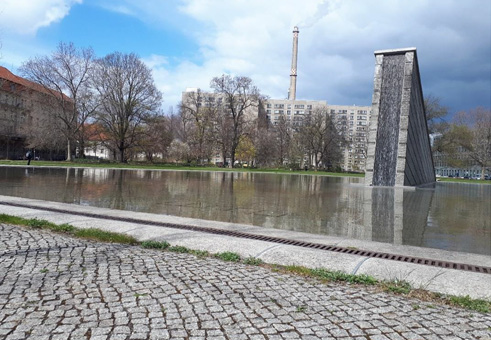
Look how empty it is here [Invalidenpark, see Figure 1], just concrete <…> no nature, no plants <…> such emptiness. When I think about school and my relationship with nature, with animals, I feel the same <…> (Alex, Berlin).
However, these specific urbanized places and their relationship to them immediately change for young climate activists every time they gather in these places, talk to each other, prepare for demonstrations, and protest. With time, young climate activists have become increasingly aware of these spaces and how they change with climate activism activities. As Ema tells us about the same place (Germany):
[Invalidenpark – S.K.] is where I became part of the climate activism movement Fridays for Future. In this triangle [the monument in the middle of the pool in the park – S.K.], you can stand on top of it and see the crowd of climate activists at the demonstration. It was a metaphorical move for me at the beginning – I came to this place as a person going to a demonstration, and my relationship with the place changed over time. Standing on top of the monument, I also shouted, even though I do not usually like to do that <…> This is the place where I started to grow as a climate activist; this is the place where I took my first steps.
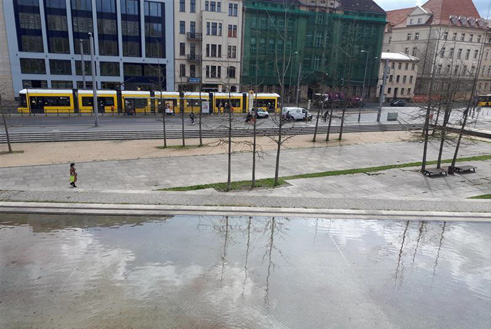
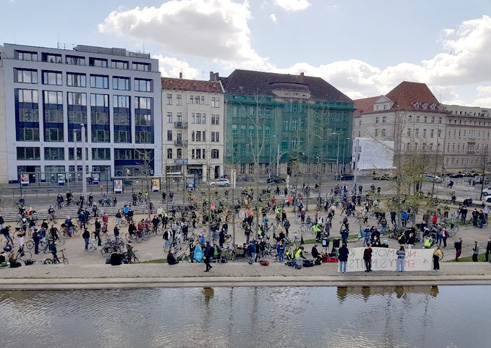
On the one hand, in these urban places, materiality, such as concrete, monuments, or buildings, is transformed by the creative practices having among a group of climate activists. These specific creative practices encompass dancing, singing, sitting, talking, chanting, writing, shouting, and demanding climate justice in these urban places.
On the other hand, these creative practices before and during protests help young climate activists cope with climate anxiety. As Eglė (Lithuania) says: “When I started doing activism, it was a refuge for me and a way to cope with anxiety, a kind of mutual aid. Planning certain actions and specific activities prevents me from overthinking or blaming myself. These activities become self-support”. Or Ema (Germany) shares: “I experience a lot of positive emotions at Invalidenpark, I recharge here. It has become a beautiful place for me. And all our creative activities here are meaningful and give me hope”.
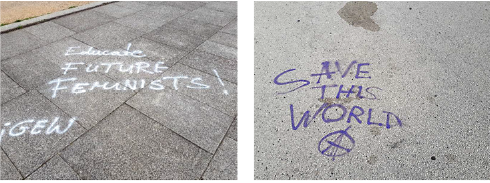
Moreover, these creative practices in particular urban places are also full of new learning opportunities, as one of the participants says: “I am learning and teaching at the same time <…> I don’t feel any hierarchy <…>” (Eglė, Lithuania). Or Martin expresses himself (Austria): “I had no clue how to start organizing the protest <…> and yes, I made mistakes many times, but that is the way I learned many things”; Lisa (Germany): “here is an open learning atmosphere that is based on projects that allow more freedom for me to learn about what I want in a creative way but also giving me general knowledge that is useful in the school”.
Drawing on Deleuze’s ideas and the new materialism approach, Linda Knight (2016) reveals contemporary playgrounds as milieus where collisions occur in movement between children’s bodies and spaces, airflows, pressures, sounds, forms, animals, and surfaces and create a series of choreographic interactions. As the author argues, these interactions also create choreographic and pedagogical possibilities that challenge normative duality between teach/learn, pedagogue/student, and human/more-than-human. “Children’s playground play is designed and regulated but not entirely so: playgrounds are chaotic, complex sites where encounters and collisions work choreographically and pedagogically beyond our reach and control” (2016: 26). Thus, in this case, the specific urban place, where young climate activists spend a lot of time, becomes a milieu that represents learning that is primarily affective, goes beyond the spaces and rules of formal learning activities, and creates complex assemblages with no single direction where and when learning takes place. As we have seen from the experience of young climate activists, learning in these urban areas as the milieu becomes a continuous creative action where there is no clear distinction between who teaches and who learns.
It is of importance to note that, by being in specific urbanized places and constantly interacting with everything that surrounds them or noticing what is missing, young climate activists not only try to understand their own becoming and their existing relationship with other climate activists, but also see their relationship with nonhumans. Thus, the specific urban place becomes the milieu, creating interconnectedness and relationships between humans and the more-than-human world.
For example, while walking around the Brandenburg Gate, Eva (Germany) tells:
I would never allow myself to have a pet. Why do I support such a rule for a dog or a cat? They are not here to serve me or to be my friend. Maybe they do not want to be my friends? If a dog comes to my house and wants to stay, then fine. But why should I lead it by the leash and tell it what to do in my place? It’s such small details <…> For example, if a mouse or a rat comes into your house, you get angry, but our house in this place could have belonged to a rat? So our thinking is in boxes <…> Why? We are all just inhabitants of this Planet <…>
Ieva and I meet at the Life Sciences Centre of Vilnius University in Saulėtekis neighborhood in Vilnius. She first entered this building as a high school student, and again re-entered it after she started her studies here. This building and place are essential for Ieva because this is where the idea of the climate activism movement ‘Fridays for Future Vilnius’ started, and where she became involved in its activities. This place, according to Ieva, has subtle allusions to nature; for example, you can still find stickers saying that the Baltic Sea starts here. However, according to Ieva, this place lacks links to climate issues, whether it is the content of the studies or the food served in the canteens. Although this place prepares professionals who should be concerned about the climate crisis, she feels that there is not enough leadership here. At the end of the interview, Ieva took me to the Zoological Museum on the ground floor of the building. Ieva said that she did not pay much attention to this space in the beginning, but, with the climate activist activities, she has been visiting it more often, and she has questioned the purpose of this place. Every time she walks there, she pays attention to the different animals and what it means to have a place where dead animals are displayed. Pointing to the different animals, she emphasizes that, if it were possible, she would like to talk to them.
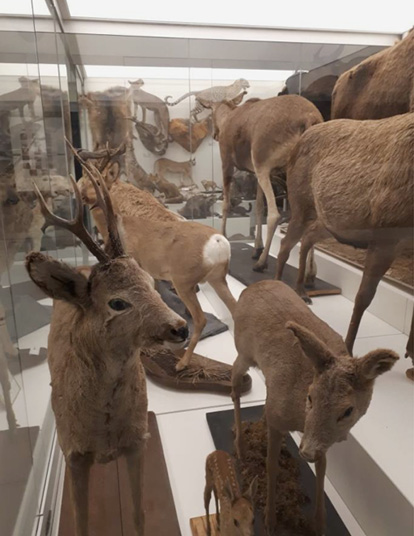
Finally, the study also shows that specific urbanized places become learning environments in which radical collisions with the more-than-human world go beyond these specific places and move into other spaces and new situations:
I know this might sound crazy, but when I go to the supermarket, and I want to buy an avocado, I start talking to the person: “What am I going to do? I want to buy you, but you’ve traveled so much to be here <…>” Two Miglės appear in my mind: one with an avocado and one without. And that is the worst thing that can happen to me. I hate it, but the avocado is talking to me, or I am talking to the avocado. And, in this inner conversation, one side of me would say: “You do a lot of things, so don’t worry and buy me <…>”, whereas the other one would say: “You can’t do enough for nature as a human being”. So, this kind of relationship is part of the identity of a climate activist that you have to live with <…> (Miglė, Lithuania)
Learning spaces and school infrastructure have historically played an urban role as cores and vital units in planning and designing well-commensurate and autonomous parts of the city. From the garden city model to the international circulation of the neighborhood unit, from the functionalist city to the neighborhood notion and right-sizing in the design of new housing districts equipped with essential services, including schools. <…> The widespread network of school spaces and services closely related to the form and organization of the city can play as the framework of an actual program of intervention at the scale of the metropolitan region, such as the contrat école (‘school contract’) program (Renzoni and Savoldi 2022: 8).
School classrooms are thus urbanized places where teaching and learning occurs most of the time. However, the methodology of phenomenon-based education proposed by the “School of Creativity” is based on the following principles: exploring the phenomenon from the perspective of the subjects taught, engaging students’ experiences, using elements of problem-based thinking, exploration and group work, and understanding how the phenomenon appears and manifests itself in the natural and cultural environment. Thus, this learning, at a certain point, encourages transcending the classroom and school boundaries and space.
In the school year 2023–2024, the fifth-grade pupils of Vilnius Simonas Konarskis Gymnasium inquired about the river, a natural phenomenon. The Neris River is not so far from the school; however, as the Lithuanian language and literature teacher reveals, it is not an easily reachable phenomenon to explore. The school must take into account the safety requirements for when and how children can be near the river. Teachers are, therefore, too often limited in their ability to be in the natural environment near the river, and they have to think of different ways in which the river can become part of phenomenon-based learning activities in the classroom and school.
In one of the subjects, specifically, the Lithuanian language and literature, the teacher decided that pupils would have a task “Lego rivers flow and… tell the stories”: in small groups, they would construct any river model and create a story. One group of fifth-grade boys builds a river as home for the great pike (yellow; seen in Figure 7 on the right side).
The emergence of the great pike in the river has been of interest to the teacher since the beginning of the construction of the river. Walking among the different groups in the classroom, each time, she comes back to the group and asks how the pike is doing and reminds them that she is waiting for a story about the river and the pike in it. The pike in the river is becoming increasingly interesting and brings curiosity to other groups of pupils. During the construction of the river models, the group is also approached by classmates who look at the model and ask them what this pike in the river means. The river pike brings more positive emotions to the pupils and encourages them to create and develop a story. Informally, the boys begin to talk to each other about how the pike begins to fly, to move in unknown directions, and that the river and the pike are the same. When it is the turn of the whole class to present the models of the river and the stories, the pupils start with the pike in the river: “She [the noun ‘pike’ is feminine in the Lithuanian language – S.K.] teaches you to be careful with the river; and the old man is the pike’s brother who has to find a way of crossing the river, as he cannot swim <…>”.
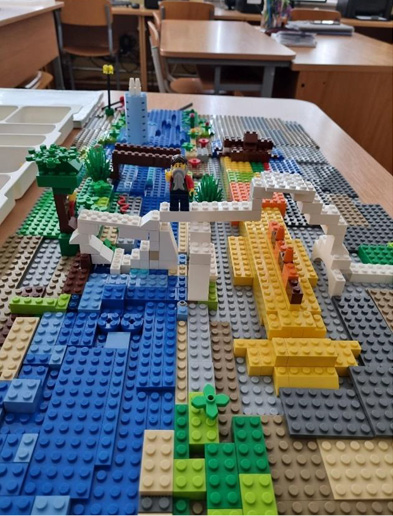
During the process, the teacher was constantly concerned that the phenomenon chosen by the school for the inquiry was physically challenging to encounter, as she could only walk to the river a few times with her class. Even though she constantly emphasized that the choice of the phenomenon was not particularly good, the classroom space became a milieu for exploring the river. The classroom space is transformed for the task (tables are arranged in order to work comfortably in smaller groups for several sessions), the movement of the pupils in the classroom is no longer constrained, and there is an opportunity for constant movement and communication among pupils. Pupils are given the freedom of creativity to create a model of a river with Lego bricks and create their own narrative of the river story. The transformation of the classroom space, different ways of communication among teachers and pupils, and the affective dimension of being and learning changed the working conditions and brought the river closer to a more-than-human world for the pupils. The pike or the mannequins (discarded clothing mannequins floating in the river model created by another group of pupils) become an opportunity for interconnectedness in a school as an urbanized space with the river to be created by the teacher and the pupils.
The transformation of the classroom as an urbanized place and the affective dimension of being and interacting with others is thus essential for learning with the milieu. This is also clearly visible in the ninth-grade pupils of Vilnius Sostinės Gymnasium, where the phenomenon of visuality was chosen and inquired. The principle of inquiring about this particular phenomenon is similar to that of the school described above, i.e., the pupils explore the phenomenon in smaller groups. However, due to the phenomenon’s complex nature, each group chooses to explore a different aspect of the visuality. One group of pupils explores visuality as a possible tension between being visible and invisible and decides to create an ‘Escape Room’ in the school corridor (where there had been hardly any movement of children previously), thus leaving the classroom space. The process of creating an ‘Escape Room’ is dynamic: the pupils move around a lot in a corridor space that was previously irrelevant to them; they consider each element of the ‘Escape Room’, consult with each other, and find creative solutions to make it happen. The creation process becomes, at certain moments, a literal opportunity for the students to become invisible. Thus, by leaving the regular classroom space (but not wholly disconnecting from it, as the ‘Escape Room’ was created next to the classroom, and the pupils keep returning to the classroom during the process) and making the ‘Escape Room’ in the corridor, they are also learning with the milieu where they can experience a relation with being visible and invisible.
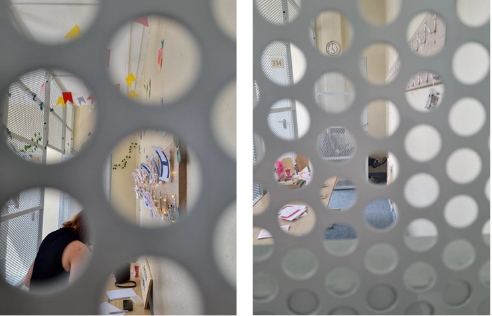
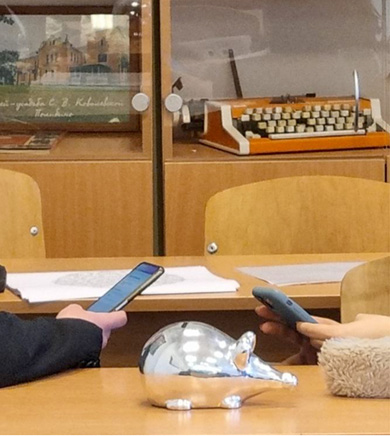
Meanwhile, the rest of the pupils inquire about the phenomenon of visuality while sitting in the classroom. The classroom space is only minimally transformed to explore the visuality as a phenomenon, essentially allowing pupils to work at their desks with computers or other additional tools (for example, a group of students has paper and coloring materials to create and color mandalas). The group work is done while sitting, with students actively waiting for the teacher’s suggestions and instructions on what to do. There is minimal interaction between the different groups in the classroom, and most of the interaction between the groups is due to the group creating the ‘Escape Room’, as its members keep coming back to the classroom to chat and see how the other groups are doing. When possible, for example, after completing a task, the pupils engage in other activities in the classroom (Figure 10). Thus, different groups of pupils have completely different interconnectedness processes and learning possibilities with the milieu of the classroom as an urban place.
The paper has sought a broad theoretical reflection on children living in the Anthropocene by engaging with the philosophical concept of the milieu. In this context, the philosophical concept of milieu expands how we understand children living and learning in urban places. Learning with the milieu reframes education as a relational, affective, and situated process. It opens up possibilities for active and creative engagements in urban environments, where the urban place itself becomes pedagogical: a relational force, a possibility capable of generating new ways of being, knowing, and learning with the more-than-human world.
This reorientation carries implications for the question of how we understand environmental and also place-based education, which, based on humanist pedagogical paradigms, conceives of the environment as a passive background or resource to be managed and controlled by the educator. Rather than relying on an understanding of the environment as a periphery in relation to human subjects who are at the central position, structurally separated from individuals (Sabolius 2024), the shift to the milieu foregrounds learning as embedded, multispecies, affective, and interconnected. It invites us to move beyond anthropocentric, linear models of pedagogy and toward an education of relationality and compossibility, where multiple humans and more-than-humans encounter, and where learning is happening based on re-creating relations with the urban place and its subject and objects, with more-than-human.
In this sense, the concept of the milieu as situated in the Anthropocene expands our understanding of who the ‘children of the Anthropocene’ are – not as isolated individuals navigating discrete spaces, but as beings-in-relation, entangled with human and more-than-human agencies. Children are not strangers to urbanized places; on the contrary, they are active participants in co-shaping these environments, developing affective, sensory, and material interconnectedness, from materiality of the urban places, like concrete, to natural phenomena like rivers.
The experiences of children and young people also show that they are directly connected to urbanized places as a milieu. Connections to urban places create the possibility of learning with the milieu that potentially becomes an opportunity for their active, affective agency and creativity, and for developing an equal relationship with all that surrounds them in these places. Moreover, the urban place as a milieu includes the possibility of bringing the child/young person closer to the world outside and thus extending this milieu. In or beyond specific spaces as the milieu, young people learn about their complex and equal relationship or (as soon as) their anthropocentric relationship with the more-than-human world. Being and learning in these specific places creates the possibility of thinking and learning with place, which many young people admit that they particularly lack in formal education institutions. Thus, a specific urbanized place, which can be considered alien to young people, with climate activism activities or a phenomenon-based education approach can become learning with the milieu possibility where relationships are forged, creative potential is unleashed, and new learning opportunities abound.
The learning experiences of children and young people show that several conditions are important for transforming urbanized environments into pedagogical milieus. Firstly, an urbanized place as a milieu requires a change in its static former human-controlled functionality and stability, where it acquires new characteristics and opportunities. Place as the milieu should enable movement, communication, observation, and creative activities. Secondly, the transcendence of individuality/loneliness is important, where everyone feels that they are creating an equal relationship, and in which isolation, boundaries or hierarchies are erased. Thirdly, an affective dimension that is directed not only toward oneself but also toward others is relevant to the presence and learning with the milieu. Fourthly, for an urbanized place as learning with the milieu, it is relevant to cross boundaries into other environments (say, from the social environment into the natural environment). Finally, it is important for educators to look at different urbanized places (both in educational institutions and beyond them) as the milieus and actively observe how children engage with these places, what children/young people are actively doing, thinking, experiencing, building relationships with nonhumans, while being able to learn in these urban places.
Creswell, J., 2018. Qualitative Inquiry & Research Design: Choosing among Five Approaches. 4th Edition. Los Angeles: SAGE Publications.
Duhn, I., Malone, K., Tesar, K., 2017. Troubling the intersections of urban/nature/childhood in environmental education. Journal of Environmental Education Research 23(10): 1357–1368. https://doi.org/10.1080/13504622.2017.1390884
Hadfield-Hill, S., & Zara, C., 2019. Children and young people as geological agents? Time, scale and multispecies vulnerabilities in the new epoch. Discourse: Studies in the Cultural Politics of Education 41(3): 407–426. https://doi.org/10.1080/01596306.2019.1644821
Harraway, D., 2015. ‘A CURIOUS PRACTICE’. Angelaki 20(2): 5–14. https://doi.org/10.1080/0969725X.2015.1039817
Kouppanou A., 2020. Environmental education and children’s agency at the time of the Anthropocene. Journal of Philosophy of Education 54(4): 944–959. https://doi.org/10.1111/1467-9752.12483
Knight, L., 2016. Playgrounds as sites of radical encounters: mapping material, affective, special and pedagogical collisions. In: Pedagogical Matters: New Materialisms and Curriculum Studie, eds. N. Snaza, D. Sonu, S. H. Truman, S. Zaliwska. New York: Peter Lang, 13–28. https://doi.org/
Malone, K., 2007. Hybrid identities: Learning from children’s stories of place in Papua New Guinea. In: Childhoods in South Asia, ed. D. Behera. London: Pearson Education, 43–64.
Malone, K., 2015. Theorizing a child–dog encounter in the slums of La Paz using post-humanistic approaches in order to disrupt universalisms in current ‘child in nature’ debates. Children’s Geographies, 14(4): 390–407. https://doi.org/10.1080/14733285.2015.1077369
Malone, K., 2018. Children in the Anthropocene: Rethinking Sustainability and Child Friendliness in Cities. London: Palgrave Macmillan.
Malone, K., Tesar, M., Ardnt, S., 2020. Theorising Posthuman Childhood Studies. Singapore: Springer.
Pacini-Ketchabaw, V., Taylor, A., 2016. Common world childhoods. In: Oxford Bibliographies in Childhood Studies, ed. H. Montgomery. New York: Oxford University Press, n.p.
Sabolius, K., 2024. Forget the Environment, Imagine with Milieu. Rivista di Estetica 87: 228–242. https://doi.org/10.4000/13tuw
Sabolius, K., 2025. Kaip mokytis iš terpių?. Acta Paedagogica Vilnensia 53: 8–18. https://doi.org/10.15388/ActPaed.2024.53.1.
Snaza, N., 2018. The Earth is not “ours” to save. In: Interrogating the Anthropocene: Ecology, Aesthetics, Pedagogy, and the Future in Question, ed. J. Jagodzinski. London: Palgrave Macmillan, 339–335.
Somerville, M., 2017. Thinking critically with children of the Anthropocene. (Un)Learning the subject in qualitative and postqualitative inquiry. International Review of Qualitative Research 10(4): 395–410. https://doi.org/10.1525/irqr.2017.10.4.395
Somerville, M., 2018. Anthropocene’s time. Journal of Educational Philosophy and Theory 50(14): 1584–1585. https://doi.org/10.1080/00131857.2018.1461428
Sommerville, M., Powell, S., 2019. Researching with children of the Anthropocene: a new paradigm? In: Educational research in the age of anthropocene, eds. V. Reyes, J. Charteris, A. Nye, S. Mavropoulou. Hershey, PA: IGI Global Scientific Publishing, 14–35. https://doi.org/10.4018/978-1-5225-5317-5.ch002
Somerville, M., Powell, S., 2019. Thinking posthuman with mud: and children of the Anthropocene. Educational Philosophy and Theory 51(8): 829–840. https://doi.org/10.1080/00131857.2018.1516138
Somerville, M., Powell, S., 2022. Becoming-with Fire and Rainforest: Emergent curriculum and pedagogies for planetary wellbeing. Australian Journal of Environmental Education 38(3-4): 298–310. https://doi.org/10.1017/aee.2021.21
Taylor, A., 2013. Reconfiguring the Natures of Childhood. London: Routledge. https://doi.org/10.4324/9780203582046
Taylor, A., 2017. Beyond stewardship: common world pedagogies for the Anthropocene. Environmental Education Research 23(10): 1448–1461. https://doi.org/10.1080/13504622.2017.1325452
Taylor, A., Pacini-Ketchabaw, V., 2015. Learning with children, ants, and worms in the Anthropocene: towards a common world pedagogy of multispecies vulnerability. Pedagogy, Culture & Society 23(4): 507–529. https://doi.org/10.1080/14681366.2015.1039050
Taylor, A., Zakharova, T., Cullen, M., 2021. Common worlding pedagogies: opening up to learning with worlds. Journal of Childhood Studies 46(4): 74–88. https://doi.org/10.18357/jcs464202120425
Verlie, B., 2021. Learning to Live with Climate Change. From Anxiety to Transformation. London: Routledge. https://doi.org/10.4324/9780367441265