Social Welfare: Interdisciplinary Approach eISSN 2424-3876
2026, vol. 16, pp. 84–112 DOI: https://doi.org/10.15388/SW.2026.16.5
Features of Green Organisational Culture in Utena District Municipality: Implications for Social Welfare
Sigita Strautnikienė
Kaunas University of Technology
Panevėžys Faculty of Technology and Business
Nemuno 33, LT-37164, Panevėžys
E-mail: ssigama@gmail.com
https://orcid.org/0009-0003-1592-904X
https://ror.org/01me6gb93
Rita Toleikienė
Kaunas University of Technology
Panevėžys Faculty of Technology and Business
Nemuno 33, LT-37164, Panevėžys
E-mail: rita.toleikiene@sa.vu.lt
https://orcid.org/0000-0001-9930-9777
https://ror.org/01me6gb93
Abstract. Sustainable development goals, social responsibility, the Green Deal and climate neutrality increasingly encourage local government institutions to reconsider their principles, values and modes of operation. Green organisational culture (hereinafter – GOC) is a multidimensional construct integrating value-based orientations with organisational practices, functioning as a strategic intangible resource. It enhances the capacity of local government to address environmental challenges, implement green initiatives, and support sustainable development. The study identifies four core GOC features – value-based, structural, behavioural, and symbolic – that collectively embed environmental principles into local government. These features facilitate not only environmental protection but also broader social welfare outcomes by promoting transparency, accountability, stakeholder participation, and policy continuity. Two dimensions of green public administration (hereinafter – GPA) are analysed: the transformation of internal organisational activities and management in line with sustainability principles, and the role of local government institutions in formulating, implementing and enforcing environmental and sustainability policies that affect citizens’ well-being. The analysis reveals that GOC functions as an intangible resource and organisational capacity necessary for the effective implementation of GPA and the pursuit of long-term social welfare goals. The research applies a qualitative case study methodology, focusing on Utena District Municipality as a single, embedded case. The research is based on triangulation, combining both qualitative and quantitative content analysis. A total of 31 municipal documents from the period 2020–2024 are analysed in order to ensure a comprehensive and reliable assessment of the phenomenon. Within the scope of this case study, the municipality is conceptualised as a unified organisational entity, integrating both the political level (the municipal council) and the administrative level (executive bodies). The case study of Utena District Municipality demonstrates a mature, proactive green culture. This is evident in the systematic integration of green values into decision-making, continuity of the green agenda, openness to innovation, and stakeholder empowerment. The findings demonstrate that GOC contributes to social welfare by improving the quality of life, fostering inclusive and transparent governance, and strengthening long-term sustainability-oriented decision-making at the local government level. The results highlight GOC as a mediating mechanism that translates environmental governance into tangible social and institutional benefits, thus confirming its role as a strategic capability in GPA.
Keywords: green organisational culture, green public management, local government institutions, sustainability, social welfare.
Recieved: 2026-02-24. Accepted: 2026-04-21
Copyright © 2026 Sigita Strautnikienė, Rita Toleikienė. Published by Vilnius University Press. This is an Open Access journal distributed under the terms of the Creative Commons Attribution 4.0, which permits unrestricted use, distribution, and reproduction in any medium, provided the original author and source are credited.
Introduction
The accelerating challenges of climate change and increasing societal environmental awareness have stimulated the development of green culture as a broader socio-ideological framework promoting sustainable economic and ecological development grounded in science, politics and aesthetics (Chandra, Arafah, and Basri, 2021). At the organisational level, these principles of sustainability become institutionalised through internal norms, managerial practices and behavioural standards, giving rise to the concept of GOC. GOC reflects the systematic integration of environmentally oriented values and practices into organisational processes (Aggarwal and Agarwala, 2021). It is conceptualised as an intangible organisational resource (Smirnova, 2021; Elshaer et al., 2024) that shapes employees’ environmental values, leadership priorities and decision-making patterns, thereby contributing to improved environmental performance (Chandra et al., 2021). GOC helps explain why some organisations are more successful than others in implementing environmental protection strategies and achieving environmental efficiency (Aggarwal and Agarwala, 2021). In GPA, such environmental commitments are closely linked to social welfare objectives, as public institutions are responsible not only for ecological outcomes but also for the citizens’ quality of life, equity, and social inclusion.
In the local government, sustainability is operationalised through GPA, which integrates environmental principles into public decision-making processes, organisational arrangements and service delivery (Khodaparasti and Garabollagh, 2023; László, Pollák, and Balogh-Békesi, 2024). Local government’s institutions play a particularly important role in this process (Štareikė, 2013), as they implement environmental policies directly at the community level. In Lithuania, this role has been reinforced through national initiatives. However, the implementation of sustainable principles depends not only on formal regulations but also on the organisational culture, which shapes employee behaviour, decision-making processes, and attitudes towards environmental objectives (László et al., 2024; Elshaer et al., 2024). By linking the theoretical construct of GOC with the practical implementation of GPA, the study advances understanding of sustainability-oriented organisational capabilities beyond the private sector domain. GOC is regarded as a key organisational capability necessary for the effective implementation of GPA (Niestroy and Meuleman, 2022; Azhar and Yang, 2022; László et al., 2024). As local government institutions increasingly assume responsibility for reducing environmental impacts, examining how GOC is expressed at the municipal level becomes particularly relevant.
Although GOC has been widely examined in the private sector, empirical research addressing its manifestation within local government institutions remains comparatively limited. There is insufficient case-based evidence from local government organisations in Central and Eastern Europe. Given that local government institutions operate under distinct accountability structures and normative expectations, analysis of GOC in local government contexts contributes to a more nuanced understanding of sustainability governance. There is a lack of empirical case study evidence demonstrating how GOC is expressed in practice and how it contributes to social welfare outcomes. This study addresses the following research questions: (1) How is GOC conceptualised in scientific literature? (2) What features of GOC are expressed in a local government institution?
The aim of the study is to identify and analyse the manifestation of GOC features in a municipality as a local government institution and to assess their implications for social welfare. To achieve this aim, the following objectives are formulated: (1) to reveal the concept, structural elements and features of GOC; (2) to identify the features of GOC in GPA; (3) to identify the expression of the features of GOC in Utena District Municipality; (4) to reveal the implications of GOC for social welfare at the local government level.
The empirical research is based on a qualitative case study methodology. Utena District Municipality was selected as the case of this study because, although it is not among the largest municipalities in Lithuania, it demonstrates comparatively high environmental performance indicators at the national level. The case study represents a high-performing municipality, allowing the exploration of green organisational culture characteristics in a context where environmental commitments are comparatively advanced. The theoretical section is based on a narrative review of scientific literature, while the empirical section employs methodological triangulation, combining qualitative and quantitative content analysis of municipal strategic planning documents, annual activity reports, and environmental policy documents (the data were collected from 31 municipal documents (2020–2024). The analysis was conducted by using ATLAS.ti Web Student software. The article is structured as follows: first, the theoretical conceptualisation of GOC and GPA is presented; second, the research methodology is described; and finally, the empirical findings are analysed and discussed.
In addition to analysing the manifestation of GOC features, the case study also seeks to assess the maturity level of GOC in the selected municipality based on the identified indicators. The maturity assessment serves as an analytical tool through which the extent of the manifestation of GOC can be evaluated. This study contributes to the literature by extending the conceptualisation of GOC to the local government context and by empirically demonstrating how GOC is manifested through formal strategic documents and organisational priorities in a high-performing local government institution.
Conceptualisation of GOC
Organisations are increasingly transforming their cultures to respond to environmental challenges and operate sustainably and socially responsibly (Chang and Lin, 2015; Firoz and Abinakad, 2016; Hastuti and Muafi, 2022). Traditional cultures focused on productivity and profit are evolving to incorporate ecological considerations, giving rise to GOC. This culture emerges from the systematic implementation of green practices and initiatives and is grounded in values, norms, and beliefs that guide environmentally friendly behaviour (Aggarwal and Agarwala, 2021; Piwowar-Sulej, 2020; Afum, Agyabeng-Mensah, and Owusu, 2020). GOC can be understood as a cultural transformation within organisations. Harris and Crane (2002) describe its formation as a process of value change, where organisations adopt environmentally friendly strategies while simultaneously creating new patterns of thinking and behaviour. They define it as “a set of values, symbols, assumptions and artefacts that reflect a commitment to being an environmentally friendly organisation” (pp. 218–219). This perspective highlights the importance of embedding environmental attitudes into employee behaviour and daily practices. Culture, from the ‘fundamental metaphor’ perspective (Jung et al., 2007; Samaraweera et al., 2017), is a shared system of meaning that cannot be imposed top-down, and green culture motivates employees to act beyond mere economic objectives, contributing to positive environmental outcomes (Roscoe et al., 2019).
The conceptualisation of GOC is informed by multiple theoretical lenses. Schein’s (1990) model frames it as shared assumptions formed through adaptation to environmental challenges, while Hatch’s (1993) dynamic model positions GOC as a mediator between the organisation and its environment. Organisational identity theory (Chen, 2011; 2018) conceptualises GOC as a strategic internal resource that shape identity and competitive advantage. The concept is multidimensional, combining interpretative and functional perspectives (Imran, Arshad, and Ismail, 2021) and drawing on structural functionalism (Janićijević, 2011), resource-based view (Hart, 1995; Gurlek and Tuna, 2018; Afum et al., 2020; Hadi et al., 2023; Elshaer et al., 2024), and capability-based theory (García-Machado and Martínez-Ávila, 2019). This diversity allows GOC to be analysed both as a cultural phenomenon and as a strategic organisational capability.
From a functional standpoint, GOC is an organisational capability that enables the achievement of strategic objectives (Jung et al., 2007; Samaraweera et al., 2017). Within resource-based and capability-based frameworks, it is an intangible asset that provides competitive advantage (Gurlek and Tuna, 2018; Afum et al., 2020; Smirnova, 2024). Empirical studies show that GOC enhances environmental performance (Wang, 2019; Afum et al., 2020; Imran et al., 2021), facilitates innovative environmental strategies (Hadi et al., 2022), and mediates between knowledge creation and organisational outcomes (Chen et al., 2018). Across normative, strategic, and operational levels, GOC functions as a strategic capability enabling organisations to respond effectively to environmental challenges (Baumgartner, 2014; Aliyu, Rogo, and Mahmood, 2015; Vargas-Hernández et al., 2024). In the scientific literature conceptualising GOC as an intangible resource, the prevailing view is that managers are the main shapers of green organisational culture (Fernández, 2003; Chen, 2011; Wang, 2019), but a strict top-down approach may hinder this process (Harris and Crane, 2002). It is valuable for organisations to apply a bottom-up approach to GOC to integrate environmentally friendly practices that are supported or initiated by members of the organisation (Azhar and Yang, 2022).
Leadership and human resource practices are crucial in supporting GOC. In contemporary scientific literature, GOC is associated with organisational performance, strategic innovation, and the interaction between leadership and employee behaviour (Siswanti and Muafi, 2022). Transformational leadership and employee empowerment drive sustainable organisational change (Azhar and Yang, 2022), while harmonisation of values ensures consistent implementation of the sustainability principles. Green human resource management is increasingly embedded within HRM practices, highlighting employees’ potential to support GOC (Jabbour and de Sousa Jabbour, 2016; Roscoe et al., 2019; Abbas and Dogan, 2022; Piwowar-Sulej, 2020; Aggarwal and Agarwala, 2021). Beyond environmental and economic outcomes, GOC promotes social welfare by enhancing employee well-being, ethical responsibility, and socially responsible behaviour (Ali et al., 2024; Roscoe et al., 2019; Piwowar-Sulej, 2020). It has been argued that an organisation fostering a sustainable culture creates a synergistic link between strategic goals, employee engagement, and broader societal interests, including improved quality of working life and social cohesion (Ali et al., 2024). Roscoe et al. (2019) note that a green culture manifests itself when employees are guided by values broader than the pursuit of profit, while Piwowar-Sulej (2020) highlights a belief in the collective ability to generate a positive impact on the environment and society, reinforcing the organisation’s contribution to long-term social welfare (p. 5).
In this study, GOC is conceptualised as a value-based, strategically embedded organisational capability that shapes behavioural norms and formal organisational commitments towards sustainability. While previous research has focused on private-sector competitive advantage, this study extends the concept to public administration, linking GOC to public value creation, institutional accountability, and sustainability governance.
Elements and features of GOC
Definitions of GOC in the scientific literature highlight its dual nature, comprising cognitive and material elements. Cognitive elements include green values, norms, beliefs, and assumptions, which shape, direct, and regulate organisational members’ behaviour, whereas material elements are expressed through symbols, artefacts, and behavioural practices that convey, reinforce, and visualise these meanings (Janićijević, 2011; Aggarwal and Agarwala, 2022). Artefacts, as external signs of organisational culture, may take physical forms, such as recycling bins or sustainability posters, or appear as verbal and behavioural practices, where environmental topics are routinely discussed (Piwowar-Sulej, 2020). Behavioural artefacts reflect the organisation’s response to environmental challenges and shape practical patterns of behaviour (Liu and Lin, 2020). Green values are central to GOC, representing stable attitudes that indicate preferred behavioural models (Janićijević, 2011). In GOC, environmental protection serves as a primary value orientation (Wang, 2019). These values act as behavioural guidelines for employees, structuring norms and directing actions (Piwowar-Sulej, 2020; Aggarwal and Agarwala, 2022). Deeply held value assumptions reveal members’ beliefs influencing sustainable practices and indicate the organisation’s commitment to environmental protection (Chen, 2011; Chang and Lin, 2015; Shahriari et al., 2023; Harris and Crane, 2002; Norton et al., 2015).
Building on Hatch’s (1993) dynamic model, organisational culture is conceptualised as a constantly evolving system in which assumptions, values, artefacts, and symbols interact through processes of manifestation, realisation, symbolisation, and interpretation (Norton et al., 2015; Chen et al., 2011; Chen et al., 2018). Symbols, incorporated in this framework, emphasise the interpretive nature of culture and the role of employees in its formation (Hatch, 1993; Szczepańska and Kosiorek, 2017). In a strong environmentally friendly culture, basic assumptions transform into values that are realised through material artefacts and everyday practices. For example, the assumption that “only a clean environment can produce high-quality products” translates into the value that production processes must be environmentally friendly (Norton et al., 2015). Green values are institutionalised in mission and vision statements and are embedded within human resource management, training, and motivation systems (Aggarwal and Agarwala, 2021; Tahir et al., 2019), ensuring alignment between employee values and organisational goals (Dumont, Shen and Deng, 2017) and strengthening environmental awareness (Hadjri, Perizade, and Farla, 2019; Piwowar-Sulej, 2020). Symbols play a communicative and motivational role by visually conveying organisational values and reinforcing employees’ commitment to sustainability, through logos, sustainability certificates, reports, and public initiatives (Siswanti and Muafi, 2022). Symbolic actions foster a shared organisational identity and can catalyse changes at both internal and external levels (Linnenluecke and Griffiths, 2010; Porter et al., 2016). Organising symbolic activities, whether formal or informal, strengthens green values and encourages employee participation in environmental initiatives (Aggarwal and Agarwala, 2021). GOC thus serves as a symbolic context, guiding employees in understanding acceptable environmental values, behaviours, and decisions, while promoting empowerment, green creativity, and the generation of environmentally friendly ideas (Shahriari et al., 2023; Abbas and Dogan, 2022; Chen, Lin and Lai, 2023).
Taken together, GOC manifests through interrelated elements that integrate environmental principles into organisational values, norms, behaviour, and symbolism. These elements can be conceptualised along four interwoven dimensions (see Figure 1):
Figure 1.
Elements and features of GOC

Source: Created by authors based on Aggarwal and Agarwala, 2021; Abbas and Dogan, 2022; Chen, Lin, and Lai, 2023; Chen et al., 2011; Chen et al., 2018; Dumont, Shen, and Deng, 2017; Harris and Crane, 2002; Hadjri, Perizade, and Farla, 2019; Hatch, 1993; Liu and Lin, 2020; Norton et al., 2015; Piwowar-Sulej, 2020; Shahriari et al., 2023; Siswanti and Muafi, 2022; Tahir et al., 2019; Wang, 2019.
Note. The figure was generated by using artificial intelligence (ChatGPT; OpenAI, 2026) based on the authors’ conceptual framework.
The theoretical contribution of this framework lies in its integration of cognitive, structural, behavioural, and symbolic elements into a coherent conceptualisation of GOC. This framework advances existing literature by providing a structured lens serving the objective to analyse how green values are operationalised, reinforced, and manifested within organisations, offering a robust foundation for empirical research in both private and public sector contexts.
The expression of GOC features in GPA
Dynamic external environmental pressures and internal organisational factors drive change not only in private sector organisations but also in public administration. The evolution of public management from classical bureaucracy to New Public Management and New Public Governance models emphasises efficiency, transparency, accountability, and stakeholder participation, aligning with the principles of sustainable development (Lasytė, 2020). These transformations foster new public sector values that respond to globalisation, digitalisation, and growing ecological awareness (Patapas and Labenskytė, 2011). Reforms in public administration are being increasingly framed to achieve the United Nations Sustainable Development Goals (Niestroy and Meuleman, 2022; United Nations, 2015) as well as to address climate change, resource depletion, and societal expectations for sustainable governance (Khodaparasti and Garabollagh, 2023). These developments underpin GPA, which integrates environmental and sustainability principles into institutional policies, strategies, and operational practices (Meadowcroft, 2006; László et al., 2024). GPA represents a paradigm shift from traditional bureaucratic approaches to an organisational culture informed by ecological awareness, guided by clearly defined goals and principles (László et al., 2024) (see Table 1). Core goals include environmental protection, climate resilience, social and economic well-being, and green governance. Principles such as sustainability, innovation, equality, inclusion, and good governance ensure that these goals are operationalised through both internal management processes and external policy actions.
Table 1.
Goals and principles of GPA
|
GPA goals |
GPA principles |
|---|---|
|
Environmental protection and sustainability |
• Sustainability and long-term thinking emphasise the need to protect natural resources and ecosystems for future generations. • Develops sustainable strategies, not temporary solutions. |
|
Resilience to climate change |
• Innovation and continuous improvement: knowledge, technology, infrastructure. Promoting innovation helps to adapt to the challenges of climate change. • Growth and development must be balanced with environmental sustainability. |
|
Social and economic well-being |
• Good governance and leadership: accountability and transparency. • Consistent and strong leadership promotes environmental education and raises public awareness, inspiring the public to participate in green initiatives. |
|
Green and good governance and policy |
• Equality and inclusion: participation in decision-making processes helps to integrate the views of different stakeholders. |
Source: László et al., 2024
To achieve these goals (see Table 1), institutions are implementing green practices, including energy efficiency, renewable energy use, carbon footprint reduction, and green public procurement (Rainey and Bozeman, 2000; Osborne et al., 2015). The value base is important here – when goals and principles are based on values, they ensure greater self-regulation and long-term commitment among employees (László et al., 2024; Piwowar-Sulej, 2020). GPA is also based on stakeholder involvement and cooperation in environmental management (Dryzek, 2022). The internalisation of values encourages employees and citizens to align their actions with the values of the institution, which reinforces ethical behaviour and a sustainable approach (Azhar and Yang, 2021). GPA comprises three interconnected elements: policy, covering visions and goals; governance, encompassing processes, responsibilities, and coordination; and capacity, including employee competencies, values, and organisational culture (Niestroy and Meuleman, 2022; László et al., 2024). The following elements manifest in two GPA dimensions:
• Greening internal administration institution. The first dimension, specifically, greening internal administration, involves transforming internal processes, infrastructure, and practices in line with the sustainability principles. Key practices include energy efficiency, renewable energy adoption, carbon footprint reduction, and green public procurement, all reinforced by employee engagement, training, and green transformational leadership (Rădulescu et al., 2023; Bargues et al., 2019; Azhar and Yang, 2021; Ngubane, 2024). It focuses on the implementation of green practices through environmentally friendly investments and infrastructure (Rădulescu et al., 2023; László et al., 2024), thus demonstrating a commitment to environmental protection. One of the most important practices is green public procurement, where environmental criteria are integrated into procurement processes. Public sector institutions, with their significant purchasing power, can stimulate demand for environmentally friendly products and innovation (Bargues et al., 2019). Molino (2021) notes that not only is the inclusion of environmental requirements in technical specifications when organising public procurement still a challenge for public organisations, but there are also gaps in the legal regulation of public procurement. Employee green behaviour depends on the perceived environmental strategy of the organisation (Liu, 2021) and civic engagement (Azhar and Yang, 2019). Green transformational leadership helps to strengthen these values, motivation and environmentally friendly behaviour (Azhar and Yang, 2021). Training and capacity building, especially in the field of public procurement, are considered essential tools for implementing green practices (Ngubane, 2024; Kettl, 2015). Zeemering (2021) emphasises the importance of organisational culture development, by highlighting citizen engagement, transparency in decision-making, and accountability. Thus, GPA is not limited to technical measures, but encompasses a broader institutional transformation – from values, norms and behaviour to management models and decision-making culture.
• Green policy development. This dimension of GPA covers the role of shaping, implementing and monitoring environmental and sustainability policies (László et al., 2024). GPA acts as an intermediary, ensuring the implementation of environmental strategies through effective policy coordination, monitoring and supervision. It relies on inter-sectoral collaboration, stakeholder involvement, and adaptability to technological and social changes, translating national and international commitments into actionable policies (Caldatto, Bortoluzzi, and de Lima, 2020; Meadowcroft, 2005; Rădulescu et al., 2023; Štareikė, 2013). GPA institutions must ensure the involvement of stakeholders in decision-making and support for green initiatives. In a dynamic environment, the ability to adapt is particularly important – institutions must respond quickly to technological and social changes, and also accept innovations and green technologies that reduce environmental impact (Meadowcroft, 2005; Khodaparasti and Garabollagh, 2023). In addition, participation in international environmental agreements entails national commitments, which are transformed into specific policies and programmes (Jordan et al., 2015). Local authorities play an important role here, as they are often responsible for implementing specific environmental measures and strategies (Štareikė, 2013). Whereas, Zeemering (2021) emphasises that cooperation, stakeholder involvement and innovation are essential for the successful implementation of sustainability policies by local authorities.
GPA is a catalyst for creating and fostering a GOC. GPA as a context for GOC features to manifest themselves at the political and administrative (executive) levels. An analysis of the dimensions and principles of the GPA concept revealed how and in what ways GOC features manifest themselves (see Table 2).
Table 2.
Interlinks between features of GOC and indicators of GPA
|
Group of GOC |
Executive level of GPA |
Political level of GPA |
|---|---|---|
|
Value-based |
• Internalisation of environmental protection values. • Clear and achievable green goals. • Commitment to the environment and sustainability (mission). |
• Value and ideological basis. • Clear and achievable green goals. • Commitment to the environment and sustainability (vision). |
|
Structural |
• Openness to green technologies and innovations. • Green organisational structure. • Green motivational system. |
• Openness to green technologies and innovations. • Green institutional structure. |
|
Behavioural |
• Green practices common to the entire organisation. • Shared green values. |
• Political support and encouragement. • Continuity of the green agenda. |
|
Symbolic |
• Internal green communication. • Representation of green values (symbols). • Involvement and empowerment of employees. |
• Green communication. • Representation of green values (symbols). • Involvement and empowerment of stakeholders. |
Source: Compiled by the authors
Within GPA, GOC manifest across four interrelated dimensions. Value-based features include the internalisation of environmental protection values and alignment with clear, achievable goals at both executive and political levels. Structural features encompass openness to green technologies, innovation, and the establishment of green organisational structures and motivational systems. Behavioural features reflect shared green practices and employee engagement, supported by political encouragement and continuity of the green agenda. Symbolic features include internal and external communication of green values, representation through symbols, and empowerment of employees and stakeholders, reinforcing organisational identity and sustainability commitment. The theoretical contribution of this framework is the integration of GOC dimensions within the public administration context, demonstrating how environmental values, structures, behaviours, and symbols manifest at both executive and political levels. This approach extends the conceptual understanding of GOC, providing a structured lens to analyse how institutions embed sustainability principles into policies, organisational culture, and daily operations, thereby advancing theory on the intersection of organisational culture and green governance. In addition to environmental outcomes, GOC in GPA contributes to social welfare by fostering socially responsible decision-making, improving employee well-being, and enhancing the quality and accessibility of public services. By integrating environmental sustainability with social objectives, local government institutions can create public value that supports healthier living conditions, social equity, and long-term societal resilience. Thus, a GOC not only strengthens environmental performance but also reinforces the role of GPA in promoting inclusive and sustainable social development.
Methodology
Methodological approach (strategy). The empirical research adopts a qualitative single-case study strategy to explore how GOC is formalised, prioritised, and communicated in a local government context. Case study research is suitable when a phenomenon is examined within its real-life organisational and governance setting, and when the intention is to capture contextual complexity rather than to produce statistical generalisation. The empirical design relies on documentary evidence as the main data source because municipal documents provide an auditable record of formal priorities, commitments, and decision-making rationales. The analysis applies methodological triangulation by combining deductive qualitative content analysis with quantitative content analysis so that to increase interpretive credibility and to provide a transparent overview of patterns across the document corpus (Noble and Heale, 2019; Elo and Kyngäs, 2008). Both types of analysis were conducted by using the ATLAS.ti Web Student software. The aim of the empirical case study is to examine how the four theoretically derived dimensions of GOC (value-based, structural, behavioural, and symbolic) are expressed in the selected Lithuanian municipality through the analysis of official documents (2020–2024) and to identify how these expressions relate to social welfare objectives at the local government level. This methodological approach allows the identified expressions to be interpreted through the lenses of organisational culture theory and strategic management theory, while ensuring a theoretically grounded analysis of the phenomenon. The basis is organisational culture theory, which emphasises the importance of culture for organisational efficiency. According to Safold (as cited in Vanagas and Vyšniauskienė, 2012), in order to assess the impact of organisational culture, it is necessary to determine its dispersion and potential. Dispersion reveals the prevalence of culture in an organisation (Harris and Crane, 2002; Dumont et al., 2017; Hadjri et al., 2019; García-Machado and Martínez-Ávila, 2019; Chen et al., 2020), while potency reveals its impact on behaviour, including symbols (Chen, 2011; Porter et al., 2016; Aggarwal and Agarwala, 2020; Shahriari et al., 2023), values (Roscoe et al., 2019; Piwowar-Sulej, 2020; Aggarwal and Agarwala, 2022; Abbas and Dogan, 2022) and the ability to change (Harris and Crane, 2002; Northon et al., 2015; Porter et al., 2016; Tahir et al., 2019; Aggarwal and Agarwala, 2021). In strategic management theory, GOC is understood as a set of intangible resources grounded on resource-based (Hart, 1995) and capability-based approaches (García-Machado and Martínez-Ávila, 2019; Afum et al., 2020). GOC is considered a strategic capability that enables organisations to address environmental challenges and employ innovative strategies to improve performance (Aliyu et al., 2015; Wang, 2019; Afum et al., 2020; Vargas-Hernández et al., 2024; Elshaer et al., 2024). It is a strategically valuable intangible asset that distinguishes organisations (Gurlek and Tuna, 2018; Hadi et al., 2023).
Case selection and rationale. The case was selected using criterion-based (purposeful) sampling to select a suitable case for the study (Gaižauskaitė and Mikėnė, 2014). The selected municipality was required to meet pre-defined criteria linked to national benchmarking of municipal environmental performance. Since 2022, the Ministry of Environment of the Republic of Lithuania has produced the “Lithuanian Municipalities Environmental Rating”, based on a standardised assessment of municipalities across environmental policy areas (Ministry of Environment of the Republic of Lithuania, 2024). The municipality selected for the case study met the following criteria: (1) geographical – i.e., located in Lithuania; (2) performance – by virtue of being ranked among the top ten municipalities in the Lithuanian Municipalities Environmental Rating for 2022–2024; (3) leadership – due to being ranked first according to the environmental awareness criterion for 2023–2024. Selecting a high-performing municipality provides a ‘most-likely’ context for observing mature manifestations of GOC and for examining how environmental governance may be linked to social welfare outcomes.
Case boundaries and the meaning of ‘municipality’. In this research, the municipality is conceptualised not only as a territorial unit but as a unified organisational entity encompassing both political (council) and administrative (executive) levels. This boundary definition is important because environmental governance in local government covers both policy formation (political level) and policy implementation/administration (executive level) (Niestroy and Meuleman, 2022; László et al., 2024). Accordingly, the empirical analysis covers documents produced by the municipal administration and formally adopted or approved by the municipal council, ensuring that both governance levels are represented.
Materials, sample and research organisation. Based on Tauginienė’s (2015) analysis, a four-year period (2020–2024) was selected to capture recent strategic and policy developments and to enable assessment of both continuity and change over time in the articulation of GOC strategic and policy developments in GPA, and accordingly 31 public internal and external municipal documents from this period were included in the case study. Documents were included if they: (1) were issued by the municipality (executive level) and/or approved by the council (political level); (2) were related to environmental management, sustainability, organisational development, or public service delivery where environmental priorities could be embedded; and (3) were publicly accessible. All documents were imported into the ATLAS.ti Web Student software for systematic coding and retrieval (ATLAS.ti, 2025).
Document identification codes used in the Results section. To ensure traceability and concise referencing, every document in the corpus was assigned an internal identifier that is used in the Results and discussion section when quoting or paraphrasing documentary evidence (e.g., BST9; BSA20). Each identifier consists of: (i) a prefix indicating the document group/source category, and (ii) a sequential number indicating the order of inclusion in the corpus. These identifiers refer to document sources (not to analytic codes). The code is composed of the following elements: analysis area, document type, issuing institution, and sequential number. The code formation algorithm is as follows: analysis area: B – stands for GOC features; document type: S – municipality; issuing body: T – council, A – administration.
Coding instrument and qualitative analysis procedure. The data were analysed via directed (deductive) qualitative content analysis. In directed content analysis, an explicit, theory-informed coding frame guides the identification and interpretation of the relevant content; this approach is appropriate when prior theory already exists, and when the research seeks to examine how a concept is represented in empirical material (Elo and Kyngäs, 2008; Paužuolienė, 2018; Žydžiūnaitė and Sabaliauskas, 2017). When implementing deductive coding, codes are usually based on theoretical concepts or themes identified from the analysis of scientific literature, and thus their number is limited (Linneberg and Korsgaard, 2019). The deductive coding instrument (category matrix) (Linneberg and Korsgaard, 2019) is presented in Table 3. It operationalises GOC as four main categories (dimensions): value-based, structural, behavioural, and symbolic. Each dimension is specified by subcategories/criteria (e.g., green value and ideological basis; green institutional structure; continuity of the green agenda; green communication). The unit of analysis is any meaningful fragment of text (e.g., an idea, statement, sentence, or paragraph) that provides evidence relevant to the defined categories.
Table 3.
Summary of the deductive qualitative content analysis instrument
|
Category (dimension) |
Subcategory (criterion) |
Unit of analysis |
|
Features of GOC |
||
|
Symbolic |
• Green communication. • Representation of green values. • Empowerment of stakeholders. |
Any meaningful fragment of content (idea, statement, paragraph) |
|
Behavioural |
• Expression of green leadership. • Continuity of the green agenda. |
|
|
Structural |
• Green institutional structure. • Openness to green technologies and innovations. |
|
|
Value-based |
• Green value and ideological basis. • Clear and achievable green goals. • Green strategic guidelines. |
|
During coding, text segments could receive more than one analytic code where the content substantively addressed multiple dimensions, thereby reflecting the multidimensional nature of organisational culture. Coding was performed in ATLAS.ti Web Student; the software was used to manage the document corpus, attach codes to text segments, retrieve coded excerpts, and export coding summaries. The results of qualitative content analysis are presented in a report indicating categories, subcategories and illustrative statements.
Quantitative content analysis procedure. Quantitative content analysis was used to summarise the distribution of coded content across categories and documents. Specifically, frequency counts of coded segments per GOC dimension (and, where appropriate, per subcategory) were calculated to provide a quantitative overview of which dimensions were most prominently articulated in the documentary corpus (Coe and Scacco, 2017). These quantitative summaries were used to support interpretation and to triangulate qualitative findings rather than to claim statistical representativeness. The integration of qualitative interpretation and quantitative distribution patterns supported the assessment of the dispersion (spread) and relative prominence of different GOC dimensions across the municipality’s official texts.
Research ethics. The empirical material consists of publicly accessible municipal documents. No direct interaction with human participants occurred, and no sensitive personal data were intentionally collected or processed. Ethical considerations were addressed through accurate representation of documentary evidence, transparent reporting of document selection criteria, and responsible citation of all sources. Where documents include personal information incidentally, reporting, as appropriate, avoided disclosing identifiable details. Ethical review for secondary data analysis is generally expected to be proportionate to potential risk and depends on data sensitivity and identifiability.
Results and discussion
The content analysis of Utena District Municipality documents revealed that GOC functions as a strategic capability and an intangible resource (Fernández et al., 2003; Chen, 2011; Pham et al., 2018; García-Machado and Martínez-Ávila, 2019; Afum et al., 2020). Environmental protection in the municipality is not treated as a formal obligation but is systematically embedded in organisational structures, processes, and decision-making mechanisms, reflecting institutionalised sustainability practices (Baumgartner, 2014; Linnenluecke and Griffiths, 2010; Gürlek and Tuna, 2018; Chowdhury et al., 2025). The transition from isolated initiatives to comprehensive environmental management demonstrates the maturity of GOC in the local government context. The establishment of green values can be seen in changes to the organisational structure and the systematic integration of environmental objectives into planning documents and operational processes. The word cloud (see Figure 2) highlights the dominance of terms related to environmental protection, sustainability, and municipal governance, by demonstrating the systematic integration of environmental priorities into strategic and operational documents.
Figure 2.
Visual representation of document content analysis results (word cloud)
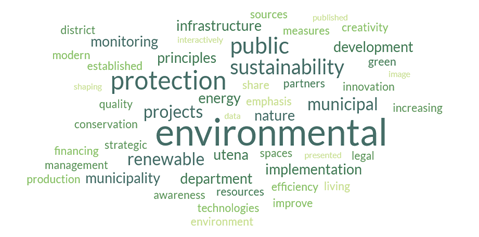
The emphasis on technological and green innovation in the documents indicates a process of institutionalisation – a long-term focus on sustainability, procedural reform and the promotion of innovation (Aliyu, Rogo, and Mahmood, 2015; Wang, 2019; Afum et al., 2020; Vargas-Hernández, Maillard, and Vargas-González, 2024; Elshaer et al., 2024). Structural features are evident in investments in energy-saving technologies, the development of renewable resources, infrastructure modernisation and the strengthening of creativity (Chen, Lin, and Lai, 2023). This direction is consistent with the principles of open organisational structures – functioning as open systems capable of responding to external challenges and integrating them into cultural development – and underpins the importance of GOC as a strategic capability (Aliyu et al., 2015; Wang, 2019; Afum et al., 2020; Vargas-Hernández et al., 2024; Elshaer et al., 2024). The rare use of green visual symbols in Utena District Municipality suggests a higher level of environmental maturity within the organisation. This suggests that environmental protection in the institution functions not as a declarative or external representation, but, instead, as a value orientation that is internalised and implemented in practice. Under such circumstan ces, there is no longer a need to artificially emphasise ecological identity, as environmental provisions are integrated into daily administrative processes and decision-making. Empirical results confirm the structure of green organisational culture outlined in the theoretical part – as all groups of GOC features are identified at the political level, although their intensity varies. The results section is structured according to the groups of GOC features identified in the theoretical part: symbolic, behavioural, structural, and value-based (see Table 4).
In addition to the four dimensions of GOC, the study applies a complementary analytical lens on social welfare. Social welfare is operationalised through references to the quality of life, public health, service accessibility, stakeholder inclusion, and equity considerations in municipal documents. This approach enables the assessment of how environmental governance contributes to broader societal outcomes. Accordingly, social welfare is treated as a cross-cutting outcome of the interaction between value-based, structural, behavioural, and symbolic GOC features.
Table 4.
Identified expressions of the GOC features
|
Feature |
Subcategory and indicator |
Identified expression of the feature |
|---|---|---|
|
Symbolic |
Green communication: Green narrative Transparency and accountability |
Diverse and systematic communication of environmental information to the public. Objective information is provided based on the results of environmental protection activities. |
|
Representation of green values: Green events / campaigns Green symbols / logos |
Promoting environmental awareness through values. The use of green symbols is not emphasised. |
|
|
Empowerment of stakeholders: Existence of inclusion mechanisms Cooperation with other sectors |
Empowerment of stakeholders through decision-making. This takes place through green projects and initiatives. Fragmentation. |
|
|
Behavioural |
Expression of green leadership: Political support Promotion of green practices |
Expression of political will, support and leadership in the field of green change. Recognition in the field of green initiatives. Decisions on the implementation of green initiatives (projects, programmes) have been approved. |
|
Continuity of the green agenda: Continuity of decisions across different terms of office Continuity and transferability of activities |
Green objectives are included in several consecutive strategies and action plans. Consistent funding for a specific area, ongoing projects. New plans are consistent with previous ones. |
|
|
Structural |
Green institutional structure: Changes in the formal structure |
Openness to change, proactivity, implementation of good practices, innovation. |
|
Openness to green technologies and innovations: Implementation of technologies and innovations Innovation financing instruments |
Funding opportunities are being utilised. A bottom-up approach is evident. |
|
|
Value-based |
Green value and ideological basis: Integration of green values and principles |
Maturity, activities linked to a broader ideology of sustainable development. Reflection of environmental protection principles in local legislation. |
|
Value-based |
Clear and achievable green goals: Measures are planned to achieve the goals A timeframe for achieving the goals has been specified |
Specific environmental objectives have been identified. The necessary actions and measures for achieving the objectives have been identified. One of the most prominent forms of expression of values. |
|
Green strategic guidelines: Environmental impact assessment Mission Vision |
Decisions based on environmental impact assessments. The introduction of environmental protection aspects is lacking in mission. A commitment to the environment and sustainability has been established in vision. |
Symbolic features
Symbolic features include green communication, representation of green values, and stakeholder empowerment. The municipality employs consistent green communication through official reports, websites, social media, and traditional press, ensuring transparency and accessibility of environmental information (BSA20; BST9). Green communication in the municipality is expressed through a consistent green narrative and transparency. Environmental information is provided in the section of the website called “Areas of activity / Environmental protection / Latest news”, where reports on waste sorting, energy, biodiversity, etc. have been published since 2020 (BSA20; BSA7). Various channels are used for communication, including social media and traditional press (BST8; BST9; BSA2 – BSA6). Transparency is ensured through public reports that provide objective and measurable indicators, “Utena District Municipality Environmental Monitoring Report 2023” (BST9). Green communication in the municipality is regular, accessible, and well-founded. Green values are represented via campaigns, projects, and events fostering environmental awareness, such as the “Waste Culture” initiative (BSA1; BST3) and projects that foster environmental awareness (BSA1; BSA19; BST3; BST7). The municipality’s approved description of the procedure for financing environmental protection projects (BSA1) is an essential sign of the representation of green values. The financing of local environmental protection projects is part of the activities of the special environmental protection programme, but the municipality itself chooses which activities will receive attention and financing. It has been noted that the use of visual expressions (logos, signs) is poor (BSA19; BSA20). The limited use of visual symbols (logos, badges) suggests that environmental protection is internalised as a core value rather than emphasised through symbolic representation. Although formal documents reflect environmental protection values, their visual expression is not emphasised. Based on the results of the analysis of the content of activity documents, it can be said that superficial and excessive representation of green values is deliberately avoided. The municipality emphasises reasonable and objective green communication and the representation of green values through actions. Stakeholder empowerment is realised through participation mechanisms, surveys, and project-based cooperation, though these remain project-specific rather than systematic (BST3; BST5). The empowerment of stakeholders is manifested through surveys and cooperation with other sectors: “... a survey of residents was conducted ...” (BST5), “Representatives of communities and non-governmental organisations participated in the workshops” (BST4). These mechanisms ensure inclusion in decision-making but are most often applied through project activities rather than systematically (BST3; BST5).
Behavioural features
Behavioural features encompass green leadership and agenda continuity. Political support for environmental initiatives is consistently demonstrated through funding allocations and the promotion of green projects across multiple office terms (2020 – 17, 2021 – 18, 2022 – 18, 2024 – 23), (BSA11–BSA14). At the political level, initiatives in various sectors are promoted: “to encourage legal entities to prepare and implement environmental protection projects related to ecological education, nature studies and nature conservation” (BSA1). The environmental monitoring programme (BST8) demonstrates the desire to strengthen environmental quality management at the municipal level. The municipality’s efforts have been recognised at the national level – notably, since 2022, it has been among the ten greenest municipalities in Lithuania, and, in 2023, it took first place (Ministry of Environment of the Republic of Lithuania, 2024). This is evidence of independent recognition of green leadership. The continuity of the green agenda is identified through the transferability of activities between different terms of office. Continuity is evident in strategic planning, where environmental objectives are maintained and built upon across consecutive plans – the implementation of waste management systems, recycling, and zero-waste technologies (BSA2 – BSA6). Decisions on the development of water management infrastructure (e.g., compensation for connection to networks) are also continued in several strategies (BSA2 – BSA6). The 2023–2024 plans reveal a structural change – the separation of the environmental protection programme from general functions, emphasising the separate objective of “implementing systems that improve environmental quality” (BSA5; BSA6). The institutional separation of the Environmental Protection Programme highlights formalisation and behavioural embedding of GOC.
Structural features
Structural features involve the institutional integration of environmental priorities and openness to green technologies and innovations. The establishment of dedicated departments, committees, and innovation funding mechanisms indicates that environmental goals are formally recognised and operationally integrated (BST11; BSA11; BST2 – BST5). The green institutional structure is identified through changes in the formal structure that establish environmental protection as a strategic priority for the municipality. “The Committee on Environmental Protection, Social, Health and Rural Affairs” is responsible for discussing issues, submitting proposals and monitoring the implementation of decisions (BST11). The establishment “of the Environmental Protection Department” demonstrates the institutional integration of environmental protection: “The aim of the department is to preserve and improve the quality of the environment in the municipality” (BSA11). These structural changes testify to the establishment of green values in the organisation and the transition from isolated initiatives to systematic environmental management. The municipality demonstrates signs of GOC maturity – a clear division of responsibilities and a strategic commitment to green goals. Openness to green technologies and innovations is manifested in the implementation of technological solutions and the creation of innovation financing mechanisms (BST2; BST3; BST5; BSA9; BSA10). The municipality actively uses external funding opportunities, including EU programmes (BST1), to promote the development of green technologies. In addition, environmental protection projects proposed by stakeholders are supported (BSA1), which demonstrates the principles of a bottom-up model and an open system. This feature of the municipality gives it advantages greater transparency, innovation and social legitimacy. The structural features of Utena Municipality’s green economy are reflected in investments in innovative and energy-saving technologies, the development of renewable energy sources, the modernisation of the infrastructure, and the promotion of creativity. Openness to technological solutions and the utilisation of EU and stakeholder funding reflect proactive and adaptive organisational structures, characteristic of a mature GOC.
Value-based features
Value-based features capture the ideological foundation, clear objectives, and strategic guidelines of GOC. Environmental principles such as sustainability, harmony, and conservation are embedded in operational principles and local legislation (BST1 – BST4). This forms the ideological basis of the GOC, from which the formation of green culture begins. An important aspect is the “fostering of an ecologically minded society” (BST2), which shows that environmental protection is perceived as a value-based and educational process. The principles of the “green deal” (BST3; BST4) show the municipality’s desire to link its activities to the ideology of sustainable development, highlighting the maturity of the GOC. Clear and measurable goals, assigned responsibilities, and strategic action plans demonstrate the systematic integration of green values into municipal planning (BST3 – BST8). The green goals are specific, measurable and assigned to responsible implementers: “Implement measures to improve and protect the quality of the environment (responsible – Environmental Protection Department)” (BST6). The tasks set out in the strategic documents are directly linked to the main objective – “to ensure a comfortable and healthy living environment in the district” (BST6). This demonstrates the systematic integration of environmental protection objectives into the municipality’s strategic planning. Green strategic guidelines are expressed through environmental impact assessment, mission and vision. The impact assessment is based on information gathering and the pursuit of sustainable development (BST4 – BST9). The mission emphasises the principles of democracy, public services and efficiency (BST1; BST2), but lacks a direct environmental aspect. Adding a commitment to environmental protection or sustainable activities would strengthen the consistency of the municipality’s values. The vision statement of a “competitive regional centre, a sustainable and prosperous region” (BST3) emphasises long-term sustainability, though mission statements could further strengthen environmental commitment. The dissonance between the mission and the vision can be explained by their different natures – the mission is more administrative, while the vision is value-oriented towards the sustainable development of the region. These findings indicate that value-based features form the core of GOC, while symbolic and structural features provide complementary support.
Quantitative Overview of GOC features
A bar chart (see Figure 3) summarises the frequency of features across analysed documents. Behavioural features are most strongly expressed (78 instances), followed by value-based features (72), indicating that the municipality focuses on implementing sustainable practices and embedding environmental values.
Symbolic features (67) show effective communication but limited visual emphasis, while structural features (53) reflect formal organisational adjustments and openness to innovation. It is worth noting that, although formal changes in the organisational structure are less emphasised in the documents, their content (meaning for the organisation) indicates the maturity of the GOC. This shows that the municipality is taking environmental challenges seriously, and is paying particular attention to their resolution. These findings support the triangulation of qualitative and quantitative analyses, revealing both the extent and intensity of GOC in practice. The municipality demonstrates a mature GOC, with a strong emphasis on practical implementation and value integration. Behavioural and value-based dimensions form the core of environmental culture, ensuring continuity and systematic management, while symbolic and structural features reinforce visibility, legitimacy, and long-term sustainability. Environmental values and principles are integrated into strategic plans, political support and funding are ensured, and specific programmes, projects and environmental monitoring measures are implemented. There is noticeable consistency and continuity, as the green agenda is included in the plans of different terms of office, and individual initiatives gradually develop into systematic environmental management. It has been determined that symbolic features – green symbols and green strategic guidelines for values – should be given additional attention.
Figure 3.
Frequency of green organisational culture features in documents
.png)
Overall, these results confirm the theoretical model of GOC and illustrate how local government institutions can leverage it as a strategic capability to achieve sustainable development goals, integrating environmental, social, and governance objectives. These quantitative patterns support and triangulate the qualitative findings, confirming that behavioural and value-based dimensions form the core of green organisational culture, while structural and symbolic elements provide complementary support. The distribution of features indicates a mature and well-integrated GOC, characterised by both strong practical implementation and a solid value foundation.
Although the empirical findings primarily demonstrate the institutionalisation of environmental values and practices, the results also indicate broader social welfare implications. The integration of environmental objectives into strategic planning, stakeholder participation mechanisms, and continuity of green policies contributes not only to ecological outcomes but also to improved quality of life, social trust, and institutional legitimacy. The municipality’s emphasis on transparency, citizen involvement, and long-term environmental planning reflects a governance approach that links sustainability with social equity and community resilience. In this sense, GOC as a public value-creating mechanism, where environmental governance becomes intertwined with social welfare enhancement. The creation of a “comfortable and healthy living environment” extends beyond environmental protection to encompass public health, social inclusion, and intergenerational responsibility. Thus, GOC should be interpreted not solely as an environmental management capability but as a multidimensional governance capacity supporting sustainable social development.
Discussion
The findings of the study confirm that GOC functions as a strategic organisational capability in the context of local government institution. The case study of Utena District Municipality demonstrates that the four dimensions of GOC identified in the theoretical framework – value-based, structural, behavioural and symbolic – are manifested through strategic planning documents, organisational structures, and environmental initiatives. The results are consistent with previous studies suggesting that GOC acts as an intangible organisational resource enabling organisations to implement sustainability-oriented strategies (Chen, 2011; Gürlek and Tuna, 2018; Afum et al., 2020). In particular, the strong expression of behavioural and value-based features identified in the analysed documents supports the argument that organisational values and leadership commitment play a crucial role in embedding environmental principles into organisational practices. At the same time, the results highlight several specific characteristics of GOC manifestation in the local government institutions. Unlike private sector organisations, where green culture is often linked to competitive advantage, in local government, it is closely related to public value creation, environmental governance and social welfare outcomes. The integration of environmental priorities into strategic planning and governance mechanisms indicates that GOC contributes to the long-term sustainability orientation of the municipality. The findings therefore extend the existing literature by demonstrating how green organisational culture operates as a governance capability within local government institutions. In this context, GOC not only supports environmental policy implementation but also strengthens the capacity of public administration to contribute to sustainable development and social welfare objectives by improving transparency and accountability, enhancing stakeholder participation, supporting environmental quality and public health, and ensuring long-term policy continuity.
Research limitations
Several limitations of this case study should be acknowledged. First, the empirical analysis focuses on a single municipality, which limits the generalisability of the findings to other local government contexts. Second, the case study is based on document analysis, which reflects formal organisational commitments but may not fully capture informal cultural practices or employees’ perceptions. Third, the analysis covers the period of 2020–2024, which provides insight into recent developments but does not allow the assessment of longer-term cultural change processes. Future studies could complement document analysis with interviews or surveys of municipal employees and stakeholders in order to obtain a more comprehensive understanding of the manifestation of GOC.
Future research
Future research could further develop the proposed analytical framework by assigning quantitative weights to the indicators used to assess the manifestation of green organisational culture. In the present study, the maturity of GOC is evaluated through qualitative and quantitative document analysis. However, a weighted indicator model could allow not only identifying the presence of specific cultural features but also measuring their relative significance and the overall degree of organisational maturity. Such an approach would enhance both the analytical precision and the practical applicability of future research in this field.
Conclusions
• The analysis of GOC confirms that it has evolved into a complex, multidimensional construct that integrates value-based orientations with concrete organisational practices. GOC functions as a strategic intangible resource, enhancing organisational capacity to address environmental challenges, improving institutional effectiveness, and supporting the implementation of GPA. Four groups of GOC features – value-based, structural, behavioural, and symbolic – were identified and empirically validated. These features collectively reflect how environmental principles are embedded within public administration organisations.
• GOC is a key element for the effective implementation of GPA. Its expression at both political and executive levels demonstrates the integration of strategic capabilities, organisational structures, leadership behaviours, and symbolic actions necessary to achieve sustainable outcomes. This confirms the theoretical view of GOC as an intangible resource that operationalises environmental governance. Thus, it functions as a strategic local governance capability linking environmental protection with social well-being. In the context of GPA, they not only facilitate environmental protection but also contribute to broader social welfare objectives by promoting transparency, accountability, stakeholder participation, and long-term policy consistency.
• Empirical findings from Utena District Municipality indicate a mature and proactive GOC. This maturity is evident in the systematic integration of green values into political decision-making, continuity of the green agenda across terms of office, openness to innovation, and stakeholder empowerment. The proactive manifestation of GOC creates institutional conditions that support sustainable development and enhances the capacity of public administration to generate tangible social welfare outcomes. Consequently, GOC functions as a mediating mechanism through which environmental governance practices are translated into measurable societal benefits. Quantitative patterns support and triangulate the qualitative findings, confirming that behavioural and value-based dimensions form the core of GOC, while structural and symbolic elements provide complementary support. The distribution of features indicates a mature and well-integrated GOC, characterised by both strong practical implementation and a solid value foundation.
• The findings demonstrate that GOC extends beyond environmental management and contributes to broader social welfare outcomes in local government. The integration of environmental values into organisational culture enhances transparency, accountability, and stakeholder participation, while supporting long-term, sustainability-oriented decision-making. As a result, it strengthens public trust and contributes to improved quality of life and a more sustainable living environment at the municipal level. Overall, the case study confirms that GOC serves as a key organisational mechanism enabling local government to advance both environmental and social objectives.
Author contributions
Sigita Strautnikienė: conceptualization, investigation, methodology, writing – original draft preparation.
Rita Toleikienė: formal analysis, methodology, supervision, visualization.
References
Abbas, J., Dogan, E. (2022). The impacts of organizational green culture and corporate social responsibility on employees’ responsible behaviour towards society. Environmental Science and Pollution Research, 29(40), 60024–60034. https://doi.org/10.1007/s11356-022-20072-w
Afum, E., Agyabeng-Mensah, Y., & Owusu, J. A. (2020). Translating environmental management practices into improved environmental performance via green organizational culture: insight from Ghanaian manufacturing SMEs. Journal of Supply Chain Management Systems, 9(1), 31–49. http://www.publishingindia.com/jscms/41/translating-environmental-management-practices-into-improved-environmental-performance-via-green-organizational-culture-insight-from-ghanaian-manufacturing-smes/875/6041/
Aggarwal, P., Agarwala, T. (2021). Green Organizational Culture: An Exploration of Dimensions. Global Business Review, 26(4), 1103–1126.
Aliyu, M. S., Rogo, H. B., & Mahmood, R. (2015). Knowledge management, entrepreneurial orientation and firm performance: The role of organizational culture. Asian Social Science, 11(23), 140–152. https://doi.org/10.5539/ass.v11n23p140
Azhar, A., & Yang, K. (2019). Workplace and Non-Workplace Pro-Environmental Behaviors: Empirical Evidence from Florida City Governments. Public Administration Review, 79(3), 399–410. https://doi.org/10.1111/puar.13003
Baumgartner, R. J. (2014). Managing corporate sustainability and CSR: A conceptual framework combining values, strategies and instruments contributing to sustainable development. Corporate Social Responsibility and Environmental Management, 21(5), 258–271. https://doi.org/10.1002/csr.1336
Caldatto, F. C., Bortoluzzi, S. C., & De Lima, E. P. (2020). The Role of Public Administration in Sustainable Development. In W. Leal Filho, P. R. Borges De Brito, & F. Frankenberger (Eds.), International Business, Trade and Institutional Sustainability (pp. 69–79). Springer International Publishing. https://doi.org/10.1007/978-3-030-26759-9_4
Chandra, K., Arafah, W., & Basri, Y. Z. (2021). Analysis of the effect of green organizational culture on organizational performance and competitive advantages of green through green innovation in manufacturing industries. Journal of Hunan University Natural Sciences, 48(6), 112–121.
Chang, C. L. H., & Lin, T. C. (2015). The role of organizational culture in the knowledge management process. Journal of Knowledge Management, 19(3), 433–455.
Chen, Y. S. (2011). Green organizational identity: sources and consequences. Management decision, 49(3), 384–404.
Chen, Y. S., Lin, Y. H., & Lai, Y. J. (2023). The determinants of green entrepreneurship: The perspectives of leadership, culture, and creativity. Business Strategy and the Environment, 32(6), 3432–3444. https://doi.org/10.1002/bse.3309
Chowdhury, S. R., Islam, M. A., Guha, S., Rahman, M., & Sanju, N. L. (2025). Assessing the Indirect Nexus Between Green Human Resource Management and Employee Green Behavior: A fuzzy DEMATEL approach. Business Strategy & Development, 8(1), Article e70075. https://doi.org/10.1002/bsd2.70075
Coe, K., & Scacco, J. M. (2017). Content Analysis, Quantitative. In J. Matthes, C. S. Davis, & R. F. Potter (Eds.), The International Encyclopedia of Communication Research Methods (1st ed., pp. 1–11). Wiley. https://doi.org/10.1002/9781118901731.iecrm0045
Dryzek, J. S. (2022). The politics of the earth: Environmental discourses. Oxford: Oxford University Press.
Dumont, J., Shen, J., & Deng, X. (2017). Effects of green HRM practices on employee workplace green behavior: The role of psychological green climate and employee green values. Human resource management, 56(4), 613–627. https://doi.org/10.1002/hrm.21792
Elo, S., Kyngäs, H. (2008). The qualitative content analysis process. Journal of advanced nursing, 62(1), 107–115. https://doi.org/10.1111/j.1365-2648.2007.04569.x
Elshaer, I. A., Azazz, A. M. S., Kooli, C., Alqasa, K. M. A., Afaneh, J., Fathy, E. A., Fouad, A. M., & Fayyad, S. (2024). Resilience for Sustainability: The Synergistic Role of Green Human Resources Management, Circular Economy, and Green Organizational Culture in the Hotel Industry. Administrative Sciences, 14(11), Article 297. https://doi.org/10.3390/admsci14110297
Fernández, E., Junquera, B., & Ordiz, M. (2003). Organizational culture and human resources in the environmental issue: a review of the literature. International Journal of Human Resource Management, 14(4), 634–656.
Firoz, N. M., & Abinakad, M. (2016). Food Safety and ethics in foreign markets. Conflict Resolution & Negotiation Journal, 2016(4), 63–76.
Fuentes-Bargues, J. L., Ferrer-Gisbert, P. S., González-Cruz, M. C., & Bastante-Ceca, M. J. (2019). Green public procurement at a regional level. Case study: The Valencia region of Spain. International Journal of Environmental Research and Public Health, 16(16), Article 2936. https://doi.org/10.3390/ijerph16162936
Gaižauskaitė, I., Mikėnė, S. (2014). Socialinių tyrimų metodai: apklausa: vadovėlis [Methods of Social Research: Survey: Textbook]. Vilnius: Mykolo Romerio universitetas. https://cris.mruni.eu/server/api/core/bitstreams/fd33de72-6951-49ef-a787-4e8190f17a0f/content
García-Machado, J. J., & Martínez-Ávila, M. (2019). Environmental performance and green culture: The mediating effect of green innovation. An application to the automotive industry. Sustainability, 11(18), Article 4874. https://doi.org/10.3390/su11184874
Gürlek, M., Tuna, M. (2018). Reinforcing competitive advantage through green organizational culture and green innovation. The Service Industries Journal. 38(7–8), 467–491. https://doi.org/10.1080/02642069.2017.1402889
Hadi, F. S., Wartini, S., & Widjaja, M. L. K. (2022). Green Organizational Culture as Mediator of the Effect of Knowledge Creation on Green Performance. In 19th International Symposium on Management (INSYMA 2022) (pp. 239–246). Atlantis Press. https://doi.org/10.2991/978-94-6463-008-4_32
Hadjri, M. I., Perizade, B., & Farla, W. (2019). Green human resource management, green organizational culture, and environmental performance: An empirical study. In 2019 International Conference on Organizational Innovation (ICOI 2019) (pp. 138–143). Atlantis Press. https://doi.org/10.2991/icoi-19.2019.25
Harris, L. C., & Crane, A. (2002). The greening of organizational culture: Management views on the depth, degree and diffusion of change. Journal of Organizational Change Management, 15(3), 214–234.
Hart, S. L. (1995). A natural-resource-based view of the firm. Academy of Management Review, 20(4), 986–1014. https://doi.org/10.2307/258963
Hastuti, D. T., & Muafi, M. (2022). The influence of organizational environmental culture on employee performance mediated by green human resource management (GHRM) and job satisfaction. International Journal of Business Ecosystem & Strategy (2687–2293), 4(1), 24–36. https://doi.org/10.36096/ijbes.v4i1.302
Hatch, M. J. (1993). The dynamics of organizational culture. Academy of Management Review, 18(4), 657–693. https://doi.org/10.5465/amr.1993.9402210154
Imran, M., Arshad, I., & Ismail, F. (2021). Green Organizational Culture and Organizational Performance: The Mediating Role of Green Innovation and Environmental Performance. Jurnal Pendidikan IPA Indonesia, 10(4), 515–530. https://doi.org/10.15294/jpii.v10i4.32386
Jabbour, C. J. C., & De Sousa Jabbour, A. B. L. (2016). Green Human Resource Management and Green Supply Chain Management: Linking two emerging agendas. Journal of Cleaner Production, 112, 1824–1833. https://doi.org/10.1016/j.jclepro.2015.01.052
Janićijević, N. (2011). Methodological approaches in the research of organizational culture. Economic Annals, 56(189), 69–99. https://doi.org/10.2298/EKA1189069J
Jordan, A., Huitema, D., Van Asselt, H., & Forster, J. (2018). Governing climate change: Polycentricity in action? Cambridge: Cambridge University Press.
Jung, T., Scott, T., Davies, H. T. O., Bower, P., Whalley, D., McNally, R., & Mannion, R. (2016). Instruments for the Exploration of Organisational Culture - Compendium of Instruments. School of Management, University of St Andrews: St Andrews, UK.
Kettl, D. F. (2015). The transformation of governance: Public administration for the twenty-first century. Baltimore: JHU Press.
Khodaparasti, R. B., & Garabollagh, H. B. (2023). Antecedents and consequences of green public administration. Administratie si Management Public, (40), 39–57.
Lasytė, G. (2020). Socially responsible organisational governance in the public sector. Public Policy and Administration, 19(3), 119–132. http://dx.doi.org/10.5755/j01.ppaa.19.3.27713
Lietuvos Respublikos Aplinkos apsaugos ministerija. (2024). Lietuvos savivaldybių aplinkosaugos reitingas 2023 [Environmental Ranking of Lithuanian Municipalities 2023]. https://am.lrv.lt/lt/lietuvos-savivaldybiu-aplinkosaugos-reitingas-puslapis/lietuvos-savivaldybiu-aplinkosaugos-reitingas-2023/
László, V., Pollák, K., & Balogh-Békesi, N. (2024). Towards Green Public Administration: Goals and Principles. Hungarian EUPAN Presidency. https://www.eupan.eu/wp-content/uploads/2024/12/HU_EUPAN_Study-on-Green-Public-Administration-Goals-and-Principles.pdf
Linneberg, M. S., & Korsgaard, S. (2019). Coding qualitative data: a synthesis guiding the novice. Qualitative Research Journal, 19(3), 259–270. https://doi.org/10.1108/QRJ-12-2018-0012
Linnenluecke, M. K., Griffiths, A. (2010). Corporate sustainability and organizational culture. Journal of World Business, 45(4), 357–366. https://doi.org/10.1016/j.jwb.2009.08.006
Liu, X., Lin, K. L. (2020). Green organizational culture, corporate social responsibility implementation, and food safety. Frontiers in Psychology, 11, Article 585435.
Maheshwari, S., Kaur, A., & Renwick, D. W. (2024). Green human resource management and green culture: an integrative sustainable competing values framework and future research directions. Organization & environment, 37(1), 32–56. https://doi.org/10.1177/10860266231217280
Meadowcroft, J. (2006). 4 Environmental political economy, technological transitions and the state. In A. Payne (Ed.), Key Debates in New Political Economy (pp. 57–78). London: Routledge.
Niestroy, I., & Meuleman, L. (2022). Managing the implementation of the SDGs. Publications Office of the European Union.
Ngubane, Z. (2024). Green Procurement Adoption and Environmental Sustainability: A Study of Public Sector Organizations in South Africa. Global Journal of Purchasing and Procurement Management, 3(1), 55–68. https://doi.org/10.47604/gjppm.2466
Molino, J. (2023). Public Procurement and CSR. In S. O. Idowu, R. Schmidpeter, N. Capaldi, L. Zu, M. Del Baldo, & R. Abreu (Eds.), Encyclopedia of Sustainable Management (pp. 2697–2705). Springer International Publishing. https://doi.org/10.1007/978-3-031-25984-5_908
Noble, H., & Heale, R. (2019). Triangulation in research, with examples. Evidence-based nursing, 22(3), 67–68. https://doi.org/10.1136/ebnurs-2019-103145
Norton, T. A., Zacher, H., & Ashkanasy, N. M. (2015). Pro-Environmental Organizational Culture and Climate. In J. L. Robertson & J. Barling (Eds.), The Psychology of Green Organizations (pp. 322–348). Oxford University Press. https://doi.org/10.1093/acprof:oso/9780199997480.003.0014
Osborne, S. P., Radnor, Z., Kinder, T., & Vidal, I. (2015). The SERVICE framework: A public‐service‐dominant approach to sustainable public services. British journal of management, 26(3), 424–438. https://doi.org/10.1111/1467-8551.12094
Patapas, A., Labenskytė, G. (2011). Organizacinės kultūros ir vertybių tyrimas N apskrities valstybinėje mokesčių inspekcijoje [Study of Organizational Culture and Values at the State Tax Inspectorate of N County]. Public Policy and Administration, 10(4), 589–603.
Paužuolienė, J. (2018). Organizacinės kultūros elementų ištyrimas taikant kokybinį tyrimo metodą [Investigation of Organizational Culture Elements Using a Qualitative Research Method]. In Studijos–verslas–visuomenė: dabartis ir ateities įžvalgos III: tarptautinės konferencijos mokslinių straipsnių rinkinys [In Studies–Business–Society: Present and Future Insights III: Proceedings of the International Scientific Conference] (pp. 81–92).
Piwowar-Sulej, K. (2020). Pro-Environmental Organizational Culture: Its Essence and a Concept for Its Operationalization. Sustainability, 12(10), Article 4197. https://doi.org/10.3390/su12104197
Porter, T. H., Gallagher, V. C., & Lawong, D. (2016). The greening of organizational culture: revisited fifteen years later. American Journal of Business, 31(4), 206–226. https://doi.org/10.1108/AJB-04-2016-0011
Rainey, H. G., & Bozeman, B. (2000). Comparing public and private organizations: Empirical research and the power of the a priori. Journal of public administration research and theory, 10(2), 447–470. https://doi.org/10.1093/oxfordjournals.jpart.a024276
Rădulescu, C. V., Mănescu, C. O., Popescu, M. L., & Burlacu, S. (2023). Sustainable Development in Public Administration: Research, Practice, and Education. European Journal of Sustainable Development, 12(4), 27–27. https://doi.org/10.14207/ejsd.2023.v12n4p27
Roscoe, S., Subramanian, N., Jabbour, C. J., & Chong, T. (2019). Green human resource management and the enablers of green organisational culture: Enhancing a firm’s environmental performance for sustainable development. Business Strategy and the Environment, 28(5), 737–749. https://doi.org/10.1002/bse.2277
Schein, E. H. (1990). Organizational culture. American Psychologist, 45(2), 109–119. https://doi.org/10.1037/0003-066X.45.2.109
Siswanti, Y., & Muafi, M. (2022). Ethical Leadership Style in Moderating the Influence of Green Organizational Culture on Green Innovative Behavior: SMEs Cases. International Journal of Sustainable Development & Planning, 17(4), 1153–1160. https://doi.org/10.18280/ijsdp.170413
Shahriari, M., Tajmir Riahi, M., Azizan, O., & Rasti-Barzoki, M. (2023). The effect of green organizational culture on organizational commitment: The mediating role of job satisfaction. Journal of Human Behavior in the Social Environment, 33(2), 180–197. https://doi.org/10.1080/10911359.2022.2029789
Smirnova, J. (2024). Organizacijos veiklos vykdymo žaliąja kryptimi vertinimas [Assessment of an Organization’s Activities in the Green Direction]. Daktaro disertacija, Vilniaus universiteto Šiaulių akademija [PhD Thesis, Vilnius University Siauliai Academy].
Smirnova, J. (2021). Strateginio valdymo sprendimų žaliųjų organizacijų plėtrai identifikavimas, didinant žaliąjį tapatumą nematerialiųjų organizacijos išteklių kontekste [Identification of Strategic Management Decisions for the Development of Green Organizations by Enhancing Green Identity in the Context of Intangible Organizational Resources]. In 24-osios Lietuvos jaunųjų mokslininkų konferencijos „Mokslas – Lietuvos ateitis“ teminė konferencija, 2021 m. spalio 21 d., Vilnius, Lietuva. [In 24th Conference of Young Scientists of Lithuania “Science – Future of Lithuania”, October 21, 2021, Vilnius, Lithuania]. https://etalpykla.vilniustech.lt/handle/123456789/156312
Szczepańska, K., & Kosiorek, D. (2017). Factors influencing organizational culture. Zeszyty Naukowe. Organizacja i Zarządzanie/Politechnika Śląska, (100), 457–468. https://repo.pw.edu.pl/info/article/WUTf845386dd78e4b7b893312b93802a572/
Štareikė, E. (2013). Darnaus vystymosi principo įgyvendinimo probleminiai aspektai [Problematic Aspects of the Implementation of the Principle of Sustainable Development]. Management Theory & Studies for Rural Business & Infrastructure Development, 35(2), 284–296.
Tahir, R., Athar, M. R., Faisal, F., Solangi, B. (2019). Green organizational culture: A review of literature and future research agenda. Annals of Contemporary Developments in Management & HR (ACDMHR), 1(1), 23–38.
Tauginienė, L. (2015). Socialiai atsakingas universitetas [Socially Responsible University]. In S. Žičkienė (Red.), Socialinė atsakomybė versle ir viešajame sektoriuje. Mokslo studija [Social Responsibility in Business and the Public Sector: Academic Study] (pp. 253–274). Vilnius: BMK leidykla.
Vanagas, R., Vyšniauskienė, L. (2012). Vadybos pagrindai: vadovėlis [Fundamentals of Management: Textbook].Vilnius: Mykolo Romerio universitetas.
Vargas-Hernández, J. G., Maillard, C. A. R., & Vargas-González, O. C. (2023). Green Organizational Culture, Green Innovation, and Green Performance for Achieving Environmental Sustainability: In I. R. Management Association (Ed.), Research Anthology on Business Law, Policy, and Social Responsibility (pp. 932–953). IGI Global. https://doi.org/10.4018/979-8-3693-2045-7.ch049
Wang, C.-H. (2019). How Organizational Green Culture Influences Green Performance and Competitive Advantage. Journal of Manufacturing Technology Management, 30(4), 666–683. https://doi.org/10.1108/JMTM-09-2018-0314
Zeemering, E. S. (2018). Sustainability management, strategy and reform in local government. Public Management Review, 20(1), 136–153. https://doi.org/10.1080/14719037.2017.1293148
Žydžiūnaitė, V., & Sabaliauskas, S. (2017). Kokybiniai tyrimai. Principai ir metodai [Qualitative research. Principles and methods]. Vilnius: Vaga.