Taikomoji kalbotyra, 23: 1–15 eISSN 2029-8935
https://www.journals.vu.lt/taikomojikalbotyra DOI: https://doi.org/10.15388/Taikalbot.2026.23.1
Dace Aleksandraviča
University of Latvia
https://orcid.org/0009-0004-5100-3006
https://ror.org/05g3mes96
dace.aleksandravica@gmail.com
Abstract. This article aims to conceptualise foreign language learners’ identity as an ecological and agentive phenomenon. Drawing on ecolinguistics and sociocultural theories of agency, the study adopts a theory-synthesising and conceptual model-building approach to integrate insights from these perspectives. Through critical analysis and conceptual integration of key literature, the paper proposes an Ecological Model of Learner Identity that situates identity at the intersection of ecological context, learner agency, and discursive practice. Within this framework, learner identity is understood as an emergent, relational, and adaptive process shaped by ongoing interaction between individual intentionality and sociocultural-institutional conditions. The model offers a holistic theoretical framework for advancing research and practice in applied linguistics and educational ecolinguistics.
Keywords. agency, ecolinguistics, language ecology, identity, foreign language learning, languaging
Santrauka. Šio straipsnio tikslas – konceptualizuoti užsienio kalbų besimokančiųjų tapatybę kaip ekologinį ir agentyvų reiškinį. Remiantis ekolingvistikos ir sociokultūrinėmis veiksnumo teorijomis, tyrime taikomas teorijos sintezės ir konceptualaus modelio kūrimo metodas, siekiant integruoti įžvalgas iš šių perspektyvų. Atlikus kritinę pagrindinės literatūros analizę ir konceptualiai integravus pagrindinę literatūrą, straipsnyje siūlomas ekologinis besimokančiojo tapatybės modelis, kuriame tapatybė pateikiama ekologinio konteksto, besimokančiojo veiksnumo ir diskursyvios praktikos sankirtoje. Šiame kontekste besimokančiojo tapatybė suprantama kaip besiformuojantis, reliacinis ir adaptyvus procesas, kurį formuoja nuolatinė individualios intencijos ir sociokultūrinių-institucinių sąlygų sąveika. Šis modelis siūlo holistinį teorinį pagrindą taikomosios kalbotyros ir edukacinės ekolingvistikos tyrimams ir praktikai tobulinti.
Raktažodžiai. veiksnumas, ekolingvistika, kalbos ekologija, tapatybė, užsienio kalbų mokymasis, kalbėjimas
_________
Copyright © 2026 Dace Aleksandraviča. Published by Vilnius University Press.
This is an Open Access article distributed under the terms of the Creative Commons Attribution Licence, which permits unrestricted use,
distribution, and reproduction in any medium, provided the original author and source are credited.
In recent decades, applied linguistics has undergone an ecological turn, moving beyond structuralist and cognitivist paradigms toward perspectives that foreground the interdependence of language, environment, and social practice (Haugen 1972; Fill 2018; Steffensen and Fill 2014; Stibbe 2015, 2021). Within this framework, ecolinguistics conceptualises language as part of a living system in which human communication is dynamically embedded in cultural, ideological, and institutional ecologies (Steffensen 2024). This approach has illuminated how discourses, power relations, and symbolic resources shape human meaning-making and, by extension, the ways individuals learn and use languages in socially situated environments (Kramsch and Steffensen 2008; Cowley 2018). As a result, ecolinguistics has increasingly intersected with applied linguistic concerns such as multilingualism, classroom discourse, and the sustainability of language education (van Lier 2004; Luardini 2018; Aleksandravica 2025b).
At the same time, identity and agency have become central constructs in contemporary second and foreign language research (Duff 2012; Darvin and Norton 2015; Larsen-Freeman et al. 2021; Aleksandravica 2025a, 2025b). Learners are no longer viewed as passive recipients of input but as active agents who negotiate meanings, invest in particular discourses, and reposition themselves within linguistic and social hierarchies (Pavlenko and Blackledge 2004; Block 2007; Aleksandravica 2025a). Identity, in this sense, is understood as a discursive, fluid process shaped through interaction and influenced by sociocultural affordances and constraints (van Lier 2004; Steffensen and Fill 2014).
Yet, despite the conceptual proximity between ecolinguistics, agency, and identity, these three strands have often developed in parallel. Research grounded in identity theory has tended to focus on narrative and positioning, while ecolinguistic studies have prioritized discourse and environment, rarely integrating the learner’s agentive role in shaping those ecologies (Zhou 2021: 463). Conversely, agency-focused accounts in foreign language acquisition have emphasised psychological or sociocognitive processes, often abstracted from the ecological contexts in which learners act (Bandura 2001; Duff 2012; Larsen-Freeman et al. 2021). This theoretical separation limits our understanding of how learners’ identities emerge within the interdependent networks of people, ideologies, and material conditions that define language ecologies.
The aim of this article is to develop a theoretically grounded ecological model of foreign language learners’ identity by systematically integrating perspectives from ecolinguistics (Haugen 1972; Steffensen and Fill 2014; Stibbe 2015, 2021) and sociocultural theories of agency (Bandura 2001; Lantolf and Thorne 2006; Duff 2012). Specifically, the study seeks to conceptualise learner identity as an emergent ecological process arising from the dynamic interaction between ecological context (linguistic affordances, institutional and ideological structures), learner agency (intentionality, investment, resistance, and adaptation), and discursive practice (languaging and identity enactment). Within this framework, identity is viewed not as a fixed attribute but as an emergent, relational, and adaptive phenomenon, which is the outcome of continuous interaction between individual intentionality and ecological conditions.
By advancing this integrative model, the paper contributes to current debates in educational ecolinguistics (Steffensen 2024) and identity approach to foreign language acquisition (Darvin and Norton 2015); it does so by foregrounding the mutual shaping of agency and environment in the construction of learner identities. Conceptualising identity ecologically highlights how empowering learners as agents within linguistically diverse environments can further foster sustainable, inclusive, and ethically grounded language education (Cummins 2000; Stibbe 2015, 2021; Aleksandravica 2025b). This ecological framing foregrounds the relational and material dimensions of learning environments in ways that extend, rather than replace, existing pedagogical principles. Established pedagogical traditions (including sociocultural pedagogy (Vygotsky 1978; Lantolf and Thorne 2006), constructivist approaches (Bruner 1996; Piaget 1972), communicative language teaching (Richards and Rodgers 2001), and critical pedagogy (Freire 1970; Pennycook 1994)) have long emphasised learners’ active engagement, agency, and the relational nature of learning. What distinguishes the present contribution, however, is not the novelty of humanistic aims per se but rather the ecological integration of these aims with an explicit theorisation of how identity is co-constructed through dynamic interactions between learners and their linguistic ecologies. The following sections develop this argument by first outlining the theoretical foundations of ecolinguistics and agency, then elaborating the proposed ecological model of learner identity, and finally discussing its implications for foreign language pedagogy and research.
As mentioned earlier, the Ecological Model of Learner Identity was constructed through a process of theoretical synthesis and conceptual integration drawing on established literature in ecolinguistics, sociocultural theory, and identity research in applied linguistics. The methodological procedure involved three interrelated stages. Firstly, key theoretical constructs related to language ecology, learner agency, and identity were identified through a critical review of foundational and contemporary scholarship in these domains. Secondly, these constructs were subjected to comparative conceptual analysis in order to examine points of convergence, tension, and complementarity across theoretical traditions. Last but not least, the model was developed through an iterative process of abstraction and integration, resulting in an analytical framework that captures the relationships among ecological context, learner agency, and discursive practice.
Rather than proposing a prescriptive or empirically exhaustive model, the framework is intended as a heuristic and analytical tool for understanding how learner identity emerges through agentive engagement within specific linguistic ecologies. The model is thus open-ended and designed to inform future empirical research, pedagogical reflection, and context-sensitive analysis of foreign language learning processes.
While ecolinguistics encompasses a broad range of theoretical perspectives on language-environment relations, this section selectively focuses on those strands most relevant to language learning and pedagogy. Rather than offering a comprehensive overview of ecolinguistic theory, the discussion foregrounds concepts that inform the present study’s understanding of learners as participants in dynamic linguistic ecologies. In particular, the notions of language ecology, affordances, and relational meaning-making are interpreted here through their implications for learner agency, identity, and educational practice.
The emergence of ecolinguistics reflects the recognition that language functions within interdependent ecological systems comprising not only the physical environment but also the social, cultural, and symbolic dimensions of human life (Haugen 1972; Fill 2018; Steffensen and Fill 2014). Haugen’s (1972: 325) foundational definition of language ecology as “the study of interactions between any given language and its environment” established the field’s orientation toward the relationships between linguistic practices and the societies that sustain them. In the context of the present study, Haugen’s ecological understanding of language is particularly relevant because it foregrounds the interdependence between language users and their sociocultural environments. This perspective supports the view that foreign language learners do not acquire language in isolation but participate in dynamic linguistic ecologies that shape and are shaped by their identity-related choices.
Haugen’s perspective was later expanded by Halliday (1990) and Fill (2018), who emphasised the ideological and ethical responsibilities of language in shaping human behaviour and environmental awareness. Accordingly, ecolinguistics is not solely descriptive but also normative, as it is concerned with promoting discourses that foster ecological and social well-being while resisting those that perpetuate inequality or harm (Stibbe 2015: 6–9).
When it comes to more recent scholarship, scholars have identified a range of overlapping subfields, including discourse-based, cognitive, educational, and identity-centred ecolinguistics (Steffensen 2024). While the majority of ecolinguistic research remains discourse-oriented, however, Steffensen (2024: 15–16) highlights the growing importance of studies that address the human dimension – specifically, how individuals act, perceive, and adapt within language ecologies. From the standpoint of this article, such ecological dynamics are especially significant because they allow learner identity to be conceptualised as an emergent phenomenon rather than a stable personal attribute. Steffensen and Fill’s emphasis on relationality and co-action thus provides a theoretical foundation for understanding how agency operates across individuals, practices, and institutional structures in language learning contexts.
This human-centred orientation is particularly relevant for language learning, where learners continuously interact with multiple semiotic environments that afford or constrain participation (van Lier 2004). From this viewpoint, learning a foreign language entails navigating a complex ecology of affordances, such as classroom norms, institutional discourses, peer networks, and wider ideological structures (Steffensen and Fill 2014; Kramsch and Steffensen 2008).
Van Lier (2004: 5) defines affordances as the perceived opportunities for action that arise through interaction between the learner and the environment. These affordances are not fixed properties but emergent relations or possibilities that depend on the learner’s goals, agency, and history of participation. Thus, ecological perspectives move beyond mechanistic views of input and output to foreground the relational, adaptive, and co-constructed nature of language learning. In this sense, ecolinguistics provides a macro-framework for understanding language not as an abstract code but as a living practice situated within overlapping ecosystems of discourse, ideology, and identity (Kramsch 2000; Cowley 2018; Aleksandravica 2025b). In educational terms, van Lier’s notion of affordances is central to the present argument, as it highlights how learning opportunities are neither fully determined by the environment nor solely by the learner. This understanding provides the ecological basis for conceptualising learner identity in this article as emerging through agentive engagement with available, perceived, and negotiated affordances.
Identity has long been recognised as a central concept in applied linguistics, particularly in understanding how individuals relate to language, culture, and power (Pavlenko and Blackledge 2004; Block 2007; Norton, Jones and Ahimbisibwe 2011). In line with poststructuralist perspectives, identity is viewed as a socially constructed, multiple, and dynamic process that emerges through discourse and interaction. Pavlenko and Blackledge (2004: 14) outline five analytical dimensions of identity: (1) its location within particular discourses and ideologies; (2) its embeddedness within relations of power; (3) its multiplicity and hybridity; (4) its imagined and aspirational dimensions; and (5) its construction through narrative and positioning. These dimensions resonate strongly with ecological thinking, which likewise conceives of identity as relational and context–sensitive.
Darvin and Norton (2015) advance the notion of investment to capture the link between identity and language learning. Investment reflects learners’ commitment to language practices that align with their imagined identities and desired forms of social participation. Through investment, learners negotiate the tension between the affordances of their environment and their own aspirations, thereby exercising agency. In this sense, identity and agency are mutually constitutive, since agency enables learners to enact desired identities, while identity provides the motivational frame for agentive action (Darvin and Norton 2015; Ishihara 2019).
Recent ecological and narrative approaches further underscore the processual nature of identity formation. Identity is not merely influenced by the linguistic environment but also contributes to shaping it through interaction, resistance, and adaptation (Kramsch and Steffensen 2008; Ishihara 2019; Steffensen 2024). Learners’ self-representations evolve as they engage in languaging – the dialogic process of making meaning through language (Swain 2006). Through languaging, learners externalise thought, negotiate understanding, and re-position themselves within their learning ecologies. Consequently, identity is enacted, rather than possessed, and its development constitutes a central mechanism through which language learning becomes a transformative ecological experience.
Within sociocultural theory, agency is understood as the capacity of individuals to act intentionally and to influence or transform the circumstances of their environment (Bandura 2001; Lantolf and Thorne 2006; Duff 2012). Bandura (2001: 8) identifies three interrelated types of agency – personal, proxy, and collective, which reflect the ways individuals act independently, through others, or collaboratively within social systems. In the context of foreign language learning, agency encompasses self-regulation, motivation, investment, and the capacity to negotiate identity and participation (Duff 2012; Darvin and Norton 2015; Aleksandravica 2025a).
From an ecological standpoint, agency is distributed across networks of people, artefacts, and institutional structures rather than residing solely within the individual (van Lier 2004; Larsen-Freeman et al. 2021). Learners’ actions are mediated by cultural tools, such as language, technology, and pedagogy, which both enable and constrain their possibilities for acting. Consequently, agency is relational: it emerges through the interplay between learners and the affordances of their environment. As Steffensen and Fill (2014: 7) note, language users continuously adapt to the sociocultural ecologies in which they participate, drawing upon available resources while also reshaping them.
This perspective aligns with dynamic systems theory (van Geert 2008), which conceptualises learning as a nonlinear process characterised by adaptation, self-organisation, and emergence. Agency within such systems is not static but fluctuates in response to contextual and temporal conditions. Learners may demonstrate high degrees of initiative and self-direction in one context yet experience constraint in another, reflecting the interdependence of personal intentionality and environmental structure (Ahearn 2001; Duff 2012; Huang 2013). In educational ecologies, therefore, agency is both an outcome of learning and a driving force behind it – a crucial part of an ecological process of intentional participation and adaptation.
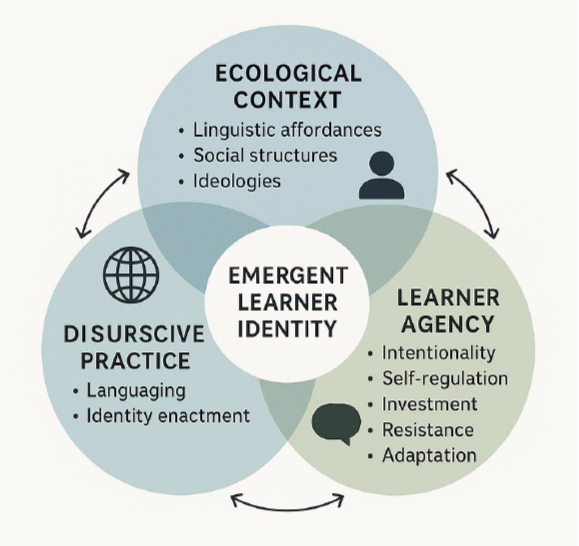
Bringing together insights from ecolinguistics, sociocultural theory, and identity research allows for a reconceptualisation of foreign language learners’ identity as an emergent ecological process. Building on the theoretical perspectives reviewed above, I propose an Ecological Model of Learner Identity that integrates ecological context, learner agency, and discursive practice. Within this framework, identity arises through the dynamic interaction of three interrelated dimensions: (1) ecological context, (2) learner agency, and (3) discursive practice. These dimensions form a continuous feedback loop, wherein changes in one dimension influence and are influenced by the others.
Ecological context refers to the network of linguistic, social, and institutional affordances that shape learners’ opportunities for participation and meaning-making (van Lier 2004; Steffensen and Fill 2014). It includes material and symbolic environments, such as classroom interactions, curriculum design, language ideologies, and power relations, that enable or constrain linguistic action. Learner agency denotes the intentional, adaptive capacity to navigate and transform these affordances (Bandura 2001; Duff 2012). As it has already been mentioned, agency is not an isolated attribute but an ecological phenomenon distributed across relationships, cultural tools, and temporal scales (Larsen-Freeman et al. 2021). Discursive practice, on the other hand, constitutes the level at which agency and context intersect, whereby through languaging, learners enact, negotiate, and sometimes resist identity positions within specific social ecologies (Swain 2006; Pavlenko and Blackledge 2004).
Conceptually, this triadic relationship can be visualised as a dynamic system rather than a static model. Accordingly, Figure 1 visualises the conceptual synthesis developed in this paper. The overlapping circles represent the co-dependence of ecological context, learner agency, and discursive practice, while the central convergence – emergent learner identity – symbolises the dynamic equilibrium produced by their continuous interaction.
The arrows between the dimensions indicate continuous mutual influence, whereby ecological context shapes the conditions for action, agency mediates learners’ engagement with those conditions and discursive practice materialises both identity and ecological change. Thus, identity is not located within the learner or the environment but emerges between them – within the ongoing, dialogic relationship that constitutes language use itself.
In educational terms, this model foregrounds the co–adaptive nature of language learning – as learners act agentively within their environments, they simultaneously reconfigure the ecology in which their identities are formed. Such an understanding aligns with Steffensen’s (2024: 15) call for identity-centred ecolinguistics that examines how individuals’ meaning-making contributes to the evolving dynamics of social ecosystems.
As Figure 1 illustrates, agency serves as the pivotal mediating process linking ecological context and identity. It provides the mechanism through which learners transform affordances into meaningful participation. As van Lier (2004: 91) notes, “agency bridges perception and action,” turning potential affordances into realised learning opportunities. In this sense, agency functions both reactively (responding to the constraints of context) and proactively (reshaping the environment to better align with learners’ goals and identities).
In foreign language learning, agency manifests through investment, resistance, and adaptation (Darvin and Norton 2015; Ishihara 2019). Learners invest in linguistic practices that reflect their imagined communities and aspirational selves (Norton 2001), yet they also resist discourses that marginalise or misrepresent them. Ishihara (2019) demonstrates, for example, how EFL learners exercise pragmatic resistance by diverging from native-speaker norms to maintain cultural authenticity and self-respect, which the scholar interprets as acts of agency that directly shape identity construction. Similarly, Bondare’s (2023) study of Latvian youth reveals how English is appropriated as a means of connecting with global networks while sustaining local identities, illustrating the dual ecological role of English as both global resource and local identity marker.
Agency therefore mediates between macro-level structures (language policies, institutional discourses) and micro-level identity practices (self–positioning, narrative construction). Through agentive engagement, learners can challenge the asymmetries inherent in linguistic hierarchies (Philipson and Skutnabb-Kangas 2018) and expand their participation spaces. Such processes exemplify Cummins’s (2000: 44) notion of collaborative power dynamics, where empowerment arises through dialogic interaction rather than imposed authority. Within the ecological model, agency thus functions as the key adaptive force that enables learners to transform both themselves and their learning environments.
The concept of languaging provides the discursive dimension of the ecological model by highlighting how identity becomes visible through the act of language use (Swain 2006; Blin and Jalkanen 2014). Languaging encompasses the dialogic and embodied processes by which individuals make meaning, articulate thought, and negotiate social positioning. In ecological terms, it is the principal mechanism through which agency operates within context, where intention meets environment through discourse (Cowley 2018).
Through languaging, learners externalise cognition, construct shared understanding, and co-create identities. Every communicative act simultaneously reflects the learner’s positioning within a social field and reshapes that field by introducing new meanings and alignments. For instance, classroom interactions that encourage collaborative dialogue enable students to engage in reflexive languaging – discussing their own linguistic choices, experiences, and identities – thus enhancing both agency and ecological awareness (van Lier 2004; Kramsch and Steffensen 2008). Similarly, narrative practices such as learner journals or autobiographical storytelling facilitate narrative identity work, allowing learners to interpret their linguistic trajectories and reposition themselves within broader cultural ecologies (Block 2007; Pavlenko and Norton 2007).
From an ecolinguistic standpoint, languaging is not limited to spoken or written utterances but encompasses multimodal and translingual practices that reflect the complexity of contemporary communicative environments (Steffensen and Fill 2014). When learners move fluidly between languages and semiotic resources, they enact identities that transcend traditional linguistic boundaries, engaging in what could be described as identity negotiation across scales (Darvin and Norton 2015). Such enactments reveal that identity construction is an ecological phenomenon, since it unfolds within, and contributes to, the dynamic evolution of linguistic ecosystems.
Therefore, identity enactment through languaging completes the triadic model proposed here. It is in the situated discursive moment wherein ecological conditions meet agentive action that the learner’s identity is continuously (re)constituted (Aleksandravica 2025a).
The pedagogical implications discussed in this section do not claim originality with respect to general principles of contemporary teaching. Learner-centred instruction, collaborative interaction, reflective practice, and meaningful participation have long been emphasised in communicative language teaching, task-based learning, sociocultural pedagogy, and humanistic education (Freire 1970; Richards and Rodgers 2001; Lantolf and Thorne 2006; Petty 2004, 2006). The specific contribution of the present study lies not in proposing new pedagogical methods but in reinterpreting these established principles through an ecological lens that foregrounds learner identity. From this perspective, educational settings are understood as linguistic ecologies in which institutional structures, interactional norms, and ideological orientations shape learners’ opportunities for agency, participation, and identity enactment (van Lier 2004; Steffensen and Fill 2014).
Within the proposed framework, educational institutions are conceptualised as sites of representation and positioning, where language learning is inseparable from processes of identity construction (Miller 2004; Norton 2013). Institutional policies, assessment practices, and classroom discourse constitute ecological conditions that afford or constrain learners’ participation as legitimate language users. From an identity perspective, pedagogical practices matter not only because of their instructional effectiveness, but because they influence how learners perceive their own voice, legitimacy, and belonging within the learning ecology.
Building on Cummins’ (2000) distinction between coercive and collaborative power relations, the ecological model highlights how institutional arrangements can either restrict or expand learners’ identity options. Collaborative pedagogical practices, such as dialogic interaction, shared decision-making, and negotiated norms, do not represent a departure from established pedagogy but rather function as ecological conditions that enable agentive identity positioning within institutional contexts.
In institutionalised settings such as schools or universities, the ecological context is structured by curricula, assessment standards, and institutional ideologies about language and success. For example, in a tertiary English-as-a-Foreign-Language programme, learners may encounter a dominant discourse equating “competence” with proximity to native-speaker norms. Within such a context, agency manifests when students selectively invest in aspects of English that align with their own aspirations, such as developing academic literacy or intercultural communication, while resisting assimilationist expectations.
A concrete case can be seen in project-based learning environments where students design bilingual multimedia presentations. Here, affordances include access to digital tools, peer collaboration, and instructor feedback. Thereby, agency emerges as learners negotiate roles, experiment with translanguaging, and reflect on identity through language choice (García and Wei 2014; Brinkman 2025). Their discursive practice – the stories, justifications, and reflections they articulate – reveals how they reconstruct themselves as legitimate multilingual users rather than deficient non-natives.
In contrast, institutional constraints may also limit identity work. High-stakes testing or monolingual policies can suppress agency by narrowing acceptable linguistic forms and discouraging experimentation (Brinkman 2025). Educators functioning as ecological mediators (Kramsch and Steffensen 2008) can counterbalance this by designing reflective tasks – for instance, journals, dialogue portfolios, or critical language awareness discussions that re-open ecological space for identity negotiation within the institutional frame.
Outside formal institutions, however, language learning unfolds in more fluid, self-organised ecologies such as online communities, volunteer projects, or peer-to-peer exchanges. These settings often offer broader affordances for agentive identity construction but fewer structural supports. For example, in the case of learners participating in transnational fan-fiction networks or social-media language exchanges, the ecological context comprises digital platforms, community norms, and algorithmic visibility. Accordingly, agency appears in learners’ choices to post, translate, or moderate discussions, and discursive practice manifests in multimodal interactions that blend languages and genres. Through these practices, learners perform hybrid identities, which are simultaneously local and global (Bondare 2023), positioning themselves as creative contributors within global English ecologies.
Similarly, community-based learning initiatives, such as migrant language cafés or tandem partnerships, provide informal yet rich ecosystems for languaging. Participants draw on multilingual repertoires to negotiate meaning, exercise pragmatic resistance to dominant language hierarchies, and co-construct supportive micro-ecologies that affirm belonging (Ishihara 2019; García and Wei 2014). Without institutional authority, identity formation becomes more openly distributed, since roles of teacher and learner shift dynamically according to expertise, situational need, or relational investment.
Comparing these two contexts illustrates the adaptive range of the model. In institutionalised settings, ecological boundaries are clearer, power asymmetries are more pronounced, and agency is often exercised through negotiation and resistance within structured affordances. In non-institutionalised environments, on the other hand, boundaries are porous, allowing freer experimentation but also requiring self-organisation and critical awareness to sustain learning trajectories. Across both contexts, identity emerges through the same triadic interaction – ecological conditions invite or restrict possibilities, learners act agentively to navigate them, and discursive practice renders these negotiations visible.
Recognising these contextual contrasts strengthens the ecological model’s explanatory power. It shows that emergent learner identity is not a singular phenomenon but a continuum of adaptive responses to the affordances, constraints, and ideologies specific to each ecology of learning. The framework thus offers researchers and educators a diagnostic tool for analysing how institutional structures, digital spaces, and community interactions shape the relational dynamics through which language learners become and continually remake themselves (Aleksandravica 2025a).
The contrasting examples of institutionalised and non-institutionalised ecologies also point toward fruitful directions for empirical research. Future studies could employ comparative ethnographic or mixed-methods designs to trace how agency and identity evolve across formal and informal environments. Longitudinal ethnographies, for instance, could document how learners navigate shifting affordances as they move between classroom and community contexts, while discourse–analytic approaches could examine how identity is linguistically enacted in reflective journals, online interactions, or classroom dialogue (Pavlenko and Blackledge 2004; Block 2007). Quantitative network analyses may complement such work by mapping relational patterns of participation and affordance access across ecological settings. Collectively, these approaches would empirically ground the conceptual model presented here, revealing how ecological context, agency, and discursive practice co-construct learner identity in real-world language learning trajectories.
Discursive practice constitutes the primary site where identity becomes visible within the ecological model. Following sociocultural and ecolinguistic perspectives, languaging is understood as a mediational process through which learners construct meaning, regulate activity, and position themselves in relation to others (Swain 2006; Steffensen 2024). Reflective talk, dialogue, and narrative practices, therefore, are therefore interpreted not merely as metacognitive strategies, but as forms of identity enactment.
When learners engage in narrative reflection – be it through journals, discussions, or multimodal texts – they articulate trajectories of learning, affiliation, and aspiration, thereby linking language use with broader identity projects (Pavlenko and Blackledge 2004). From an ecological standpoint, such practices support identity coherence by enabling learners to integrate past experiences, present participation, and future orientations within a shared learning ecology.
Taken together, the ecological model offers a theoretical lens for analysing how established pedagogical practices shape learner identity across institutional and non-institutional contexts. Rather than prescribing specific teaching techniques, the model invites educators and researchers to examine how interactional practices, institutional norms, and learning environments influence learners’ possibilities for agency, belonging, and self-positioning. By foregrounding identity as an ecological, relational, and agentive process, the framework contributes to ongoing discussions in applied linguistics and educational ecolinguistics concerning inclusive, participatory, and identity-affirming language education (Kramsch and Steffensen 2008; Larsen-Freeman et al. 2021).
Furthermore, ecolinguistic pedagogy situates linguistic diversity as an ecological asset rather than a pedagogical challenge. Each language variety contributes to the resilience of the communicative ecosystem, offering unique ways of perceiving and interacting with the world (Fill 2018; Stibbe 2021). In multilingual classrooms, valuing diversity involves creating translanguaging spaces where learners can mobilise their full repertoires for meaning-making (García and Wei 2014). Such spaces reflect the ecological principle of interdependence, wherein languages coexist, interact, and evolve through learners’ agentive use. Encouraging students to compare linguistic structures, explore cultural metaphors, and analyse how language choices reflect values nurtures both ecological awareness and linguistic competence.
Moreover, positioning multilingualism as ecological strength reinforces equitable participation and counters linguistic hierarchies (Philipson and Skutnabb-Kangas 2018). By acknowledging the ecological value of all languages, educators have the power to cultivate inclusive environments where identity, agency, and sustainability converge.
The conceptual integration of agency and language ecology presented in this article advances a relational and ecological understanding of foreign language learners’ identity, rather than proposing new pedagogical principles. Building on ecolinguistics (Haugen 1972; Steffensen and Fill 2014; Stibbe 2015, 2021) and sociocultural theory (Bandura 2001; Lantolf and Thorne 2006; Duff 2012), the study has argued that identity in foreign language learning is best understood as an ecological construct – emergent, adaptive, and contextually mediated through learners’ agentive engagement with their environments.
By synthesising ecolinguistic and agency perspectives, this model challenges linear or compartmentalised accounts of language learning. It posits that identity is not a fixed trait or internal psychological state but an outcome of continuous interaction between intentional action and ecological affordances (van Lier 2004; Steffensen 2024). Within this framework, learners’ sense of self evolves through participation in diverse discursive and institutional contexts, where language use both reflects and reshapes social relations. The notion of agency as mediation underscores that learners are neither fully determined by context nor wholly autonomous; rather, they act within, and upon, their environments to construct meaningful identities (Duff 2012; Darvin and Norton 2015).
This understanding aligns with recent developments in identity-centred ecolinguistics, which foreground the human dimension of ecological systems (Zhou 2021: 463). By viewing identity as a site of adaptive interaction between person and context, ecolinguistic theory gains a more nuanced account of how language users co-create the ecologies in which communication and learning unfold. Conversely, agency theory gains ecological depth, revealing how intentional action is distributed across human and non-human affordances (technological, institutional, and discursive) that together constitute the environment of learning.
The integration proposed here contributes to applied linguistics in several ways. First, it offers a unifying conceptual vocabulary for discussing the relationships between identity, agency, and ecology – three constructs often treated separately in the literature. By situating learner identity within an ecological system, the model extends the reach of sociocultural approaches to encompass the material and ideological conditions that mediate language learning (Kramsch and Steffensen 2008; Cowley 2018).
Second, it bridges macro-level and micro-level analyses - macro structures such as language policies, cultural ideologies, and institutional discourses intersect with micro-level practices of interaction, reflection, and resistance. This multiscalar perspective contributes to what Steffensen (2024: 29) identifies as educational ecolinguistics, where the goal is to design learning environments that sustain both linguistic diversity and social inclusion.
Third, the model reframes agency as an ecological property rather than a purely cognitive or psychological one. Agency emerges not from isolated self-determination but from relational dynamics involving educators, peers, materials, and cultural narratives. Such a view encourages interdisciplinary dialogue between ecolinguistics, applied linguistics, and educational psychology, facilitating more comprehensive understandings of learning as participation in evolving systems.
While this article has been primarily conceptual, it opens several avenues for empirical investigation. Future research could explore how agency and identity co-evolve within specific linguistic ecologies, such as multilingual higher education, online language learning communities, or transnational mobility contexts. Ethnographic, narrative, and discourse-analytic methodologies would be particularly suited to capturing the dynamic processes of ecological participation and identity negotiation (Pavlenko and Blackledge 2004; Block 2007).
Comparative studies could also examine how different institutional ecologies – those characterised by coercive versus collaborative power dynamics (Cummins 2000) – shape learners’ capacity for agentive action. Additionally, integrating quantitative network analysis or dynamic systems modelling might help visualise how affordances, agency, and identity interact over time, advancing the theoretical precision of ecological approaches in applied linguistics.
Reconceptualising learner identity through the integration of agency and language ecology provides a theoretical lens, rather than a prescriptive pedagogy, for understanding foreign language learning as a relational, adaptive, and ethically situated process. The ecological model proposed here invites scholars and educators to view language learning not merely as skill acquisition or instructional outcome, but as participation in linguistic ecologies where identities are continuously negotiated.
In this sense, supporting learners as ecological agents is not framed as a new pedagogical doctrine, but as an analytical recognition of how established educational practices shape learners’ possibilities for voice, belonging, and action. By foregrounding identity as an ecological phenomenon, the model contributes to ongoing efforts in applied linguistics to promote context-sensitive, inclusive, and ethically responsible approaches to language education. Recognising learners as active participants in shaping their linguistic ecologies reaffirms a central insight of ecolinguistics - that human well-being and linguistic diversity are interdependent, and that sustainable educational futures depend on learners’ capacity to act and to become through language.
Aleksandraviča, D. 2025a. The process of foreign language acquisition as an act of repositioning oneself: Perspective of ecolinguistics. Philobiblon. Transylvanian Journal of Multidisciplinary Research in Humanities 30(1), 249–259. DOI: https://doi.org/10.26424/philobib.2025.30.1.16
Aleksandraviča, D. 2025b. Ecolinguistics as a framework for understanding the role of learners’ identity and agency in foreign language acquisition. Respectus Philologicus 48(53), 51–64. DOI: http://dx.doi.org/10.15388/RESPECTUS.2025.48.4
Ahearn, L. M. 2001. Language and agency. Annual Review of Anthropology 30, 109–137. https://doi.org/10.1146/annurev.anthro.30.1.109
Bandura, A. 2001. Social cognitive theory: An agentic perspective. Annual Review of Psychology 52, 1–26. https://psycnet.apa.org/doi/10.1146/annurev.psych.52.1.1
Blin, F., J. Jalkanen. 2014. Designing for language learning: Agency and languaging in hybrid environments. Apples: Journal of Applied Language Studies 8, 147–170. https://apples.journal.fi/article/view/97861
Block, D. 2007. Second Language Identities. London: Bloomsbury. https://doi.org/10.1080/15348458.2010.486279
Bondare, J. 2023. The use of English among Latvian adolescents: A study of multilingual identity and language dominance. Taikomoji Kalbotyra 20, 28–52. Vilnius: Vilnius University Press. DOI: https://doi.org/10.15388/Taikalbot.2023.20.4
Brinkmann, L. M. 2025. Does plurilingual agency exist in the French-as-a-foreign-language classroom? A single-case study. Journal of Multilingual and Multicultural Development, 1–13. https://doi.org/10.1080/01434632.2025.2594468
Bourdieu, P. 1991. Language and Symbolic Power. Cambridge: Harvard University Press.
Bruner, J. 1996. The Culture of Education. Cambridge, MA: Harvard University Press.
Carrington, V., A. Luke. 1997. Literacy and Bourdieu’s sociological theory: A reframing. Language and Education 11(2), 96–112. https://doi.org/10.1080/09500789708666721
Cowley, S. J. 2018. Life and language: Is meaning biosemiotic? Language Sciences 67, 46–58. DOI: https://doi.org/10.1016/j.langsci.2018.04.004
Cummins, J. 2000. Language, Power and Pedagogy. Clevedon: Multilingual Matters.
Darvin, R., B. Norton. 2015. Identity and a model of investment in applied linguistics. Annual Review of Applied Linguistics 35, 36–56. DOI: https://doi.org/10.1017/S0267190514000191
Duff, P. A. 2012. Identity, agency, and second language acquisition. The Routledge Handbook of Second Language Acquisition. S. M. Gass, A. Mackey (eds.). London: Routledge. 410–426.
Fill, A. F. 2018. Introduction. The Routledge Handbook of Ecolinguistics (1st edition). A. F. Fill, H. Penz. (eds.). New York: Routledge. 1–7.
Freire, P. 1970. Pedagogy of the Oppressed. New York: Seabury Press.
García, O., L. Wei. 2014. Translanguaging: Language, Bilingualism, and Education. New York, NY: Palgrave MacMillan. DOI: https://doi.org/10.1057/9781137385765
Halliday, M. A. K. 1990. New ways of meaning: The challenge to applied linguistics. Journal of Applied Linguistics 6, 7–36.
Haugen, E. 1972. The ecology of language. The Ecology of Language: Essays by Einar Haugen. A. S. Dil (ed.). Stanford: Stanford University Press. 325–339.
Huang, J. 2013. Autonomy, Agency and Identity in Foreign Language Learning and Teaching. Bern: Peter Lang. https://doi.org/10.3726/978-3-0351-0558-2
Ishihara, N. 2019. Understanding English language learners’ pragmatic resistance and subjectivity. Second Handbook of English Language Teaching. X. Gao (ed.). Cham: Springer. 621–641.
Kramsch, C. 2000. Social discursive constructions of self in L2 learning. Sociocultural Theory and Second Language Learning. J. Lantolf (ed.). New York: Oxford University Press. 133–153. https://doi.org/10.1007/978-3-319-58542-0_33-1
Kramsch, C., S.V. Steffensen. 2008. Ecological perspectives on second language acquisition and socialization. Encyclopedia of Language and Education. Volume 8: language socialization, 2nd edition. P.A. Duff, N. H. Hornberger (eds.). Berlin: Springer Science + Business Media LLC. 17–28. https://doi.org/10.1007/978-0-387-30424-3_194
Lantolf, J. P., S. L. Thorne. 2006. Sociocultural Theory and the Genesis of Second Language Development. Oxford: Oxford University Press. https://doi.org/10.1093/applin/amm027
Larsen–Freeman, D., P. Driver, X.Gao, S. Mercer. 2021. Learner Agency: Maximizing Learner Potential. Oxford University Press. https://elt.oup.com/feature/global/expert.
Luardini, M. A. 2018. Introducing ecolinguistics in EFL classroom. Advances in Social Science, Education and Humanities Research 262, 375–381. Atlantis Press. DOI: https://doi.org/10.2991/ictte-18.2018.70
Miller, J. 2004. Identity and language use: The politics of speaking ESL at schools. Negotiation of Identities in Multilingual Contexts. A. Pavlenko, A. Blackledge (eds.). Toronto: Multilingual Matters Ltd. 290–315.
Norton, B. 2001. Non-participation, imagined communities and the language classroom. Learner Contributions to Language Learning: New Directions in Research. M. Breen (ed.). London: Longman/Pearson Education. 159–171.
Norton, B., S. Jones, D. Ahimbisibwe. 2011. Learning about HIV/AIDS in Uganda: Digital resources and language learner identities. Canadian Modern Language Review /La Revue Canadienne des Langues Vivantes 67 (4), 568–589. DOI: https://doi.org/10.3138/cmlr.67.4.568
Pavlenko, A., A. Blackledge. 2004. Introduction: New theoretical approaches to the study of negotiation of identities in multilingual contexts. Negotiation of Identities in Multilingual Contexts. A. Pavlenko, A. Blackledge (eds.). Toronto: Multilingual Matters Ltd. 1–33. https://doi.org/10.1177/13670069010050030101
Pavlenko, A., B. Norton. 2007. Imagined communities, identity, and English language teaching. International Handbook of English Language Teaching. J. Cummins, C. Davison (eds.). New York: Springer. 669–680. https://doi.org/10.1007/978-0-387-46301-8_43
Pennycook, A. 1994. The Cultural Politics of English as an International Language (1st edition). London: Routledge. DOI: https://doi.org/10.4324/9781315843605
Phillipson, R., T. Skutnabb-Kangas. 2018. Linguistic imperialism and the consequences for language ecology. The Routledge Handbook of Ecolinguistics (1st edition). A. F. Fill, H. Penz. (eds.). New York: Routledge. 121–134. https://doi.org/10.4324/9781315687391.ch8
Piaget, J. 1972. Intellectual evolution from adolescence to adulthood. Human Development 15, 1–12. DOI: http://dx.doi.org/10.1159/000271225
Richards, J., T. Rodgers. 2001. Approaches and Methods in Language Teaching. New York: Cambridge University Press. DOI: http://dx.doi.org/10.1017/CBO9780511667305.021
Steffensen, S.V., A.F. Fill. 2014. Ecolinguistics: The state of the art and future horizons. Language Sciences 4, 6–25. DOI: https://doi.org/10.1016/j.langsci.2013.08.003
Steffensen, S.V. 2024. Surveying ecolinguistics. Journal of World Languages, 2024, 1–49. DOI: https://doi.org/10.1515/jwl–2024–0044
Stibbe, A. 2015. Ecolinguistics: Language, Ecology and the Stories We Live by. New York: Routledge. https://doi.org/10.4324/9780367855512
Stibbe, A. 2021. Ecolinguistics: Language, Ecology and the Stories We Live by, 2nd edition. London: Routledge. https://doi.org/10.4324/9780367855512
Swain, M. 2006. Languaging, agency and collaboration in advanced second language proficiency. Advanced Language Learning: The Contribution of Halliday and Vygotsky. H. Byrnes (ed.). London: Continuum. 95–108.
van Geert, P. 2008. The dynamic systems approach in the study of L1 and L2 acquisition: An introduction. Modern Language Journal 92, 179–99. DOI: https://doi.org/10.1111/j.1540-4781.2008.00712.x
van Lier, L. 2004. The Ecology and Semiotics of Language Learning. A Sociocultural Perspective. Dordrecht: Kluwer Academic. https://doi.org/10.1007/1-4020-7912-5
Vygotsky, L. S. 1978. Mind in Society: The Development of Higher Psychological Processes. Cambridge, MA: Harvard University Press. https://doi.org/10.2307/j.ctvjf9vz4
Zhou, W. 2021. Ecolinguistics: A half–century overview. Journal of World Languages 7(3), 461–486. DOI: https://doi.org/10.1515/jwl–2021–0022
This article benefited from the use of generative AI (ChatGPT by OpenAI) for language refinement, clarity enhancement, and structural editing. All content, interpretations, and critical arguments were conceived and authored by the researcher. The AI was not used for generating original academic content, data analysis, or literature synthesis.
________
Dace Aleksandraviča holds a Master’s degree in English Philology and is currently a third-year doctoral student in the Language and Culture Studies programme at the University of Latvia, Faculty of Humanities. Her doctoral dissertation is devoted to researching student agency in EFL acquisition from the perspective of ecolinguistics. She works as an EFL tutor, with her research interests including foreign language acquisition, applied linguistics, ecolinguistics, and English for specific purposes. Her current academic accomplishments include receiving the University of Latvia Rector’s Commendation for her master’s thesis titled “Enhancing English for Specific Purposes Learners’ Pragmatic Competence Through an Online Language Learning Course”, as well as several recent publications on foreign language learners’ identity and agency from the perspective of ecolinguistics.
________
Submitted December 2025
Accepted January 2026
1 Figure 1 produced with the help of ClickUpBrain.