Slavistica Vilnensis ISSN 2351-6895 eISSN 2424-6115
2026, vol. 71(1), pp. 96–111 DOI: https://doi.org/10.15388/SlavViln.2026.71(1).8
Criteria for Distinguishing Between Polysemy and Homonymy with Borrowed Components in the Ukrainian Language
Oksana Kushlyk
Drohobych Ivan Franko State Pedagogical University, Ukraine
E-mail: okushlyk@gmail.com
ORCID iD: https://orcid.org/0000-0001-7502-622X
https://ror.org/04vpyax58
Oksana Dutka
Separate Structural Unit Svalyava Technical College
of the National University of Food Technologies, Svalyava, Ukraine
E-mail: dutkaoksana@gmail.com
ORCID iD: https://orcid.org/0000-0003-3666-3124
https://ror.org/03sgk3c38
Abstract. The proposed study confirms the validity of using a set of criteria to distinguish between homonymy and polysemy in Ukrainian-language word complexes with borrowings. After outlining the theoretical foundations of homonymy and polysemy and analyzing the works of foreign and Ukrainian linguists with the focus on assessing the state of the problem and the criteria they propose, the authors conclude that there is no consensus on this issue. The distinction between homonymy and polysemy at the lexical level depends on various factors, including the research material, the current state of lexical theory, and the approaches adopted by certain linguists, which determine the diversity of the proposed criteria for distinction. At the same time, the authors note that an approach in which a set of criteria is relevant has become increasingly common, with each criterion complementing, clarifying, and specifying the lexical status of a particular phenomenon. The validity of such a set of criteria is demonstrated by the example of homocomplexes with a borrowed component, which, after adaptation to the Ukrainian language, have entered the lexical fund of the Ukrainian language. The manifestation of the corresponding features is traced for each criterion, and a hierarchy of the significance of each of them is established.
Keywords: homonymy, polysemy, borrowing, criteria for distinguishing, breakdown of the semantic unity, homocomplex.
Критерії розмежування полісемії та омонімії із запозиченими компонентами в українській мові
Анотація. У пропонованому дослідженні засвідчено валідність використання сукупності критеріїв для розрізнення омонімії та полісемії щодо комплексу слів в українській мові із запозиченим компонентом. Констатовано неодностайність розв’язання проблеми розмежування омонімії і полісемії у світовій лінгвістиці та окреслено чинники цього. Серед важливих чинників, що сукупно зумовлюють неоднаковість критеріїв розмежування названих лінгвальних явищ, – різність досліджуваного матеріалу, етапи розвитку лексичної теорії, підходи, релевантні в тій чи тій ситуації тощо. Водночас зауважено, що все більшої актуальності набуває підхід, згідно з яким визначальною є сукупність критеріїв, кожен з яких доповнює, уточнює та конкретизує лексичний статус того чи іншого явища. Доцільність такого набору критеріїв проілюстровано на прикладі омокомплексів із запозиченим компонентом, які після адаптації до української мови увійшли до лексичного фонду української мови. Для кожного критерію простежено прояв відповідних ознак і встановлено ієрархію значущості кожного з них.
Ключові слова: омонімія, полісемія, запозичення, критерій розмежування, розпад полісемії, омокомплекс.
Kriterijai, leidžiantys atskirti polisemiją ir homonimiją nuo pasiskolintų komponentų ukrainiečių kalboje
Santrauka. Siūlomame tyrime patvirtintas kriterijų, skirtų homonimams ir polisemijoms atskirti, taikymo ukrainiečių kalbos žodžių komplekse su pasiskolintu komponentu pagrįstumas. Nustatyta, kad pasaulio lingvistikos srityje nėra bendros nuomonės dėl homonimų ir polisemijų atskyrimo problemos sprendimo, ir priežastys, kurios tai lemia. Svarbūs veiksniai, apskritai lemiantys kriterijų minėtiems lingvistiniams reiškiniams atskirti nevienodumą, yra tiriamosios medžiagos skirtumai, leksikos teorijos raidos etapai, tam tikrose situacijose aktualūs požiūriai ir pan. Kartu reikia pažymėti, kad vis aktualesnis tampa požiūris, pagal kurį lemiamas yra kriterijų, kurių kiekvienas papildo, patikslina ir konkretina vieno ar kito reiškinio leksinį statusą, rinkinys. Tokio kriterijų rinkinio tinkamumas iliustruojamas homokompleksų su pasiskolintu komponentu, kurie po adaptacijos į ukrainiečių kalbą pateko į ukrainiečių kalbos leksikos fondą, pavyzdžiu. Kiekvieno kriterijaus buvo stebimas atitinkamų požymių pasireiškimas ir nustatyta kiekvieno jų svarbos hierarchija.
Reikšminiai žodžiai: homonimiškumas, polisemija, skolinimas, atskyrimo kriterijus, polisemijos iširimas, homokompleksas.
Received: 2026-02-25. Accepted: 2026-05-20.
Copyright © 2026 Oksana Kushlyk, Oksana Dutka. Published by Vilnius University Press. This is an Open Access article distributed under the terms of the Creative Commons Attribution Licence, which permits unrestricted use, distribution, and reproduction in any medium, provided the original author and source are credited.
Introduction
The current stage of societal development, marked by various globalization processes in the economy, science, culture, and the information sphere, leading to a global division of labor, migration of capital, human and production resources, standardization of legislation, economic and technological processes, as well as the merging of cultures, demands new approaches to understanding these effects and developing ideas that match social changes. Research into these changes in language, especially in its lexical system, which responds to societal shifts quickly and sensitively, is a crucial part of such theoretical reflection.
One of the primary methods of such rapid response is the emergence of new words, which can, first, be created through lexical or semantic derivation, and, second, be borrowed from other languages, which happens very quickly due to constant integration, cultural convergence, deepening interlingual relations, and rapid progress in science and technology. Е. Sаpir once wrote in his book Language. An Introduction to the Study of Speech states that “the nature and degree of borrowing depend entirely on the historical facts of cultural relation” [Sapir 1921, 194–195]. The modern pace of life and the related development of language fully confirm his words.
Borrowing as a result of interlingual contacts determined by social, economic, and cultural ties between different nations is, first and foremost, one of the ways to enrich the vocabulary of a language. The well-known European linguist I. Baudouin de Courtenay emphasized: “they [the effects of language mixing] enrich a given language with elements of another, foreign language (with a stock of new words, new syntactic phrases, forms, pronunciation) …” [Baudouin de Courtenay 1972, 219]. His thesis that “no language is pure or unmixed” [ibid., 217] was also reflected in the similar statements of other linguists, e.g.: “...the intensive nature of such relations [political, trade, economic, cultural, and other contacts] contributes to the development of both the material and spiritual culture of peoples and stimulates the improvement of their literary languages” [Stychov 2003, 239].
The issue of borrowings has long been of considerable interest to both foreign linguists [Weinreich 1953; Saussure 1959; Martine 1960; Baudouin de Courtenay 1972; Bloomfield 1984, etc.] and Ukrainian researchers [Zhluktenko 1966; Semchynsky 1974; Styshov 2003; Azhnyuk 2008, etc.].
Among the issues most frequently raised by researchers are: an overview of aspects of studying borrowings in linguistics; the role of borrowing as a linguistic phenomenon; the controversy surrounding the term ‘borrowing’ itself; clarification of linguistic and extra-linguistic factors of borrowing; typology of borrowing; characterization of the peculiarities of borrowings in different language systems (language worldviews); adaptation of borrowings in such-and-such specific language; peculiarities of the part-of-speech status of borrowings; defining the place of borrowings in various terminological systems or different discourses; establishing the word-formation potential of borrowings; identifying the characteristics of the latest borrowings, etc.
Another approach to studying borrowings in a language is to view them as instances of homonymy, a linguistic phenomenon that is a type of lexical-semantic relation between words.
Homonymy occurs between a borrowed word and a word that already exists in the recipient language’s vocabulary, regardless of whether it was borrowed earlier or later from another language or languages. Linguists define this homonymy as intralinguistic and distinguish two types of its development. The first type combines homonymous words borrowed from different languages. In the recipient language, their different etymologies usually lead to heterogeneous homonymy. This type of homonymy forms relatively quickly.
The second type is formed by homonymous words borrowed from one language. Typically, a borrowing enters the recipient language with a single meaning (monosemous borrowing) or with multiple meanings (polysemous borrowing). Over time, as the language evolves, the semantic structure of a word may expand so much that some sememes lose the features that make them common. In other words, polysemy breaks down, leading to the creation of two or more independent words, which is a sign of homonymy. In contrast to the first type, the development of homonymy as a result of the breakdown of polysemy takes longer. Moreover, at the intermediate stage, it is sometimes impossible to determine whether the breakdown is complete and we are dealing with homonyms, or whether it is still ongoing and we are still dealing with polysemy. Therefore, scholars are unanimous in their opinion that it is difficult to determine the status of homophones in language, whether they are homonyms or polysemes, and state that there are all grounds for recognizing linguistic antinomy, i.e., a contradiction whose final resolution will never be possible. If, in the past, only semantic criteria determined the status of homophones, today, with the expansion of scientific paradigms through which all linguistic phenomena are studied, particularly focusing on anthropocentrism, a single semantic criterion is no longer sufficient, as it alone does not provide a complete answer to the question. That is why most researchers support a set of criteria (semantic, word-formation, lexical, functional, syntactic, and substantive), each of which complements and clarifies the previous one. However, the number of relevant criteria, as well as their ranking, may vary depending on the object of study, i.e., the part-of-speech status of the analyzed homocomplexes, the peculiarities of their origin, and other factors. From this perspective, homonymy, especially involving a borrowed component, has not yet been thoroughly studied in Ukrainian linguistics, which is why this work is so important.
Research Purpose, Materials, and Methods
The purpose of this study is to validate a set of criteria for distinguishing between homonymy and polysemy, and to determine the sequence in which to apply each criterion to different types of homonym complexes with borrowing. To achieve this purpose, it is necessary to review the works of authors who propose specific criteria for distinguishing between homonymy and polysemy; to identify a set of relevant criteria in favor of homonymy and clarify the essence of each; and to apply the established set of criteria to homocomplexes with borrowings to verify their effectiveness. The material for the study consists of noun homopairs and homorows from the Dictionary of homonyms of the Ukrainian language with a borrowed component [Dutka 2025, 297–372].
The research methodology uses descriptive methods, including inventory, segmentation, taxonomy, and interpretation, serving the objective to identify factual material, group it into structural types to rationalize its classification, and outline characteristic features. It also employs structural methods and their techniques, primarily oppositional analysis (to establish asymmetrical relationships within the analyzed linguistic units), component analysis (to determine the semantic structure of components in a pair of homonym series), and dictionary definitions (to clarify differences in the meanings of the analyzed lexemes).
Theoretical Framework
One of the most challenging issues in semasiology, which directly concerns the phenomena of lexical homonymy and polysemy, is the nature of the relation between them and the criteria for their differentiation. In both cases, we are dealing with the same sound complex with different meanings. However, while, in the case of homonymy, these meanings are based on different semes, and therefore their lexical meanings do not overlap at any stage, yet, in the case of polysemy, we are dealing with both common and different semes, and it is the common semes at a certain stage that make their semantics related. By highlighting the different nature of these phenomena and the linguistic units that correspond to them, researchers are trying to identify the most valid criteria for distinguishing between them.
This problem has been extensively studied by linguists worldwide [Buttler 1968; Fraaß 1985; Lipka 1986; Persson 1988; Beretta et al. 2005; Touratier 2010; Bergenholtz & Agerbo 2014; Osolsobě 2015; Valera 2020, and others]. The authors of these works, with varying levels of detail and focus – either comprehensive or focused on a single aspect – have attempted to understand the nature of polysemy and homonymy, define the concepts they represent, clarify their differences, identify the reasons behind them, propose criteria to distinguish which phenomenon occurs in specific cases, and explore moments of syncretism. First, all researchers agree that polysemy and homonymy are language phenomena that violate isomorphism, meaning that “the correspondence between the two sides of a linguistic sign is not one-to-one” [Valera 2020]. Traditionally, polysemes are words with different meanings of the same word [Lyons 1977, 552; Palmer 1981, 101; Persson 1988, 269], while homonyms are different words with different meanings. The shape of the word and the meaning of the lexeme, as independent quantities, may change over time. The opposition between polysemy and homonymy “lies precisely on which of the two dimensions of the linguistic sign, the form or the meaning, the changes have taken place” [Valera 2020]. However, determining whether a specific phenomenon belongs to the scope of homonymy or polysemy is difficult because the process and the changes associated with it are relative and cannot be objectified. Therefore, linguists have long been unable to agree on criteria for distinguishing between homonymy and polysemy. Nevertheless, as mentioned above, this will ultimately be impossible to achieve, since the constant development of language will always create such relativity.
Throughout the history of the problem of distinguishing between polysemy and homonymy in linguistics, the number and quality of criteria have varied. Initially, linguists proposed two primary criteria: etymological and semantic. However, they rightly noted that neither criterion was ideal. Nevertheless, lexicographers agreed that the semantic criterion, based on the relatedness vs. unrelatedness of meanings, played a significant role in determining the lexical status of words [Lyons 1977, 551; Bergenholtz & Agerbo 2014, 28]. Subsequently, it was suggested that lexical, morphological, and syntactic criteria should be added to the semantic criterion. The lexical criterion focused on paradigmatic relations between words. By examining these relations, it was determined that homonymy involves a different set of synonyms or antonyms, whereas polysemy involves a similar set [Palmer 1981, 105–107]. According to the morphological criterion, homonyms are words that belong to the same part of speech. If words belong to different parts of speech, they are considered homographs, a phenomenon that linguists often classify as ‘related to homonymy’. The morphological criterion is naturally connected to the syntactic criterion, which is evident, first, in the different collocations in the case of homonymy, and the same collocations in the case of polysemy, and second, in the different syntactic abilities of homonymous words – if compared with the same abilities of polysemous ones [Lyons 1977, 560; Valera 2020].
Additionally, studying the behavioral and neurophysiological manifestations of perceiving polysemic and homonymous words [Beretta et al. 2005] is noteworthy because it suggests that there are still opportunities for scientists to analyze the phenomena of homonymy and polysemy in language.
H. Bergenholtz’s and H. Agerbo’s research is more of applied nature. The authors challenge the recognition of homonymy and polysemy as distinct categories and, accordingly, question the value of establishing the core of the issue, highlighting the unique features of each phenomenon or setting relevant criteria for their differentiation. These researchers recommend avoiding analysis a word’s meaning based on individual intuition, as this does not support a systematic approach. Instead, they suggest bypassing this issue through modeling: each lexeme could be represented by a lemma in a language processing tool [Bergenholtz & Agerbo 2014].
In Ukrainian linguistics, the problem of distinguishing between homonymy and polysemy has been addressed by: L. Lysychenko in his monograph Polysemy in the Lexical-Semantic System: Structural, Semantic, and Cognitive Aspects [2008]; L. Soldatova in the PhD thesis Distinguishing between complete lexical homonymy and polysemy (lexical and functional-stylistic aspects) [2007]; S. Kiyko in the monograph Homonymy in Language and Speech [2014, 56–67]; l. Polyuga in the article Homonymy and Polysemy of Words [1985]; O. Kushlyk in the article Comprehensive definition of the part-of-speech status of “transitional” units [1997]; S. Kantemir in the article Polysemy versus homonymy [2012], and others.
Building on the theories of homonymy and polysemy developed by world scholars, Ukrainian linguists have also contributed to this field, aiming to characterize these phenomena, describe their specific features both generally and within the Ukrainian language, and establish relevant criteria for distinguishing them. The search for optimal methods has been similarly successful, ranging from single- to multi-criteria approaches. Today, with the expansion of scientific paradigms through which certain linguistic phenomena are viewed – from structuralism to cognitivism – we believe that a comprehensive approach is the most valid way to establish homonymous or polysemous lexical-semantic relations. This idea is confirmed by the works of Ukrainian linguists L. Soldatova [2007], S. Kiyko [2014], and others.
L. Soldatova systematizes the criteria for distinguishing between these phenomena into four types: 1) “Set of semantic criteria for differentiation”; 2) “Complex grammatical and syntactic criteria”; 3) “Set of linguistic and historical criteria”; 4) “Complex of psychophysiological criteria”. Each type includes subcriteria which specify and supplement the identification provided by the main criterion in specific ways [Soldatova 2007, 80]. Summarizing these criteria, the researcher concludes that “the optimal criterion for distinguishing ambiguities should contain all the constructive and positive aspects of the criteria given in the classification and contribute to the complete and unambiguous identification of complete lexical homonyms and polysemes” [ibid., 90]. In other words, the researcher believes that distinguishing homonymy from polysemy requires a set of criteria, and their combined use is most relevant in this case. According to the author, such a logical criterion should be “the difference contained in their definitions, i.e., the absence of an overlap of information in the essence of the meanings of words for homonyms and the presence of such an overlap of information for polysemes” [ibid., 91].
S. Kiyko also emphasizes the importance of using a set of criteria to distinguish between homonymy and polysemy. However, she organizes these criteria differently. The author arranges them in a hierarchy, starting with the most decisive ones that influence others, and ending with those that supplement the previous criteria [Kiyko 2014, 56–64]:
1. The etymological criterion, which is based on the idea that polysemous words share a common origin, whereas homonymous words, whose sound sequences coincided by chance during language development, do not.
2. The semantic criterion, which is detailed as follows: a) criterion for intersecting sets: shared semes within a sound complex indicate polysemy, while differences in the seme composition signify homonymy; b) field criterion: the subordination of two meanings to one sound shell, where they belong to different semantic fields, indicates homonymy; conversely, the subordination of two meanings to one sound shell within the same semantic field indicates polysemy; c) the invariant criterion: the presence of a common meaning that unifies others around it indicates polysemy relations between components, and, accordingly, the absence of such a unifying meaning indicates homonymy relations; d) criterion of synonymy: selecting different synonyms for a given sound shell indicates homonymy; e) psycholinguistic criterion as an indicator of the perception by language speakers of the degree of semantic connection between lexemes of one polysemous word and lexemes that have already lost their connection with each other, forming different words – homonyms.
3. The functional criterion, which holds that the indicator of homonymy or polysemy is the different distributional possibilities (combinatorial potencies) of the considered words.
4. The word-forming criterion: this criterion’s main principle is that the ability of lexical units to serve as motivators for derivatives representing different word-forming models is the basis for identifying such lexical units as homonyms.
5. The syntactic criterion: polysemous words perform the same syntactic functions, while homonymous words perform different ones.
6. The substitutive criterion: the ability to adequately replace a component of a same-sound word with a pronoun signals polysemy; the inability to do so without losing logical coherence indicates homonymy.
The author also notes that none of the criteria can be used in isolation, as each complements the others; therefore, it is important to apply them comprehensively.
Results
The difficulty of distinguishing between homonymy and polysemy complicates the compilation of lexicographic sources. Understanding the differences between these phenomena helps the compiler determine how to distinguish them and present them in dictionaries: as a single lemma if it is polysemy, and as separate lemmas if it is homonymy.
In Ukrainian, there are two tendencies in the ways how homonymy related to borrowings develops. According to one path, borrowing identical-sounding words from different languages often results in homonyms. These homonyms do not cause identification issues, and the process occurs relatively quickly. The etymological criterion is decisive in such cases, and it determines the mechanism for applying other criteria, such as semantic, word formation, functional, and substitution, among others.
The situation is very different when dealing with borrowings from another language, as many questions arise. What changes will the already existing lexical units undergo – both native ones and those adapted to Ukrainian long ago and which are now part of its internal linguistic system? If these borrowings were monosemous, will they become polysemous? If they were polysemous, perhaps, another meaning would emerge, expanding the word’s semantic structure, or perhaps the polysemy would break apart, forming distinct lexemes that constitute homonymy. How can we be sure that the process of disintegration between old meanings has finally ended, and that we are dealing with homonyms? Or is it still ongoing? A comprehensive set of criteria helps answer all these questions.
The Dictionary of Ukrainian noun homonyms with borrowed components [Dutka 2025, 297–372] validates a set of criteria for distinguishing between homonyms and polysemes proposed by S. Kiyko. In our opinion, this set of criteria is the most effective. However, the particular nature of the study object – noun homonymy with a borrowed component – somewhat influences the applicability of each criterion. For example, since the research words are nouns, there is no need to consider morphological and syntactic criteria. Additionally, because we are dealing with foreign words that are often borrowed into a language to name a specific object, phenomenon, or concept that has no equivalent in the recipient language, it may be unnecessary to apply certain types of lexical criteria, such as selecting synonyms or antonyms, because they do not exist.
Noun homonymy that developed through borrowing from one language into Ukrainian is represented by 229 homocomplexes, including 199 homopairs (a homocomplex with two components) and 30 homorows (a homocomplex with three or more components) [Dutka 2025, 297–372]1. The main sources of borrowing were distantly related languages, such as Latin, Greek, French, English, and German, as well as unrelated languages, including Turkic and Arabic (see Fig. 1). Two (or more) independent lexemes, now linked by homonymy, emerged from the breakdown of the semantic unity of polysemy. The presence of homonymy is confirmed by a set of criteria used to distinguish between homonymy and polysemy, with the number of criteria varying for each homocomplex.
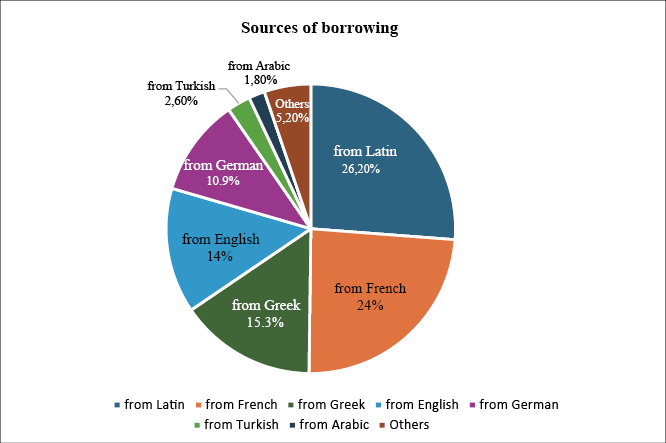
Fig. 1. Percentage indicators of homonymy with a borrowed component from one language
Let us examine some examples. The homonymous row ASTRAGÁL1 – ASTRAGÁL 2 – ASTRAGÁL 3 – ASTRAGÁL 4 (from Greek αστράγαλος – ‘spine’, ‘bone’) consists of four components. Among codified Ukrainian homonyms are ASTRAGÁL1, meaning “annual or perennial herbaceous or bushy plant of the legume family”, and ASTRAGÁL 2, meaning “archit. a detail in classical architecture that has the shape of a roller (sometimes decorated with a thread of stylized beads) with a shelf (connecting the column to the capital or base)” (СУМ, I, 279). The Dictionary of Architecture and Construction by K. Harris lists three meanings of ASTRAGÁL 2: 1) “a bead, usually semicircular, with a fillet on one or both sides. It may be smooth, but this term is more correctly used to describe classical molding consisting of a small convex molding decorated with a string of beads or beads and coils”; 2) “a plain bead molding (also called roundel, baguette, or chaplet)”; 3) “a member, or combination of members, fixed to one of a pair of doors or casement windows to cover the joint between the meeting stiles and to close the clearance gap” [Harris 2005, 62].
Most Ukrainian lexicographical sources record only the first two components of the homonymy. However, they do not explain the meaning of the fragment with the word ‘astragal’ in this context: “Astragal, as the name of the bone of the first joint of the third toe of a horse, the third and fourth toes of a bull, goat, and sheep, has a shape convenient for playing games. <...> The finds indicate the popularity of dice games, which were the most beloved in Greece...” [Shaptsev 2012, 109]. Therefore, it is necessary to distinguish two additional meanings, which prove that we are dealing with two independent lexemes, since the semantic connection has long been lost: ASTRAGÁL 3, meaning “bone located in the lower leg between the tibia and the calcaneus” and ASTRAGÁL 4, meaning “a game of dice”, which were, perhaps, the first to be recorded in the relevant dictionaries: αστράγαλος as ‘spine’, ‘bone’, ‘dice’ [Dvoretskiy 1958, 252].
Thus, to establish four-component homonymy, the semantic criterion, with subcriteria such as set intersection, semantic field, selection of different synonyms, psycholinguistic perception, as well as functional, word-forming, and substitution criteria, proved relevant.
Almost the same set of criteria (except for the word-forming criterion) helps identify homopairs MULINÉ1 (from French moulinet, “twisted silk; yarn of different colors twisted from threads”, derived from French mouliner, which means “to twist silk”), which refers to “twisted cotton or viscose staple colored threads for embroidery” [СУМ, IX, 182], and MULINÉ2 (from French mouliner, meaning ‘quick turn’ or ‘swing’) as “in fencing, a strike with a circular or incomplete circular movement of the blade to bypass the opponent’s weapon” [СУМ, IX, 182].
To confirm the development of homonymous relations between the components NÚKLEUS1 (from Latin nucleus ‘core’, ‘bone’, ‘hard center’) with meanings 1) “s. g. small bee colony with a young infertile queen or fertile spare queen”; 2) “a smaller version of a regular beehive, designed for several frames” and NÚKLEUS2 with the meaning “archeol. stone cores made of flint, obsidian, jasper, and other materials” [СУМ, X, 645], the same criteria apply. However, the word-forming criterion comes into play, since adjectives are formed from both nouns by using different word-forming means, i.e., according to different models.
The set of criteria, including word-forming, is also characteristic of CENTÚRIA1, meaning 1) in Ancient Rome, “part of a legion, a military unit consisting of one hundred men”; 2) “classification of citizens according to property ownership” and CENTÚRIA2 (from Latin centuria < centum ‘one hundred’), meaning “same as zolototysiachnyk (Centaurium, Hill) (a herbaceous medicinal plant of the gentian family, with pink flowers and golden-yellow anthers)” [ВТССУМ, 1581].
Generally, borrowing from one language lessens the importance of the etymological criterion. However, in some cases, the etymological criterion remains relevant and is included among the criteria used to distinguish between homonymy and polysemy. An example is the pair of homonyms SKATE1 – SKATE2. The component SKATE1 (or skateboard, from the English words skate ‘to slide’ and board ‘board’) conveys the lexical meaning “a roller board for skating on asphalt”. SKATE2 means “dealers’ refusal to quote shares, previously published by them in the media” [ВТССУМ, 1328]. There is no consensus among lexicographers regarding the origin of the second component. Some sources derive this word from the English skate ‘to slide’ [Zaikovski & Adamovska 2020, 508], while others – from the English scathe ‘damage’, ‘harm’, related to scatter ‘to scatter, to spill’, ‘to disperse’, ‘to waste’ [ibid., 485]. If we accept the first view, then we are dealing with homogeneous homonyms, i.e., those that share a common etymology; if we accept the second alternative, then, they are heterogeneous, i.e., those with different etymologies.
Thus, the recognition of certain relationships between borrowed components as homonymous is supported by the comprehensiveness of the criteria for distinguishing homonymy from polysemy (see Table 1)2.
Table 1. Excerpt from the table of relevance criteria for distinguishing between homonymy and polysemy
|
Criterion Homo- |
language-donor |
the etymological criterion |
semantic criterion |
the functional criterion |
the word-forming criterion |
the substitution criterion |
||||
|---|---|---|---|---|---|---|---|---|---|---|
|
the criterion for intersecting sets |
the field criterion |
the invariant criterion |
the criterion of synonymy |
psychological criterion |
||||||
|
AKOLÁDA1 AKOLÁDA2 AKOLÁDA3 |
French |
– |
+ |
+ |
+ |
+ |
+ |
+ |
+ |
+ |
|
ASTRAGÁL1 ASTRAGÁL2 ASTRAGÁL3 ASTRAGÁL4 |
Greek |
– |
+ |
+ |
+ |
+ |
+ |
+ |
+ |
+ |
|
BALBÓA1 BALBÓA2 |
Spanish |
– |
+ |
+ |
– |
+ |
– |
+ |
– |
+ |
|
BOLIVÁR1 BOLIVÁR2 |
Spanish |
– |
+ |
+ |
– |
+ |
– |
+ |
+ |
+ |
|
CENTÚRIA1 CENTÚRIA2 |
Latin |
– |
+ |
+ |
– |
+ |
– |
+ |
+ |
+ |
|
MULINÉ1 MULINÉ2 |
French |
– |
+ |
+ |
– |
+ |
+ |
+ |
– |
+ |
|
NÚKLEUS1 NÚKLEUS2 |
Latin |
– |
+ |
+ |
– |
+ |
+ |
+ |
+ |
+ |
|
ONÁGR1 ONÁGR2 |
Greek |
– |
+ |
+ |
– |
+ |
+ |
+ |
– |
+ |
|
SKATE1 SKATE2 |
English |
+ |
+ |
+ |
+ |
+ |
+ |
+ |
+ |
+ |
|
SHTOF1 SHTOF2 |
German |
+ |
+ |
+ |
+ |
+ |
+ |
+ |
+ |
+ |
Conclusion
The presence of homonyms in each language’s vocabulary, especially those with borrowed components, is a natural phenomenon. The fundamental nature of language makes it a system with specific characteristics and categories, including the symmetry of form paired with the asymmetry of content. It also involves principles such as the principle of language’s self-preservation, along with laws and tendencies – particularly tendencies toward economizing on linguistic means and on the speaker’s efforts.
Noun homonymy with borrowed elements, as a type of intra-language lexical-semantic relationship, makes up a relatively small part of modern Ukrainian vocabulary. However, using a set of criteria to identify it introduces a new approach to analyzing this phenomenon.
Within the scope of borrowing from one language, homonymy occurs when polysemy breaks down, resulting in the loss of semantic connection between components and the formation of two separate lexemes. A set of criteria for distinguishing between homonymy and polysemy helps determine whether the process has fully occurred and we are dealing with homonymy, or whether it is still ongoing and we are dealing with polysemy.
The sequence of their use varies. In most cases, the semantic criterion, with its subcriteria, is the most important, followed by the functional, word-forming, and substitutive criteria. However, sometimes, the semantic criterion is supplemented only by the functional and substantive criteria. The word-formation criterion is not relevant as long as the same word-formation means are used to create derivative words. There are isolated cases where the etymological criterion is considered, even when borrowing from another language. This is common in situations where words are borrowed from one language but differ in their motivational basis.
Author contributions
Oksana Kushlyk: conceptualization, methodology, supervision, validation, writing – review and editing.
Oksana Dutka: investigation, data curation, formal analysis, writing – original draft.
List of Abbreviations
СУМ – Slovnyk ukrainskoi movy: u 20 t. Kyiv: Naukova dumka, 2010–2024 [Словник української мови: у 20 т. Київ: Наукова думка]. https://sum20ua.com/?page=1645&searchWord=місто&wordid=51673
ВТССУМ – BUSEL, V. T. (ed.), 2005. Velykyi tlumachnyi slovnyk suchasnoi ukrainskoi movy. Kyiv; Irpin: Perun. [Великий тлумачний словник сучасної української мови. Укл. і гол. ред. В. Т. Бусел. Київ; Ірпінь: Перун].
Bibliography
BAUDOUIN DE COURTENAY, J., STANKIEWICZ, E., 1972. Chapter IX. On the Mixed Character of All Languages. In STANKIEWICZ, E. (ed.). A Baudouin de Courtenay Anthology: The Beginnings of Structural Linguistics. Bloomington: Indiana University Press, 216–226.
BERETTA, A., FIORENTINO, R., POEPPEL, D., 2005. The effects of homonymy and polysemy on lexical access: an MEG study, Cognitive Brain Research, 24(1). 57–65. https://doi.org/10.1016/j.cogbrainres.2004.12.006
BERGENHOLTZ, H., AGERBO, H., 2014. There is no need for the terms polysemy and homonymy in lexicography, Lexikos, 24. 27–35. https://doi.org/10.5788/24-1-1251
BLOOMFIELD, L., 1984. Language. With a new Foreword by C. F. Hockett. Chicago and London: The University of Chicago Press.
BUTTLER, D., 1968. Problematyka badań nad homonimią, Przegląd Humanistyczny, 3. 57–79.
FRAAß, I., 1985. Polysemie und Homonymie in einsprachigen Wörterbüchern der portugiesischen Gegenwartssprache. Berlin: Univ. Diss. A.
HARRIS, C. M., 2005. Dictionary of Architecture and Construction (4th ed.). New York, Chicago, San Francisco; Lisbon; London; Madrid; Mexico City; Milan; New Delhi; San Juan; Seoul; Singapore; Sydney; Toronto: McGraw-Hill.
LIPKA, L., 1986. Homonymie, Polysemie und Ableitung im heutigen Englisch, Zeitschrift für Anglistik und Amerikanistik, 34(2). 128–138.
LYONS, J., 1977. Semantics. Vol. 2. Cambridge: Cambridge University Press.
MARTINET, A., 1960. Elements of general linguistics. Chicago: University of Chicago Press.
OSOLSOBĚ, K., 2015. Homonymie jako jeden z problémů lingvistického využití jazykových korpusů. In RUSINOVÁ, E. (ed.). Letní škola slovanských (bohemistických) studií: přednášky a besedy ze XLVIII. ročníku LŠSS. Brno: Masarykova univerzita, 121–134.
PALMER, F. R., 1981. Semantics. Cambridge, U. K.: Cambridge University Press.
PERSSON, G., 1988. Homonymy, polysemy, heterosemy: The types of lexical ambiguity in English. In HYLDGAARD-JENSEN, K., ZETTERSTEN, A. (eds.). Proceedings of the Third International Symposium on Lexicography. Tübingen: Max Niemeyer, 269–280. https://doi.org/10.1515/9783111347349-010
SAPIR, E., 1921. Chapter 9: How Languages Influence Each Other. In Language. An introduction to the study of speech. New York: Harcourt, Brace & World, 192–206.
SAUSSURE, de F., 1959. Course in General Linguistics / translated from the French by W. Baskin. New York: Philosophical Library.
TOURATIER, Ch., 2010. Chapitre 4. Homonymie et polysémie. In TOURATIER, Ch. La sémantique. Paris, Armand Colin: Cursus, 98–143.
VALERA, S., 2020. Polysemy versus homonymy. In ARONOFF, M. (ed.). Oxford Research Encyclopedia of Linguistics.
https://doi.org/10.1093/acrefore/9780199384655.013.617
WEINREICH, U., 1953. Languages in Contact. Findings and Problems. Paris; New York: Mouton Publishers. The Hague.
АЖНЮК, Б., 2008. Англізми в сучасній українській, російській і чеській мовах, Мовознавство, 2–3. 190–207.
ДВОРЕЦКИЙ, И., 1958. Древнегреческо-русский словарь: в 2 т. Москва: Гос. изд-во иностр. и нац. словарей.
ДУТКА, О., 2025. Параметризація іменникової омонімії з компонентом-запозиченням в українській мові. (Дисертація доктора філософії). Drohobych.
ЖЛУКТЕНКО, Ю., 1966. Мовні контакти. Проблеми інтерлінгвістики. Київ: Вид-во КУ.
ЗАЙКОВСЬКІ, С., АДАМОВСЬКА, Л., 2020. Англо-український, українсько-англійський ілюстрований словник. Тернопіль: Навчальна книга – Богдан.
КАНТЕМІР, С., 2012. Полісемія vs омонімія: труднощі розмежування, Наукові записки. Серія “Філологічна”, 24. 104–107.
КІЙКО, С., 2014. Омонімія в мові і мовленні. Чернівці: Родовід.
КУШЛИК, О., 1997. Комплексне визначення частиномовного статусу “перехідних” одиниць, Мовознавство, 4–5. 45–49.
ЛИСИЧЕНКО, Л., 2008. Багатозначність у лексико-семантичній системі: структурний, семантичний, когнітивний аспекти. Харків: Основа.
ПОЛЮГА, Л., 1985. Омонімія і багатозначність слова, Українська мова і література в школі, 7. 40–45.
СЕМЧИНСЬКИЙ, С., 1974. Семантична інтерференція мов. Київ: Вища школа.
СОЛДАТОВА, Л., 2007. Розмежування явищ повної лексичної омонімії та полісемії (словниковий та функціонально-стилістичний аспекти). Дисертація канд. філол. наук. Київ.
СТИШОВ, О., 2005. Українська лексика кінця ХХ століття: на матеріалі мови засобів масової інформації. Київ: Пугач.
ШАПЦЕВ, М., 2012. Астрагал з графіті з городища Кара-Тобе, Археологія, 3. 108–110.
Bibliography (Transliteration)
AZHNIUK, B., 2008. Anhlizmy v suchasnii ukrainskii, rosiiskii i cheskii movakh, Movoznavstvo, 2–3. 190–207.
DVORETSKIY, I., 1958. Drevnegrechesko-russkiy slovar: u 2 t. Moskva: Gosudarstvennoe izd-vo inostrannyih i natsionalnyih slovarey.
DUTKA, O., 2025. Parametrization of noun homonymy with a borrowed component in the Ukrainian language. PhD Thesis. Drohobych.
KANTEMIR, S., 2012. Polisemiia vs. omonimiia: trudnoshchi rozmezhuvannia, Naukovi zapysky. Seriia “Filolohichna”, 24. 104–107.
KIYKO, S., 2014. Omonimiia v movi i movlenni. Chernivtsi: Rodovid.
KUSHLYK, O., 1997. Kompleksne vyznachennia chastynomovnoho statusu “perekhidnykh” odynyts, Movoznavstvo, 4–5. 45–49.
LYSYCHENKO, L., 2008. Bahatoznachnist u leksyko-semantychnii systemi: strukturnyi, semantychnyi, kohnityvnyi aspekty. Kharkiv: Osnova.
POLIUHA, L., 1985. Omonimiia i bahatoznachnist slova, Ukrainska mova i literatura v shkoli, 7. 40–45.
SEMCHYNSKYI, S., 1974. Semantychna interferentsiia mov. Kyiv: Vyshcha shkola.
SHAPTSEV, M., 2012. Astrahal z hrafiti z horodyshcha Kara-Tobe, Arkheolohiia, 3. 108–110.
SOLDATOVA, L., 2007. Rozmezhuvannia yavyshch povnoi leksychnoi omonimii ta polisemii (slovnykovyi ta funktsionalno-stylistychnyi aspekty). PhD Thesis. Kyiv.
STYSHOV, O., 2005. Ukrainska leksyka kintsia XX stolittia (na materiali movy zasobiv masovoi informatsii). Kyiv: Puhach.
ZAIKOVSKI, S., ADAMOVSKA, L., 2020. Anhlo-ukrainskyi, ukrainsko-anhliiskyi iliustrovanyi slovnyk. Ternopil: Navchalna knyha – Bohdan.
ZHLUKTENKO, Yu. O., 1966. Movni kontakty. Problemy interlinhvistyky. Kyiv: Vyd-vo KU.