Slavistica Vilnensis ISSN 2351-6895 eISSN 2424-6115
2025, vol. 70(2), pp. 101–116 DOI: https://doi.org/10.15388/SlavViln.2025.70(2).7
‘Estonian Schools are the Homesite of the Estonian Language’? Language Ideologies and Discussions around Teaching Non-Native Speakers
Natalia Tšuikina
Tallinn University, Estonia
E-mail: natalia.tshuikina@tlu.ee
ORCID iD: https://orcid.org/0000-0002-0362-1457
https://ror.org/05mey9k78
Kapitolina Fedorova
Tallinn University, Estonia
E-mail: kapitolina.fedorova@tlu.ee
ORCID iD: https://orcid.org/0000-0003-1838-3217
https://ror.org/05mey9k78
Ekaterina Batrakova
Tallinn University, Estonia
E-mail: ekaterina.batrakova@tlu.ee
ORCID iD: https://orcid.org/0009-0004-3635-6006
https://ror.org/05mey9k78
------------------------------------
The study was partly financed by the project TF/924 Multilingual Virtual Space of Estonia, grant holder Prof. Anna Verschik.
------------------------------------
Abstract. The paper explores the language ideologies surrounding the transition to Estonian-language education in Estonia, a country where linguistic issues are at the heart of public discourse due to its complex historical and geopolitical context. In light of the Estonian Government’s push for educational reform, debates surrounding the roles of both the Estonian and Russian languages have become more prominent. This study examines public discourses by analyzing articles published in both Estonian- and Russian-language traditional media, alongside reactions to them on social media platforms such as Facebook. By tracking these interactions, the study reveals a dynamic exchange, where content from one media source often prompts responses from the other. These conflicting discourses are grouped into three key themes: success stories, concerns about the potential threat to the Estonian language and culture, and restrictions on the use of language outside the classroom. Critical discourse analysis is employed as the method for analyzing these media sources, allowing for a nuanced understanding of the various perspectives at play. This research contributes to the broader understanding of language ideologies and the complexities surrounding language use in teaching and learning in post-Soviet societies.
Keywords: language ideology, second language teaching, transition into Estonian-language education, language policy, education in a non-native language.
„Estijos mokyklos yra estų kalbos gimtieji namai“? Kalbos ideologijos ir diskusijos apie mokymą ne gimtąja kalba
Santrauka. Straipsnyje nagrinėjamos kalbos ideologijos, susijusios su perėjimu Estijos mokyklose prie mokymo estų kalba. Reformos švietimo srityje sukėlė karštas diskusijas apie estų ir rusų kalbų vaidmenį visuomenėje. Autorės analizuoja estų ir rusų kalbomis publikuotus žiniasklaidos straipsnius bei jų sukeltas reakcijas „Facebook“ platformoje. Tyrimas atskleidžia diskursų cirkuliavimą tarp skirtingų medijų ir skaitytojų reakcijas. Prieštaringi diskursai suskirstyti pagal tris pagrindines temas: sėkmingas reformos įgyvendinimas, susirūpinimas dėl galimos grėsmės estų kalbai ir kultūrai bei kalbos vartojimo už klasės ribų apribojimai. Taikydamos kritinę diskurso analizę, autorės išryškina konkuruojančias perspektyvas, formuojančias kalbos vartojimą švietime, ir prisideda prie kalbos ideologijų postsovietiniame kontekste supratimo.
Reikšminiai žodžiai: kalbos ideologija, antrosios kalbos mokymas, švietimo reformos, perėjimas prie mokymo estų kalba, kalbos politika.
«Эстонские школы – родной дом для эстонского языка»? Языковые идеологии и дискуссии вокруг обучения на неродном языке
Аннотация. В статье рассматриваются языковые идеологии, связанные с переходом русских школ на эстонский язык обучения – реформой, которая усилила споры о роли эстонского и русского языков. Анализируя материалы СМИ, а также реакции на них в Facebook, исследование отслеживает, как дискурсы циркулируют между платформами и взаимодействуют друг с другом. Эти дебаты группируются вокруг трёх тем: дискурсов об успешной реализации реформы, о сохранности эстонского языка и культуры и об ограничениях в использования языка за пределами учебного процесса. Использование критического дискурс-анализа позволяет выявить конкурирующие позиции, формирующие практики языка в образовании, и способствует более глубокому пониманию языковых идеологий в постсоветском контексте.
Ключевые слова: языковая идеология, обучение второму языку, переход на обучение на эстонском языке, языковая политика, обучение на неродном языке.
Received: 2025-09-29. Accepted: 2025-11-27
Copyright © 2025 Natalia Tšuikina, Kapitolina Fedorova, Ekaterina Batrakova. Published by Vilnius University Press. This is an Open Access article distributed under the terms of the Creative Commons Attribution Licence, which permits unrestricted use, distribution, and reproduction in any medium, provided the original author and source are credited.
Introduction
Language ideologies, as a core element of social and cultural identity, are clearly visible in traditional and social media, where they help shape public opinion and power relations [Fowler 2013]. Media language choices can signal political or ethnic identity [Edelman 1977] and often reflect tensions between monolingualism, associated with national unity, versus multilingualism, which is linked to cultural diversity and inclusion [Blommaert et al. 2009]. These discourses also intersect with economic factors, as language proficiency can enable access to prestigious opportunities while its absence leads to marginalization [De Costa et al. 2016]. Media further mirrors state language policies through standardization or support for minority varieties, shaping public perceptions of identity and power [Romaine 2017].
Fundamental language ideologies shape language planning. Ruiz [1984] outlines three orientations – language as a problem, a right, and a resource – with the first two long dominating international debates. Mason and Hajek [2020] show that language is still mainly framed as a challenge or an economic asset, while its social or rights-based dimensions remain underexplored, and that such media framings influence public views on language education and student motivation.
EU documents on linguistic rights reflect ideological views that shape policy and social norms, notably, the idea of languages as fixed, separate entities – a view that contrasts with the fluid ways people actually use language [Jørgensen 2012]. Because languages are socio-cultural constructs, purity-based norms clash with multilingual practices such as translanguaging, even though institutions in education, governance, and media continue to enforce rigid standards [Valdés 2019]. These frameworks often stigmatize such fluid practices as deficiencies, pushing multilingual speakers to navigate identities in systems that privilege linguistic purity over diversity [Siebenhütter 2023].
In Estonia’s complex historical and geopolitical context, language remains central to public debate. Since independence and EU accession, the state has promoted Estonian to reinforce national identity and distance itself from Soviet-era Russian influence, sometimes framing bilingualism negatively [Lindström et al. 2023, 25]. However, the large Russian-speaking population and Soviet legacies complicate this effort. Russia’s invasion of Ukraine has further intensified disputes over the place of Russian in Estonia, and spurred shifts in language education policy, revealing underlying political, ethnic, and ideological tensions.
This article examines public debates on language in Estonian education, focusing on how conflicting discourses and underlying beliefs shape these discussions. After a brief socio-historical overview, we analyze debates on the transition to Estonian-medium schooling across traditional and social media, showing how traditional outlets often trigger responses on social platforms. The study draws on 14 Estonian- and Russian-language media articles published between July 2022 and January 2025, along with related Facebook debates on media outlets’ pages and in public groups. These perspectives are summarized and interpreted through media discourse analysis [cf. van Dijk 2009].
Socio-Historical Background
A remnant of the Soviet legacy, Russian-medium schools remained in Estonia after independence in 1992 due to a 30% Russian-speaking population. While some parents chose Estonian-medium schools, most preferred Russian-medium ones, which were expected to provide adequate Estonian language instruction. By the late 1990s, these schools began teaching some subjects (e.g., handicrafts, physical education, arts) in Estonian, while mathematics and physics continued in Russian to avoid comprehension issues.
Following Russia’s full-scale invasion of Ukraine, Minister Lukas announced in July 2022 that all Russian-medium schools must transition to Estonian by 2030, which was a policy approved by the Parliament of Estonia on December 12, 2022 [Annus 2022]. Russian is currently being taught as ‘Native Language and Culture’, available only if at least ten parents request it, and scheduled as 1–2 optional after-school classes per week.
From September 1, 2024, all students in grades 1 and 4 began education entirely in Estonian. The shift was smoother for 1st-graders but harder for 4th-graders, who had established learning habits [Begunkova 2025]. Tallinn also announced new ‘transition schools’ with dedicated classes for Estonian-speaking students to promote integration [Ossinovski 2023].
These reforms fuel debates on teaching Estonian as a second language to a minority that once formed the majority in the region [Fedorova, Tšuikina 2024]. Officially, the transition is framed as vital for integration, equal opportunities, and access to higher education, as well as for national cohesion and security. Against the backdrop of the war, the Russian language is increasingly framed as that of the ‘enemy,’ though intellectuals warn against conflating political aggression with cultural identity [Tšuikina, Fedorova forthcoming].
Conflicting Discourses around the Transition and Language Teaching
Traditional and social media provide rich data on the public opinion, ideological conflicts, discourse strategies, and the social impact of language policies. They reveal narrative framing, emotional responses, discursive patterns, and community engagement with policy changes. They also highlight the interplay between institutional messaging and grassroots reactions, as well as the role of digital activism in shaping debates. Before turning to the data analysis, we outline three main, opposing discourses competing for public support.
To begin, it is essential to highlight the official discourse put forth by the representatives of various state institutions. The Estonian government presents the language transition as a necessary step for national unity, better educational opportunities, and long-term social cohesion. The official stance emphasizes the role of language in fostering integration, while arguing that proficiency in Estonian is key to social mobility, economic success, and active participation in public life.
The debate is also fueled by security concerns, as officials warn that linguistic separation can create parallel societies and deepen cultural isolation. Shifting all students to Estonian is framed as a way to lessen division and strengthen national identity across the country. Critics argue this push for cohesion may erode minority language rights, with both ‘pro-Estonian’ and ‘pro-Russian’ groups challenging the policy aims and questioning its long-term social impact on local communities.
A significant pro-Estonian counter-discourse revolves around concerns that the transition may weaken, rather than strengthen, Estonian. Some argue that integrating Russian-speaking students will force teachers and native speakers to adjust their language, leading to hybridization. This view is rooted in historical anxieties over the survival of the Estonian language and culture under the Soviet rule, with supporters warning that an increased Russian-speaking enrollment could threaten the long-term purity and sustainability of Estonian.
The pro-Russian counter-discourse portrays the transition as a threat to linguistic and cultural identity. Russian-speaking communities fear that children will struggle academically in Estonian, leading to weaker outcomes and social marginalization. Critics argue that the reform is moving too quickly, without adequate teacher training, support, or adapted materials. Many parents worry that their children will become ‘educationally handicapped’, able to speak Estonian but lacking mastery of complex subjects. Some also view the policy as cultural erasure, citing cases where students were discouraged from speaking Russian, and thereby suggesting that the measures extend beyond education into social control, too.
Debate on the language transition moves actively across media, shaping public discussion in varied ways. It often starts in traditional outlets, where policies and expert views set the tone. Officials, scholars, and administrators defend the shift by stressing long-term gains, while editorials scrutinize its weaknesses by using formal argumentation, while citing consequences for schools and communities.
In contrast, social media platforms and the comment sections provided by traditional media allow for more emotionally charged and polarized discussions. Posts in groups generate an abundance of comments, where users share personal stories, express frustration, or reinforce collective grievances. Naturally, these discussions can reflect nationalist anxieties about linguistic and cultural preservation in a more direct way than the official publications.
The interaction between the traditional and social media plays a crucial role in shaping public perceptions. Politicians’ statements are quickly picked up and reframed online, often with skepticism or hostility. Social media outrage can then push mainstream outlets to amplify disputes and pressure officials to clarify or adjust their messages.
Let us examine how this discourse unfolds through specific news reports in the Estonian media and dealing with the issues of educational transition.
‘Success Story’?
According to the Minister of Education Kristina Kallas, the transition has started successfully. Despite the initial concerns about a shortage of teachers with C1-level proficiency in Estonian to teach first- and fourth-graders, nearly all transition classes have been staffed with such teachers. The exception lies in some classes for children with special needs, where finding teachers with both C1 proficiency and expertise in special education proved challenging. However, the Minister expressed confidence that, by September 2025, there will be enough Estonian-speaking teachers to accommodate the next cohort of first- and fourth-graders [Postimees 2025].
This news, shared in the Facebook group ‘Russian-Speaking Estonia’,1 sparked significant engagement, generating 300 reactions within 24 hours, and 177 comments. Most comments were negative, criticizing the Minister for self-praise and unsubstantiated claims. Users echoed concerns that many teachers, despite holding C1-level Estonian qualifications, lack professional qualifications and fail to adopt effective teaching methods. Members shared examples of children experiencing stress and their declining academic performance, attributing it to both limited Estonian proficiency and a shortage of teaching materials tailored to the transition.
Another notable discussion emerged around the recent announcement that, starting from September 2025, the so-called transition schools will open first-grade classes for students whose Estonian proficiency is at a native level. In the news [Tribuna 2025], Tallinn’s Deputy Mayor Aleksei Jašin explained that these classes are intended for children from Estonian-speaking families, bilingual families where one parent speaks Estonian, and non-Estonian-speaking families if the child’s Estonian proficiency is close to that of a native speaker. In an article published in Estonian, the journalists also highlighted his statement that Estonian should be spoken not only in the classroom but also during the breaks [Võhma, Saabas 2025].
Reactions in the Facebook group Tallinners2 highlighted concerns about segregation. Commenters argued that, instead of integrating non-Estonian speakers into schools where all subjects are traditionally taught in Estonian, Tallinn authorities are perpetuating segregation by keeping Russian-speaking children in separate schools. This, in turn, creates further segregation within transition schools, where Russian-speaking children with a high command of Estonian will be placed in separate classes: “Shouldn’t it be the other way around, with Russian-speaking kids in Estonian classes?”; “Now the schools are being divided into... Now there will be first-class Russian kids, with all doors open for them, and second-class ones – only by default. It’s like what we saw in American movies” (authors’ translation).
Tido’s [2025] article offers a detailed analysis of the transition process by examining a meeting organized by the Russian-speaking politician Maria Jufereva-Skuratovski, where Deputy Mayor Jašin discussed the issue with parents from Tallinn schools. The meeting highlighted challenges in the shift to Estonian-language instruction, with Jašin noting uneven teacher proficiency and highlighting the need for more second-language pedagogy training, better-prepared immersion schools, and parental reports ranging from student struggles to smooth adaptation.
Comments from Russian-speaking readers were largely negative, arguing that professional competence should depend on subject expertise rather than flawless Estonian, and many cited personal experiences as Soviet-era Russian-medium school graduates who succeeded at Tallinn Technical University and felt that strong foundations in math and physics – and not language – determined their academic and professional success.
Some commenters even stated that they would enroll their children in private Russian-medium schools, due to fearing that the reform would produce students who speak Estonian but lack strong subject knowledge and therefore face low(er)-paid jobs. This ‘pro-Russian’ counter-discourse challenges the official claim that the transition helps Russian-speaking children and, instead, portrays the state language policy as ineffective or even hostile, while the ‘pro-Estonian’ camp likewise invokes concern for children, but refers to the wellbeing and interests of Estonian-speaking children.
‘Hands off our Children!’
One of the most prominent examples of the ‘pro-Estonian’ counter-discourse opposing the official narrative and its ‘success story’ comes from the Facebook group Eesti kool on eesti keele kodu (Estonian School is the Homesite of the Estonian Language). This group, created on May 28, 2020, in its first page emphasizes the belief that Estonian children have the right to study in an Estonian-speaking environment so that to preserve their mother tongue and culture, which would be free from the influence of the Slavic (primarily Russian) language and culture, which, according to the group, has already deeply infiltrated Estonia. The founder of the group argues that children from Slavic families, whose numbers reportedly grow each year, should be educated in Estonian but in separate schools – similar to how indigenous peoples, such as the Sámi in Scandinavia or Australian Aboriginals, are educated in specialized systems or reservations.
The group is private,3 and applicants must answer three yes/no questions about their specific beliefs. The first question concerns agreeing that the Estonian language and culture should dominate in schools at all times. The second question presents incorrect demographic data from the 2021 Estonian Census, which actually reports approximately 380,000 Russian speakers; see [Statistikaamet 2022]. Instead, the group claims that there are 550,000 Russian speakers and fewer than 900,000 Estonian speakers, and asks whether mixing Estonian- and Russian-speaking children would hinder this dominance. The third question cites unnamed ‘experienced pedagogists’ who claim that no more than 10% of pupils should come from one foreign-language background, asking applicants to agree with this view.
To join, the respondents must answer questions and accept the group’s rules. Although the group presents itself as a politically neutral citizens’ movement, it enforces strict conduct: its members must remain polite and communicate only in Estonian, which is justified as protecting the national language from ongoing Russian cultural influence. These requirements discourage those with differing views, thereby creating an ideologically uniform environment.
However, the administrator, Triin Teramäe permits her views to be reposted and frequently shares them in traditional media outlets herself, and also maintains a thematic website with the same title.4 Teramäe’s statements reflect the group’s core ideology and objectives, offering insight into its beliefs and concerns. Her media presence extends the group’s narrative beyond its private setting, shaping public discourse on language and cultural policies in Estonia.
Teramäe’s Facebook page highlights her concerns about Estonia’s education system, claiming that Estonian-medium schools have become mixed-language environments that undermine their original purpose. Drawing on reports from parents and teachers, she argues that, instead of promoting Estonian linguistic and cultural identity (Estoniaphilia), the process fosters Russification, as the growing presence of Russian-speaking students sustains the Russian language along with Russian cultural practices in classrooms.
Insights from the movement ‘Estonian Schools are the Homesite of the Estonian Language’ led its members to petition the Cultural Affairs Committee of the Estonian Parliament, advocating for education aligned with European standards. Over 1,000 members express concerns about integrating Russian- and Ukrainian-speaking children into Estonian-medium classrooms, by arguing that this approach unintentionally erodes the Estonian language instead of strengthening it. They contend that such outcomes violate the Estonian Language Act, which requires that language policies preserve the integrity of Estonian, even while educating minority children [Laurik 2025].
The movement argues that Government policies seek to forge a shared Estonian-Russian civic identity in which Estonian becomes a common rather than a privileged language. Members strongly oppose this, by claiming that it undermines Estonia’s historical and cultural foundations. They insist that Estonian is central to national identity, and that reducing its privileged status violates constitutional protections safeguarding the language as part of the nation’s heritage.
They propose mandatory Estonian proficiency testing for all children from non-Estonian backgrounds before first grade, by insisting that those with insufficient skills should not be placed with native speakers. This, they argue, would protect the Estonian-language learning environment.
They also call for a strict cap limiting non-Estonian-speaking students to 10% per school. This, they argue, would preserve an immersive Estonian-language and cultural environment and prevent what they view as the erosion of linguistic and cultural dominance.
They further advocate giving school councils the authority to declare Estonian the sole official language on school premises, by citing Brussels’ language policies as a precedent. Estonian schools, they argue, should remain strongholds of the national language, while ‘transition schools’ should decide independently which languages may be used during breaks, thereby reinforcing the distinction between the two school types.
A detailed response to these concerns came from Irene Käosaar, principal of an Estonian-medium state high school in Russian-speaking Narva. As an experienced integration specialist, she has implemented her ideas in practice. Although not addressing Triin Teramäe directly, her article indirectly challenges several of Teramäe’s key arguments and offers an alternative perspective.
Käosaar [2025] argues that the presence of Russian-speaking students in Estonian-language classrooms is both natural and beneficial, offering valuable opportunities for Estonia. Although the increasing linguistic diversity poses challenges, it also drives the teachers’ professional growth and strengthens the country’s future. Käosaar highlights that no class is ever truly ‘average’: even in monolingual Estonian schools, students differ in backgrounds, interpretations, and abilities. Effective teachers adapt instruction to diverse needs, provide support or enrichment, and include students with special needs regardless of their home language.
Käosaar explains that non-Estonian-speaking children should learn in an environment alongside ethnic Estonians, as such interactions provide not only language skills but also exposure to the values, mentality, and traditions of the Estonian nation as an indigenous people. While addressing parents’ concerns, she also outlines benefits for Estonian-speaking students: by assisting their non-Estonian-speaking peers, these students develop essential social and cognitive skills that will be valuable in the future. Ultimately, both teachers and students become more adaptable and creative through this process.
Käosaar’s perspective has been published in both Estonian and Russian. On the Estonian-language side, most commenters echoed the arguments put forward by Teramäe. Some even expressed concerns that in previously Russian-speaking kindergartens, where instruction only in Estonian is intended for Russian-speaking children, the presence of teachers who speak Estonian with an accent or imperfect fluency is problematic. Others highlighted cultural differences: Russian-speaking children exhibit poorer behavior compared to their Estonian peers, show disrespect for teachers, frequently use profanity in classes, not to mention during breaks. This, they suggested, creates an environment that is disruptive and incompatible with the traditional Estonian school culture. One commenter, aware of Käosaar’s family background, also added: “Only a person with a distorted and confused national identity, who doesn’t even understand themselves whether they are Estonian or Russian, could think and say such things. They assume that Estonians want to raise their children to be the same kind of semi-cultured ‘successful’ half-breeds for whom education and national culture are not values” (authors’ translation).
Russian speakers were largely unprovoked by Käosaar’s perspective, expressing only doubts about the feasibility of cooperation between Russian- and Estonian-speaking students. In contrast, the above-mentioned joint statement from ‘Estonian Schools are the Homesite of the Estonian Language’, translated into Russian by Postimees and shared in the Facebook group ‘Russian-speaking Estonia’, sparked intense debate.5 Many commenters voiced frustration over the rights of Russian-speaking children, worrying that they were being treated as test subjects, and perceived the transition as a deliberate attempt to marginalize their linguistic and cultural identity.
‘Give it a Break’?
Media discussions have highlighted restrictions in some schools on students speaking Russian, their native language, during breaks. In certain cases, teachers and administrators actively discourage or forbid its use. A widely reported incident involved a teacher requiring students speaking Russian outside the classroom to apologize [Kundla 2024], sparking public debate on the language policies, linguistic rights, discrimination, and the broader effects of enforcing monolingual norms in informal settings.
In response to parental concerns about the case, the Ministry of Education of Estonia clarified that such policies should not be applied, thereby emphasizing students’ right to use their mother tongue in informal interactions and the need for inclusive school environments [Kundla 2024]. An Eesti Päevaleht editorial [2024] criticized schools that ignore this right, arguing that educators and leaders failing to respect it should resign.
To illustrate more effective ways of fostering Estonian-only communication, representatives from several schools shared their experiences. Instead of imposing strict language bans, teachers casually joined students’ break-time conversations and asked questions in Estonian. This gentle intervention, they argue, naturally encouraged students to continue speaking the state language without coercion [Viil 2024].
Comments on the article show that the supporters of the restrictive approach view speaking Russian in front of Estonian speakers as a sign of poor manners and disrespect. Some even call for legal penalties for those who fail to achieve state-language proficiency, including the revocation of citizenship. Others propose declaring Estonia a protected zone for the Estonian language, by arguing that Estonian-speaking children deserve a linguistically homogeneous environment. Advocates of monolingual school communication also cite policies from other EU countries, even though these states have far smaller national minority populations, making such comparisons problematic. Predictably, the ‘pro-Russian’ counter-discourse frames these ideas as ethnolinguistic discrimination and an attack on the Russian language, culture, and identity in Estonia.
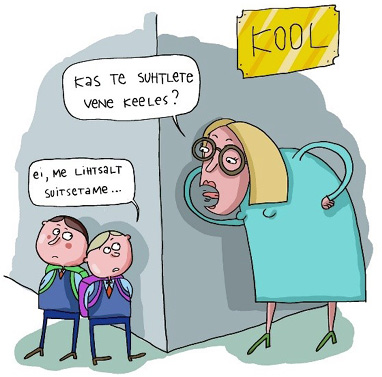
Fig. 1. Mokijevski’s caricature of 3 December 2024.6 Teacher: Are you speaking Russian? Students: No, we are just smoking (authors’ translation)
‘Language obsession’, fear of losing the language, or its purity, evidently dominates both counter-discourses around the transition, and, in general, all metalinguistic discussions in Estonia. Speaking Russian can be presented as a threat and a violation of the norms, or, hyperbolically, even a crime, as in the caricature by Andrei Mokijevski (Fig. 1).
This mutual ‘linguistic mistrust’, both between two speech communities and towards the official state policy and its justification, reveals the deep impact and continuing strong dominance of monolingual ideology in Estonia. Meanwhile, the disruption between the official discourse and the counter-discourses becomes even more acute since it is seen, by both attacking sides, as a conscious attempt to ‘manipulate the truth’ and ‘promote the false values under the disguise’, in other words, as (a) propaganda.
Conclusions
The interaction between traditional and social media further intensifies debates over the transition to Estonian-language education, keeping it a contentious public issue. The reform is not only a linguistic change but also a political and ideological one, generating competing narratives. The government presents it as a tool for national integration, while pro-Estonian groups view it as essential for protecting linguistic purity and cultural identity. Russian-speaking communities, however, see the reform as a threat to their own cultural identity, raising concerns about marginalization and assimilation rather than genuine integration.
Both Estonian- and Russian-speaking groups share concerns about the education quality under the new language policy: Estonians worry that students struggling with Estonian may disrupt classes, while Russian speakers fear that comprehension difficulties will hinder learning. The underlying point for both camps is a sense of threat to linguistic identity. All three perspectives, including the official discourse, reflect a monolingual bias: communities frame language as a problem or a right, while the official discourse treats Estonian as a resource, reinforcing power dynamics rather than fostering true linguistic inclusivity.
The official stance on Estonian-language education views the Estonian language as the central medium for societal participation and national identity, thus reflecting a monolingual bias. Integration of Russian-speaking students is expected through Estonian fluency, while overlooking the value of multilingualism. Even micro-level language choices outside the classroom are framed as Estonian (preferred) versus Russian (undesirable or tolerable), with translanguaging ignored. Some commentators note the growing role of English among the youth as a common communicative tool, thereby highlighting that actual school communication is multilingual, though authorities are unprepared to embrace this reality.
The Estonian purist stance reflects a monolingual mindset, viewing Estonian as the sole legitimate language which is essential for national identity and sovereignty. Bilingualism, especially involving Russian, is seen as a threat to cultural purity. This perspective emphasizes maintaining Estonian’s dominance in public life and education, framing Russian as a challenge to national integrity, while overlooking the potential of bilingualism to enrich society and foster inclusivity.
The Russian-speaking community’s critique also reflects a monolingual bias, but from another perspective. They argue that the Estonian-focused system neglects their needs, causing alienation and hindering learning for students with limited Estonian proficiency. While not seeking Russian dominance, they advocate for a more nuanced multilingual approach, by insisting that children should learn in a language they understand. Many also believe that the reform aims to assimilate Russian speakers, undermining their cultural identity and maintaining social inferiority.
Conflicting discourses, therefore, in their own way keep to maintain the same system of oppositions in which languages are competing with each other, and any deviation from monolingual norms is dangerous for the core symbolic values represented by ‘our’ language. It is true that monolingualism and purism as an ideology was at the roots of the Estonian language planning [Lindström et al. 2023, 22], and they also historically prevailed and now are highly prominent in Russia [Nam, Fedorova 2023], and therefore it is by no way surprising. But is there a way out of this Catch-22? Can de facto multilingualism and an easygoing attitude to it, which is typical for many young Estonian citizens, overcome ideological restraints and deeply rooted mistrust? Will the Estonian school become a home for everyone, for every child, whatever language s/he speaks? Probably, a change in the narrative is necessary, first of all, on the part of those who make political decisions. But, for that, they have to move from a monologue to a dialogue, from treating schools, teachers and children as objects of their policies to recognizing them as actors and the real implementers of any incoming changes.
Author contributions
Natalia Tšuikina: conceptualization, methodology, formal analysis, investigation, writing – original draft, writing – review & editing, visualization.
Kapitolina Fedorova: conceptualization, methodology, formal analysis, investigation, writing – original draft, writing – review & editing.
Ekaterina Batrakova: investigation, writing – original draft.
Data Sources
ANNUS, M., 2022. Minister Tõnis Lukas: üleminek eestikeelsele õppele toimub kindlasti. Haridus- ja Teadusministeerium, 12.12.2022. URL: https://www.hm.ee/uudised/minister-tonis-lukas-uleminek-eestikeelsele-oppele-toimub-kindlasti (8.02.2025)
[BEGUNKOVA]=БЕГУНКОВА, М., 2025. Трудности перехода: Что делать, когда родители говорят четверокласснику: „Я не понимаю, давай сам!’ DELFI.ee, 24.01.2025. URL: https://rus.delfi.ee/statja/120351876/trudnosti-perehoda-chto-delat-kogda-roditeli-govoryat-chetveroklassniku-ya-ne-ponimayu-davay-sam (8.02.2025)
EESTI PÄEVALEHT, 2024. Juhtkiri: Eesti keele pealesurumine vahetunnis tekitab vaid trotsi. Eesti Päevaleht, 22.11.2024. URL: https://epl.delfi.ee/artikkel/120338534/juhtkiri-eesti-keele-pealesurumine-vahetunnis-tekitab-vaid-trotsi (8.02.2025)
KUNDLA, R., 2024. Vahetunnis võõrast keelt kasutanud lapsed on pidanud selle pärast vabandama. ERR, 21.11.2024. URL: https://www.err.ee/1609528330/vahetunnis-voorast-keelt-kasutanud-lapsed-on-pidanud-selle-parast-vabandama (8.02.2025)
KÄOSAAR, I., 2025. Venekeelne õpilane eesti koolis on normaalsus ja suur võimalus Eestile. Postimees, 21.01.2025. URL: https://arvamus.postimees.ee/8176436/irene-kaosaar-venekeelne-opilane-eesti-koolis-on-normaalsus-ja-suur-voimalus-eestile (8.02.2025)
LAURIK, M., 2025. Ühispöördumine: Eesti lapsed ei pea olema lõimumispoliitika katsejänesed. Postimees, 2.01.2025. URL: https://arvamus.postimees.ee/8164961/uhispoordumine-eesti-lapsed-ei-pea-olema-loimumispoliitika-katsejanesed (8.02.2025)
OSSINOVSKI, J., 2023. Eestikeelsest õppest ei piisa. Sirp, 15.12.2023. URL: https://www.sirp.ee/s1-artiklid/c9-sotsiaalia/eestikeelsest-oppest-ei-piisa/ (8.02.2025)
POSTIMEES, 2025. Haridusminister kiitis eestikeelsele õppele ülemineku kulgu. Postimees, 24.01.2025. URL: https://haridus.postimees.ee/8178626/haridusminister-kiitis-eestikeelsele-oppele-ulemineku-kulgu (8.02.2025)
STATISTIKAAMET, 2022. Rahvastiku demograafilised ja etno-kultuurilised näitajad. Eesti loeb 2021. URL: https://rahvaloendus.ee/et/tulemused/rahvastiku-demograafilised-ja-etno-kultuurilised-naitajad (8.02.2025)
[TIDO]=ТИДО, А., 2025. Обзор: «Банально съезжают на двойки» vs «родители довольны, дети спокойны». Первые результаты перехода на эстонский язык. Postimees, 21.01.2025. URL: https://rus.postimees.ee/8177360/obzor-banalno-sezzhayut-na-dvoyki-vs-roditeli-dovolny-deti-spokoyny-pervye-rezultaty-perehoda-na-estonskiy-yazyk?fbclid=IwY2xjawIG3IhleHRuA2FlbQIxMQABHZfjyp1fbRU8-CMYk1eCORrsRmGGq2ojAY5AL1DTY6dDQvup5ipwDAajvw_aem_7tD4-lLNSh6IYdvHBw9Ztg (8.02.2025)
TRIBUNA, 2025. В Таллинне идет набор в классы для детей, владеющих эстонским на уровне родного. Tribuna.ee, 21.01.2025. URL: https://tribuna.ee/tribuna/education/tallinn-idet-nabor-klassy-vladenie-estonskim-jazykom/?fbclid=IwY2xjawIG33tleHRuA2FlbQIxMQABHWtALSLzB372HD_8LP4aJM9myqcB6cxk66nQ9N3IGXc6YQO6gjsCuojqaw_aem_zXIQDMUO1SwsUCHd5wW8bA (8.02.2025)
VIIL, E., 2024. Vahetund või перемена? Riik kinnitab: õpilased tohivad koolis vene keeles rääkida. DELFI, 1.12.2024. URL: https://www.delfi.ee/artikkel/120340051/vahetund-voi-peremena-riik-kinnitab-opilased-tohivad-koolis-vene-keeles-raakida (8.02.2025)
VÕHMA, K.-L., SAABAS, I., 2025. Tallinn püüab meelitada eestikeelseid lapsi endistesse vene koolidesse. Jašin: eesti keel peab kõlama ka vahetundides. DELFI, 21.01.2025. URL: https://www.delfi.ee/artikkel/120351275/video-tallinn-puuab-meelitada-eestikeelseid-lapsi-endistesse-vene-koolidesse-jasin-eesti-keel-peab-kolama-ka-vahetundides (8.02.2025)
References
BLOMMAERT, J., KELLY-HOLMES, H., LANE, P., LEPPÄNEN, S., MORIARTY, M., PIETIKÄINEN, S., PIIRAINEN-MARSH, A., 2009. Media, multilingualism and language policing: An introduction, Language Policy, 8(3). 203–207. https://doi.org/10.1007/s10993-009-9138-7
DE COSTA, P., PARK, J., WEE, L., 2016. Language learning as linguistic entrepreneurship: Implications for language education, The Asia-Pacific Education Researcher, 25. 695–702. https://doi.org/10.1007/s40299-016-0302-5
EDELMAN, M., 1977. Political Language: Words that Succeed and Policies that Fail. New York: Academic Press, inc.
FEDOROVA, K., TŠUIKINA, N., 2024. From ‘Oppressors’ to ‘Oppressed’: Baltic Russian Post-Soviet Speakers in Search of a New Identity through Social Networking, Region Regional Studies of Russia Eastern Europe and Central Asia, 13(1). 29–53. https://doi.org/10.1353/reg.2024.a950430
FOWLER, R., 2013. Language in the News: Discourse and Ideology in the Press. London: Routledge.
JØRGENSEN, J. N., 2012. Ideologies and norms in language and education policies in Europe and their relationship with everyday language behaviours, Language, Culture and Curriculum, 25(1). 57–71. https://doi.org/10.1080/07908318.2011.653058
LINDSTRÖM, L., RISBERG, L., PLADO, H., 2023. Language ideologies and beliefs about language in Estonia and Estonian language planning, Eesti ja soome-ugri keeleteaduse ajakiri. Journal of Estonian and Finno-Ugric Linguistics, 14(1). 7–48. https://doi.org/10.12697/jeful.2023.14.1.01
MASON, S., HAJEK, J., 2020. Language education and language ideologies in Australian print media, Applied Linguistics, 41(2). 215–233. https://doi.org/10.1093/applin/amy052
NAM, H. H., FEDOROVA, K., 2023. Treatment of and attitudes towards ‘other’ languages in modern Russia: evidence from metalinguistic discourse, Journal of Eurasian Studies, 14(2). 92–105. https://doi.org/10.1177/18793665231186636
ROMAINE, S., 2017. The impact of language policy on endangered languages. In KOENIG, M. (Ed.). Democracy and human rights in multicultural societies. Routledge, 217–236. https://doi.org/10.4324/9781315095028-10
RUIZ, R., 1984. Orientations in language planning, NABE journal, 8(2). 15–34. https://doi.org/10.1080/08855072.1984.10668464
SIEBENHÜTTER, S., 2023. The multilingual profile and its impact on identity: Approaching the difference between multilingualism and multilingual identity or linguistic identity, Ampersand, 10. Article 100123. https://doi.org/10.1016/j.amper.2023.100123
TŠUIKINA, N., FEDOROVA, K. Forthcoming. ‘Language as a threat’ vs. ‘language as a resource’: the future of Russian in Estonia. In KISS, N., WINGENDER, M. (Eds.). The future of Slavic languages and Slavic studies: Sociolinguistics, multilingualism, scenarios, prognostic methods. Wiesbaden: Harrassowitz.
VALDÉS, G., 2019. Sandwiching, polylanguaging, translanguaging, and codeswitching. In MACSWAN, J., FALTIS, C. J. (Eds.). Codeswitching in the Classroom. New York: Routledge, 114–147. https://doi.org/10.4324/9781315401102
VAN DIJK, T. A., 2009. Society and Discourse: How Social Contexts Influence Text and Talk. Cambridge: Cambridge University Press.
1 The group is public; it can be followed at: https://www.facebook.com/groups/russkaja.estonia/permalink/1154379849574717/ (15 February 2025).
2 Tallinners is also a public group; see the post and comments here: https://www.facebook.com/groups/558566015247421/permalink/1254702148967134/ (15 February 2025).
3 The authors follow ethical standards when using data from closed online communities, by only summarizing publicly available group information without citing specific posts.
4 https://www.eestikool.eu (15 February 2025).
5 See: https://www.facebook.com/groups/russkaja.estonia/permalink/1141310314215004/
(15 February 2025).6 Available for open access: https://www.facebook.com/andrei.mokijevski (15 February 2025).